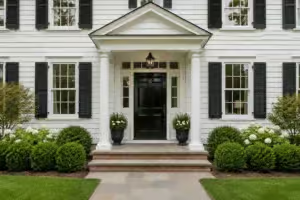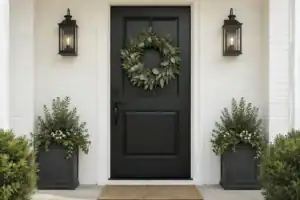
Most front doors sold today are steel, fiberglass or wood. Steel costs the least and is the hardest to break through, fiberglass needs the least care, and wood is the most customizable but asks the most of you. If you lean toward steel, these steel front door designs show how clean it can look.
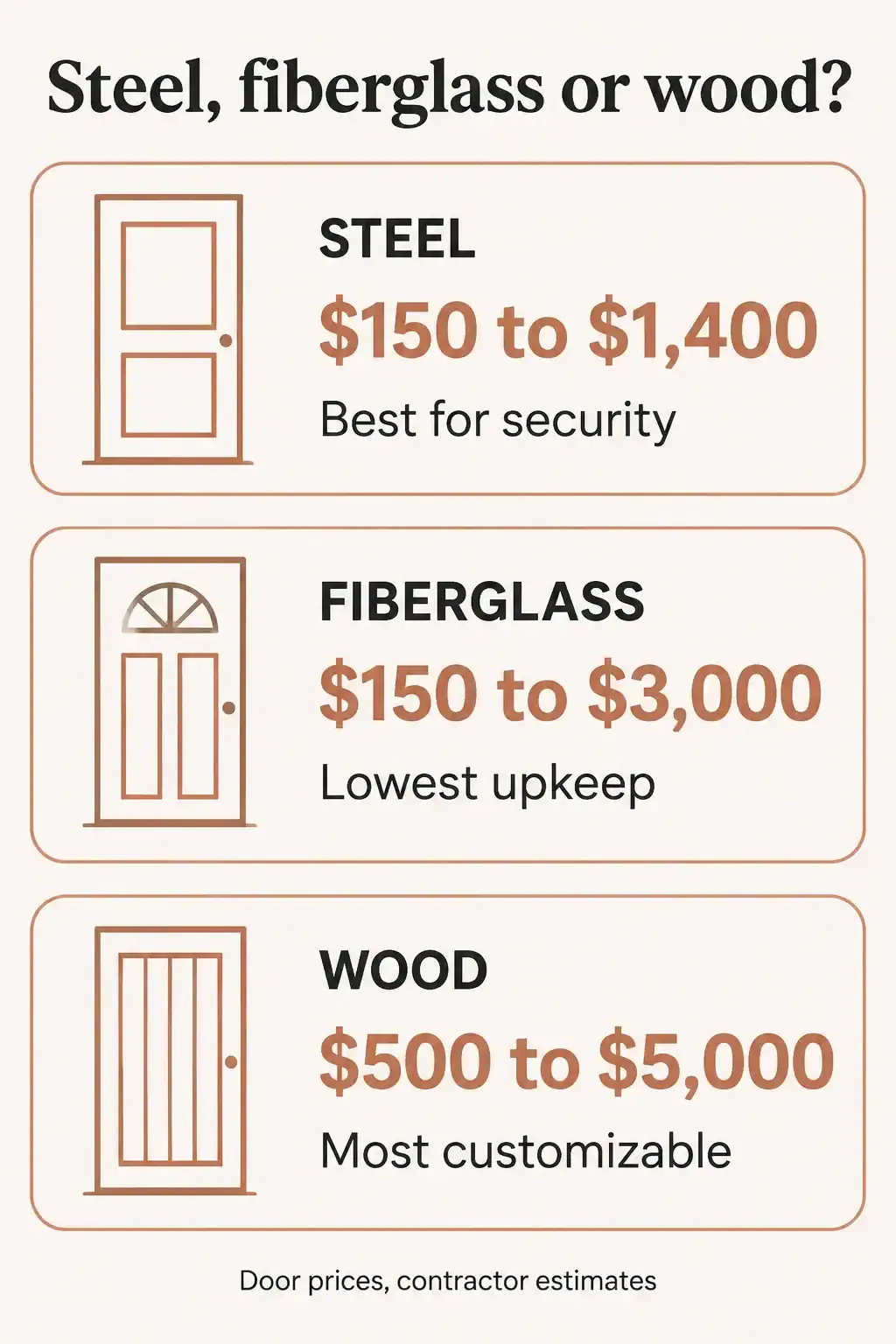
Pick the material first, then the style and the glass. The rest of this page is how to make that call for your own entry.
Which material fits your entry?
Start with where the door sits. A door under a deep porch roof can be wood. A door that takes afternoon sun and rain head-on does better in fiberglass or steel.
Then look at the price range. This Old House, using Angi’s contractor estimates, puts steel doors at $150 to $1,400, fiberglass at $150 to $3,000 and wood at $500 to $5,000.
Bob Vila gives a tighter band for steel: usually $200 to $1,000, with $1,300 not unusual, and says high-end fiberglass can pass $3,000. Treat all of these as ranges to compare quotes against, not as prices.
Steel: the budget pick that is hard to break
A steel door is a metal skin over an insulating core. Hit it hard and it may dent, but Bob Vila says it will rarely break or warp, which is why it tops the list for security.
The weak spot is the finish. If the paint is scratched or worn through, a steel door rusts unless you repaint it right away.
The same source suggests a yearly coat of linseed oil or car wax. Adding windows lessens steel’s security advantage, so if you want glass, look at fiberglass or wood first.

Fiberglass: the low-upkeep wood look
Fiberglass doesn’t dent, warp or decay, and a stained finish can show a convincing wood grain. Bob Vila notes that homeowners often choose it when they want windows in the door.
It isn’t maintenance-free. Sun fades the finish, so plan on repainting or re-staining now and then.
Wood: the most customizable, with conditions
Wood gives you the widest choice of species, stains, carving and glass, and it can be sanded, filled and refinished. The price of that is upkeep: This Old House says to refinish with stain or paint every few years, more often in harsh weather.
Three site conditions decide whether wood will last at your entry, all from the same This Old House guide:
- A roof overhang that reaches one-third to one-half of the distance from the door to the eave, and is wider than the door on both sides.
- No more than about four hours of direct sun a day; more than that means more frequent refinishing.
- A sill at least 4 to 6 inches above the porch landing, so snowmelt and standing water can’t soak into the wood.
On species, the guide calls mahogany naturally rot-resistant and fir a cheaper but less dense choice that needs more upkeep. Engineered cores have mostly replaced the old problem of solid doors warping.

Our take · Octopus Doors
For most family homes we would start with fiberglass, and move to steel if the budget is tight or security comes first. Choose wood only if the porch protects it and you will actually refinish it. A wood door that is left alone looks worse than a plain fiberglass one.
What the ENERGY STAR numbers mean for a front door
ENERGY STAR judges a door by tested performance rather than by what it is made of. The program says certified doors have NFRC ratings that meet EPA guidelines, and that door criteria depend on how much glass the door has (ENERGY STAR).
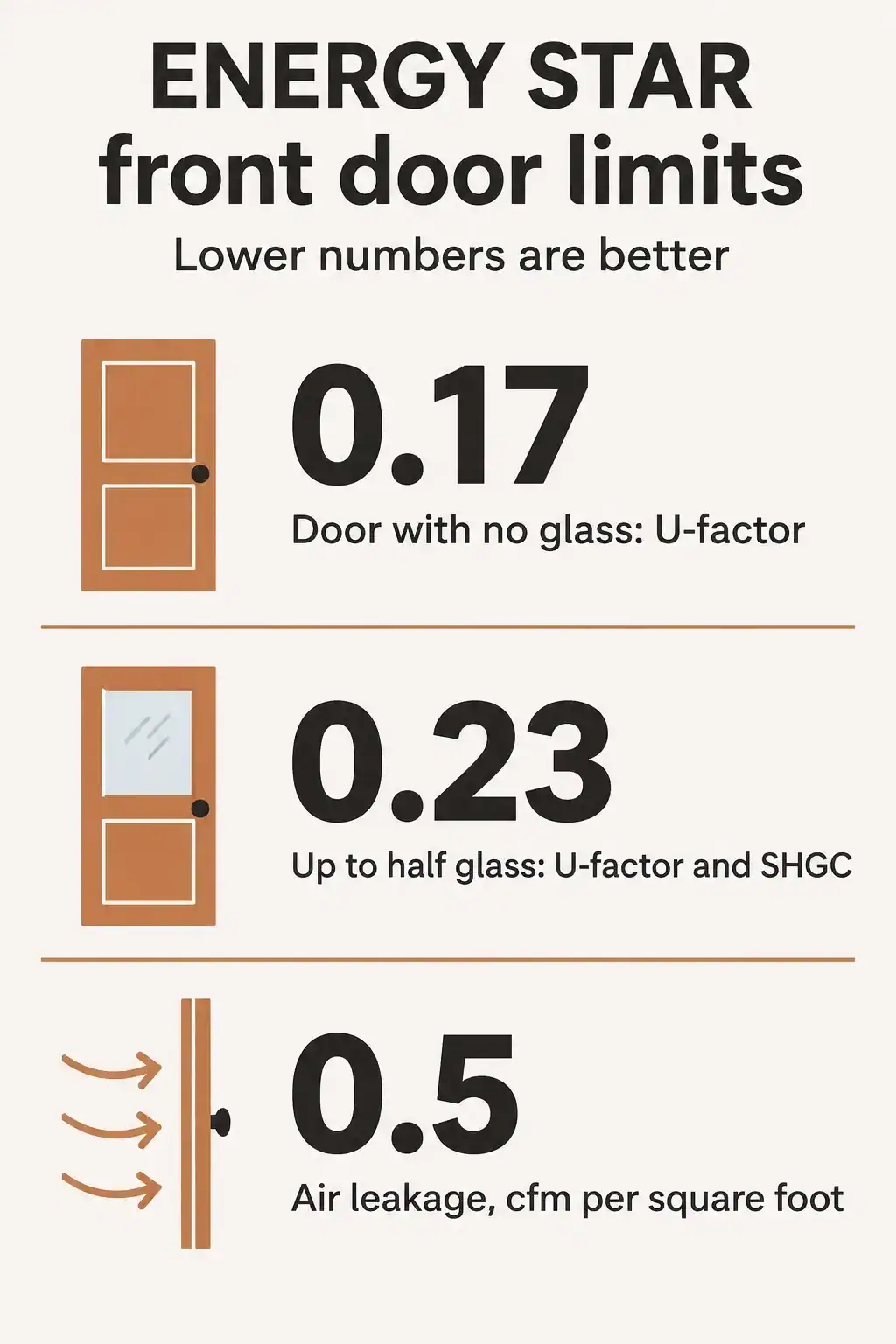
The Version 7 specification, effective October 23, 2023, sets the limits. A door with no glass needs a U-factor of 0.17 or lower. A door with up to half glass needs a U-factor and a solar heat gain coefficient (SHGC) of 0.23 or lower.
Swinging doors also need an air leakage rating of 0.5 cfm per square foot or lower (ENERGY STAR V7 specification). For U-factor, lower is better.
Material still matters. Bob Vila, citing the US Department of Energy, puts windowless steel and fiberglass doors at R-5 to R-6 or higher, against about R-2 to R-3 for windowless wood. Glass changes the picture, which is why the limits above differ by glazing level.
Glass, sidelites and security hardware
Decorative glass, sidelites and a transom bring light into a dark entry. Glass near the lock is a weak point, so ask the supplier what type of safety glass the door uses and keep the lock side strong.
This Old House lists the basics for any door. Use a solid or reinforced frame, a deadbolt with a throw bolt at least 1 inch long, and a long reinforced strike plate with screws 3 inches or longer.
Before you order
- Measure the rough opening and note which way the door swings.
- Check how many hours of sun and how much rain the door gets.
- Decide how much glass you want, then compare the NFRC label with the numbers above.
- Ask whether the quote includes the frame, the threshold and the finish.
- Confirm the deadbolt and strike plate meet the specs in the section above.
For a closer look at each material, see our pages on steel doors and fiberglass doors, and our guide to solid core timber doors.
Related posts
 Pivot Front Doors: How They Work and When They Are Worth It
 Security Screen Doors
 10 Cream Front Doors That Pair Perfectly With Natural Wood Tones
 Fiberglass vs. Steel Front Doors: Which One Is the Better Investment?
 Why Deep Green and Navy Front Doors Are Easier to Live With Than Black
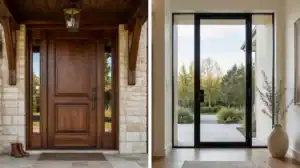 Wood or Glass Front Doors and What Each Gives Up
 12 Modern Fall Wreaths for Front Doors in Clean Monochrome
 11 Planter Ideas for Front Doors With Sidelights