As an Amazon Associate we earn from qualifying purchases.
What “solid core” means
A solid core door has a dense engineered core, usually particleboard, under a wood veneer. For more on this, see our solid wood door ideas with warm stains. It is not solid timber. It weighs more, blocks more sound and costs more than a hollow core door, and it costs less than solid wood.
Solid core wood doors are the usual upgrade for bedrooms, home offices and any room where you want privacy. This page explains what you are paying for, how to spot the real thing, and what limits the sound reduction.
What is inside a solid core door?
Most solid core doors have a core of wood particles glued together with heat, resin and pressure. A fir frame runs round the edge to protect it and make the door look like solid wood, and a thin veneer covers both faces (Hunker).
That is different from a solid wood door, which is assembled from lumber in stile-and-rail construction and costs more. It also differs from a hollow core door, which has a wood frame around a honeycomb or grid core of cardboard or foam.
Standard thickness is 1 3/8 inches for interior doors and 1 3/4 inches for entry doors. Veneer can be birch, oak or another species, and the face can be routed to imitate a raised panel.
How can you tell it is really solid core?
From across the room, a solid core and a hollow core door look the same. Four checks separate them.
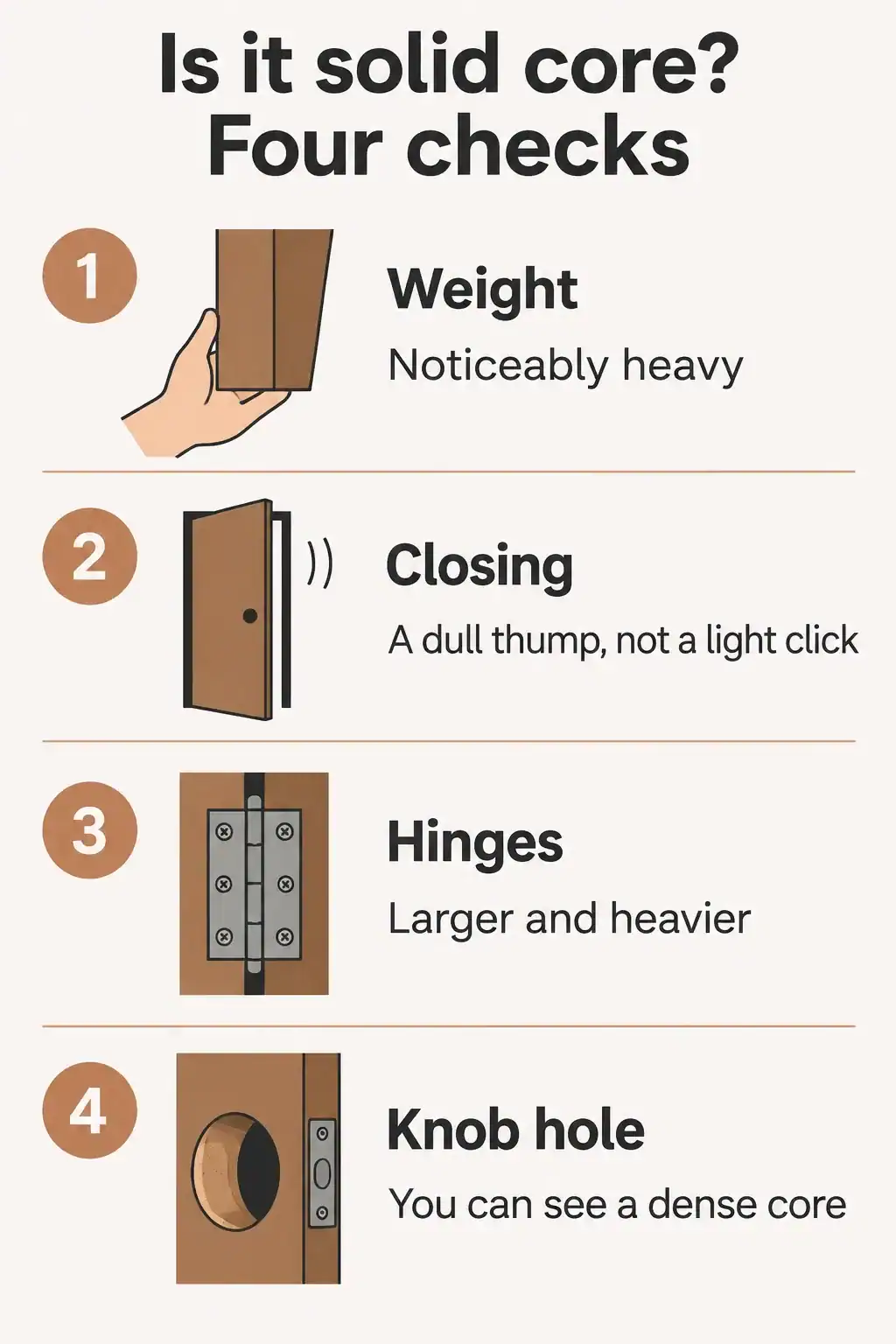
Hollow core doors shut with a light click, and solid core doors close with a heavy thump. Solid core doors also take a bit more force to swing, and their hinges are typically larger and heavier. Take the knob off and the dense core is visible in the hole.
How much quieter is it?
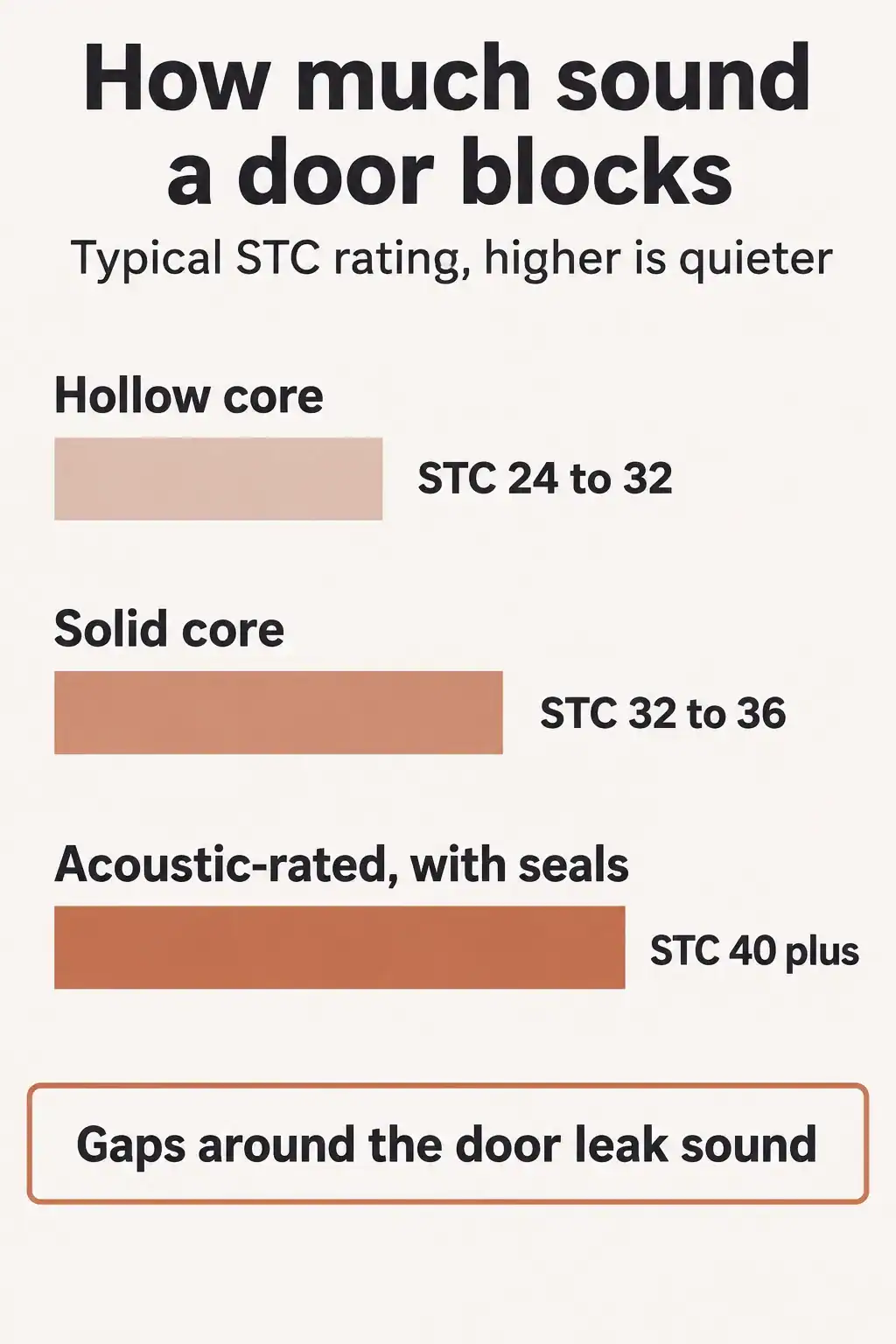
A standard hollow core interior door tests at STC 24 to 32. A standard solid core door tests at STC 32 to 36. An acoustic-rated door with seals reaches STC 40 or higher.
STC, sound transmission class, is a rating where a higher number means less noise gets through.
The same consultancy describes a field test in which the door base measured 9 decibels louder than the wall it sat in, even with door sweeps fitted. The door was the weakest point in the partition.
That is why a solid core door that does not fit well loses much of its advantage. Gaps at the jamb, head and floor let sound through, so ask for seals and a threshold or drop seal if quiet matters (Nick’s Building).
Our take · Octopus Doors
For a bedroom or a home office, a solid core door with a proper seal is where we would spend the money first. A solid core door hung with a gap under it will not do much better than a cheap one.
Security, fire and warping
Hollow core doors can be smashed or punctured with a kick, while solid core doors resist a lot more force. Solid core doors are also less likely to warp, and they keep heat in better.
Fire is where people assume too much. A standard solid core door is not fireproof. It protects better than a hollow core door, and fire ratings can be raised by adding materials to the core at a higher price.
If you need a fire rating, buy a door that carries a rating label and check the frame and local code requirements with your building department.

Weight, hinges and fitting
The extra weight is the main fitting issue. Solid core doors are heavier to handle and swing, and they come with larger, heavier hinges than hollow core doors.
Because the door is heavier, the hinges and the frame it hangs on matter more. Ask the installer which hinges the manufacturer specifies, and have the door hung in a frame that is plumb and square.
Shop this idea
Hinges built for a heavy door
- BALL BEARING HINGESBall Bearing Door Hinges, Matte Black, 30 PackShop on Amazon
Where a solid core door earns its price
- Bedrooms, nurseries and home offices where privacy and noise matter.
- Rooms next to a media room, laundry or garage.
- Interior doors that need to resist force better than hollow core, such as a workshop or utility room.
- Not needed for closets and low-traffic rooms, where hollow core is enough.
If the budget is tight, compare it against hollow core doors or step up to the wood options in our guide to front door material options.
Related posts
 Hollow Core Bedroom Doors Built Up to Feel More Like Solid Wood
 Hollow Core Doors
 How Much Can You Cut Off a Solid Wood Door? A Complete Guide
 15 Solid Wood Door Ideas Using Warm Stained Finishes
 Unlock the Secrets to the Perfect Cut: Find the Ultimate Blade for Hollow Core Doors
 Unlock the Secrets to Perfectly Cutting Hollow Core Doors
 Hollow Core Door Makeover DIY With Real Depth and Character
 11 Hollow Core Door Makeovers With Molding and Paint