
A roll-up garage door, also called a coiling or rolling door, is made of narrow slats that wrap around a drum above the opening. That makes it the door to look at when the garage has little headroom, and the one to question when the garage is attached to living space.
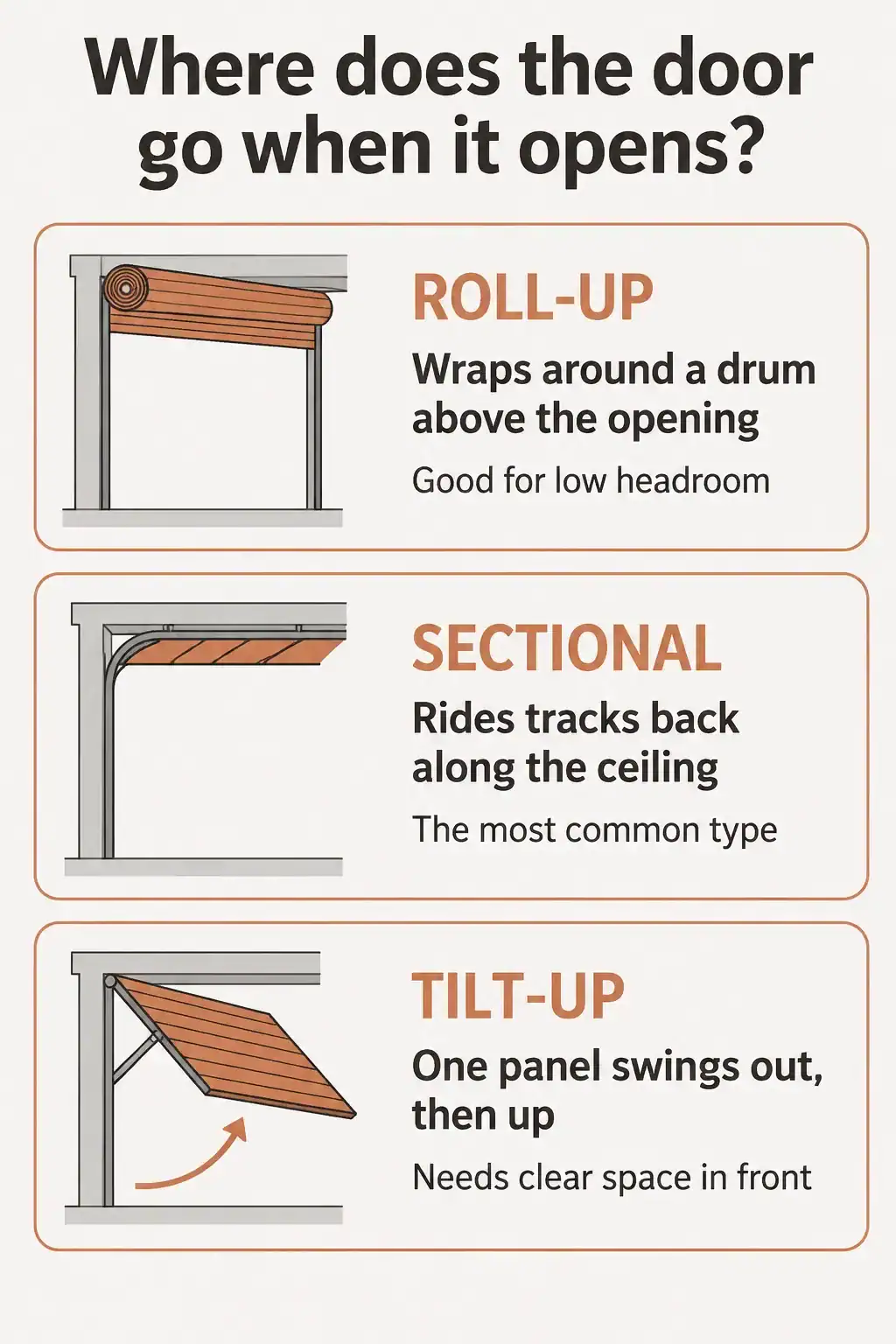
This guide covers how roll-up doors work, how they compare with sectional and tilt-up doors, and the insulation and safety checks to make before you buy.
How a roll-up door works
A roll-up door is like a sectional door with each panel only two to three inches wide. When you open it, the slats wrap around a drum at the top of the door frame instead of lying flat along the ceiling. That is why it suits small garages with limited headroom (Family Handyman).
Most are galvanized steel, which resists wind and impacts. The look is industrial, so it often suits a workshop, a storage unit or a shop front better than a house front. Corrugations in the steel let the curtain flex, and wider doors need sturdier corrugations.

Roll-up, sectional or tilt-up?
| Door | How it opens | Typical cost |
|---|---|---|
| Roll-up | Slats wrap around a drum above the opening | $800 to $2,500, mainly depending on size |
| Sectional | Hinged panels ride tracks back along the ceiling | $800 to $4,000 with installation, not including the opener |
| Tilt-up | One panel swings out, then up | $400 to $700 installed |
Sectional doors are the most common type, with a spring-balanced panel set and an automatic opener. A tilt-up is the budget option, and it can be hard to open by hand.
Insulation and comfort
Foam-insulated steel doors can reach R-values as high as 17, and R-values for garage doors run from zero to 20. Insulated steel and aluminum doors can reach about R-17, while wood door insulation often tops out near R-10 (This Old House).
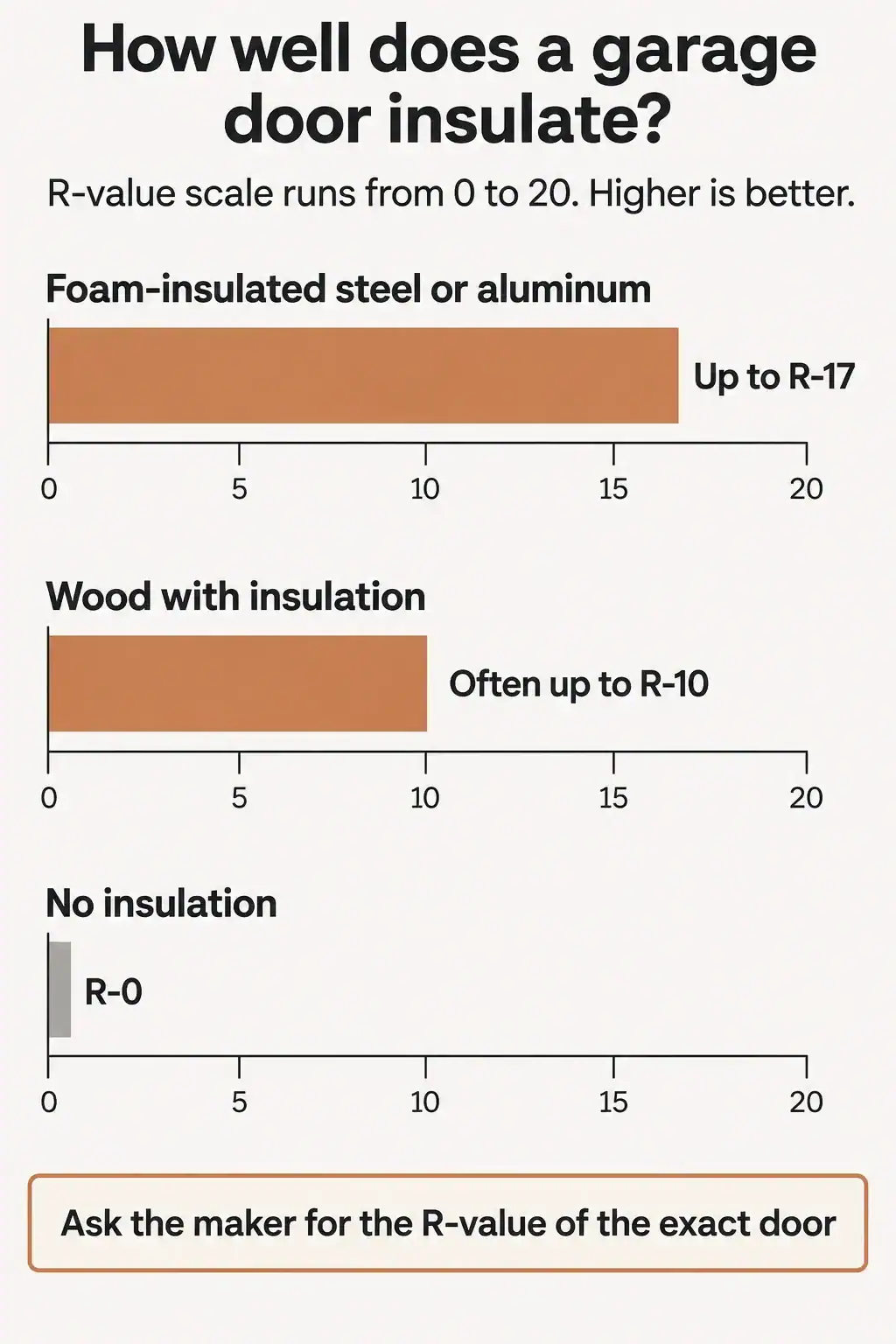
Those figures describe foam-insulated sectional panels. The slats of a roll-up are narrow, and we found no published R-value for a residential roll-up, so ask the maker for the rating of the exact door. If the garage is attached to a bedroom or kitchen, that number matters.
Our take · Octopus Doors
A roll-up door makes sense for a detached garage, a workshop or a low-ceilinged garage where nothing else fits. For an attached garage in a hot or cold climate, we would price a foam-insulated sectional door first and use the roll-up if headroom rules the sectional out.
Manual or motor?
A roll-up can run on a pulley and chain, or on a motor with a remote, so you do not have to leave the car to open it.

US law requires every residential opener sold in the US to reverse a moving door within 2 seconds. It must also accept an external entrapment sensor such as an electric eye, and include a 30-second backup that reopens a door that cannot close (Federal Register, 16 CFR Part 1211). Test yours regularly, and replace an old opener that lacks these features.
Before you buy
- Measure the headroom above the opening and the side room for the tracks.
- Ask for the R-value of the exact roll-up model, and the warranty on the finish.
- Look for 24-gauge dent-resistant steel on a metal door.
- Confirm that the opener has a reversing system and an electric eye.
- Ask how the door is repaired if a slat is damaged.
For related options, see tilt-up garage doors, steel doors and the overview of door types.
Related posts
 Tilt-Up Garage Doors
 Unlock the Secrets: Magnetic Garage Doors Revealed
 Unlocking the Mystery: The Truth About Universal Garage Doors
 Replacing a Garage Door With French Doors: Is It Feasible?
 Product Comparison: Heavy Duty Garage Door Hinges with Galvanized Finish
 Garage Door Hinges #1-14 Gauge Steel Heavy Duty Review
 Doors Shorter Than 80 Inches: A Complete Guide
 Door Facts: A Historic and Cultural Journey Through the World of Doors