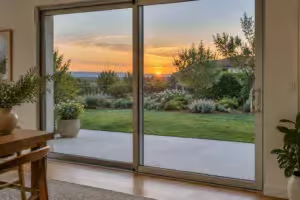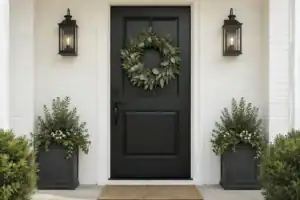
A Dutch door, also called a stable or split door, is cut in half across the middle so the top opens on its own. Keep the bottom shut and you get air, light and a conversation with the garden while kids and pets stay inside.
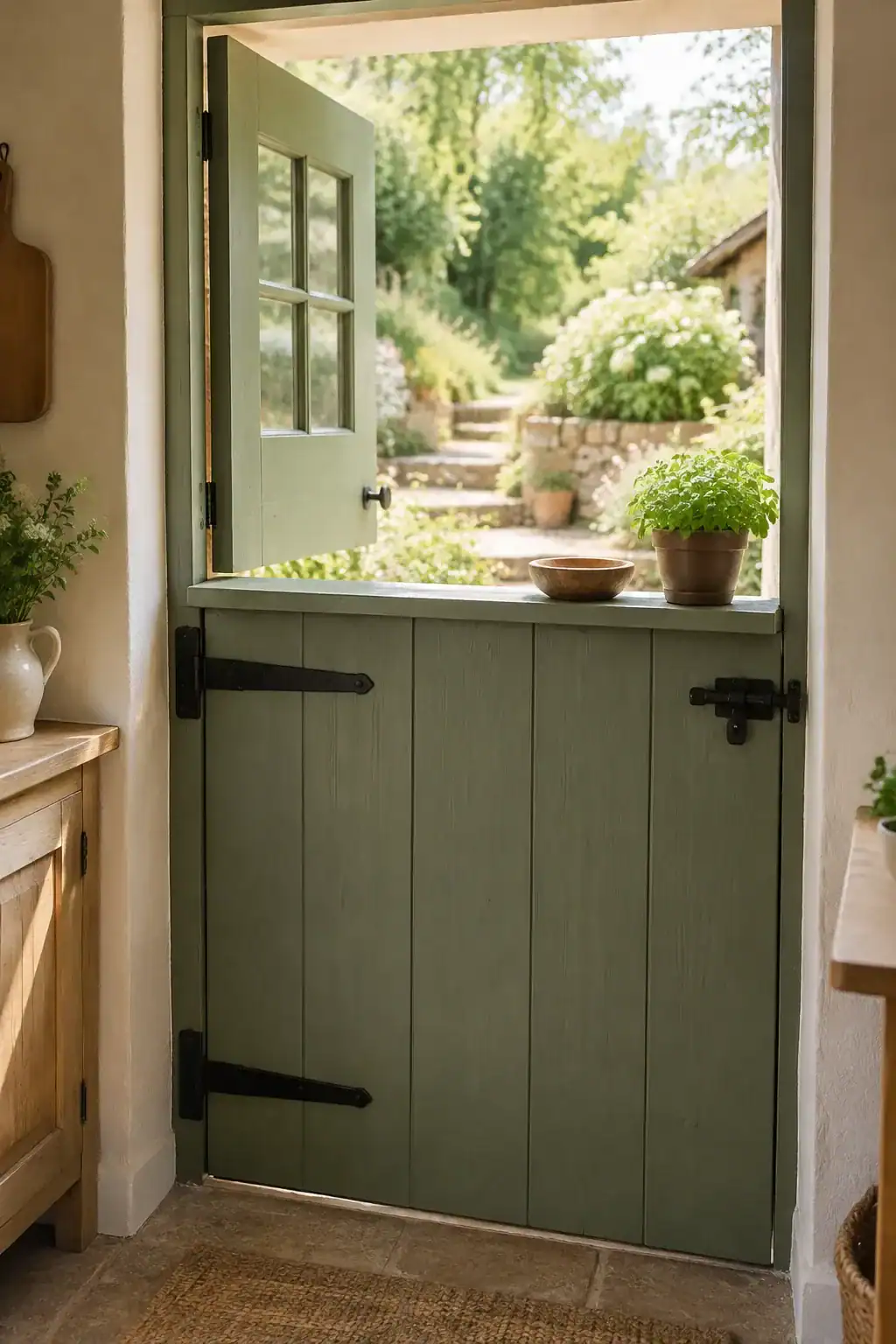
This guide covers where Dutch doors work, what they add to the bill, how to keep them secure, and how to convert a door you already own.
What a Dutch door is, and where it came from
Dutch doors started on Dutch farms, and they reached the early American colonies with Dutch settlers. Bob Vila says they appeared in Holland in the 17th century for a plain reason: with the bottom closed, rodents and farm animals stayed out, and the top opened for light and air. The lower door often had a small shelf along its top edge, a handy spot for baked goods to cool (Bob Vila).
They fell from favor when the screen door was invented. Interior versions survived in kitchens and dining rooms, and the modern farmhouse look has brought them back to entries, kitchen doors and garden sheds.
Where they work best
Dutch doors suit a kitchen door, a back door to the garden, a nursery, a laundry or a shed. An interior one can double as a baby gate, and a closed bottom half keeps a toddler or a dog in while you enjoy the view.
Single Dutch doors replace a single door, indoors or out. Double Dutch doors work as a wide entry, and they are more often used as front exterior doors because of their size.
What a Dutch door adds to the bill
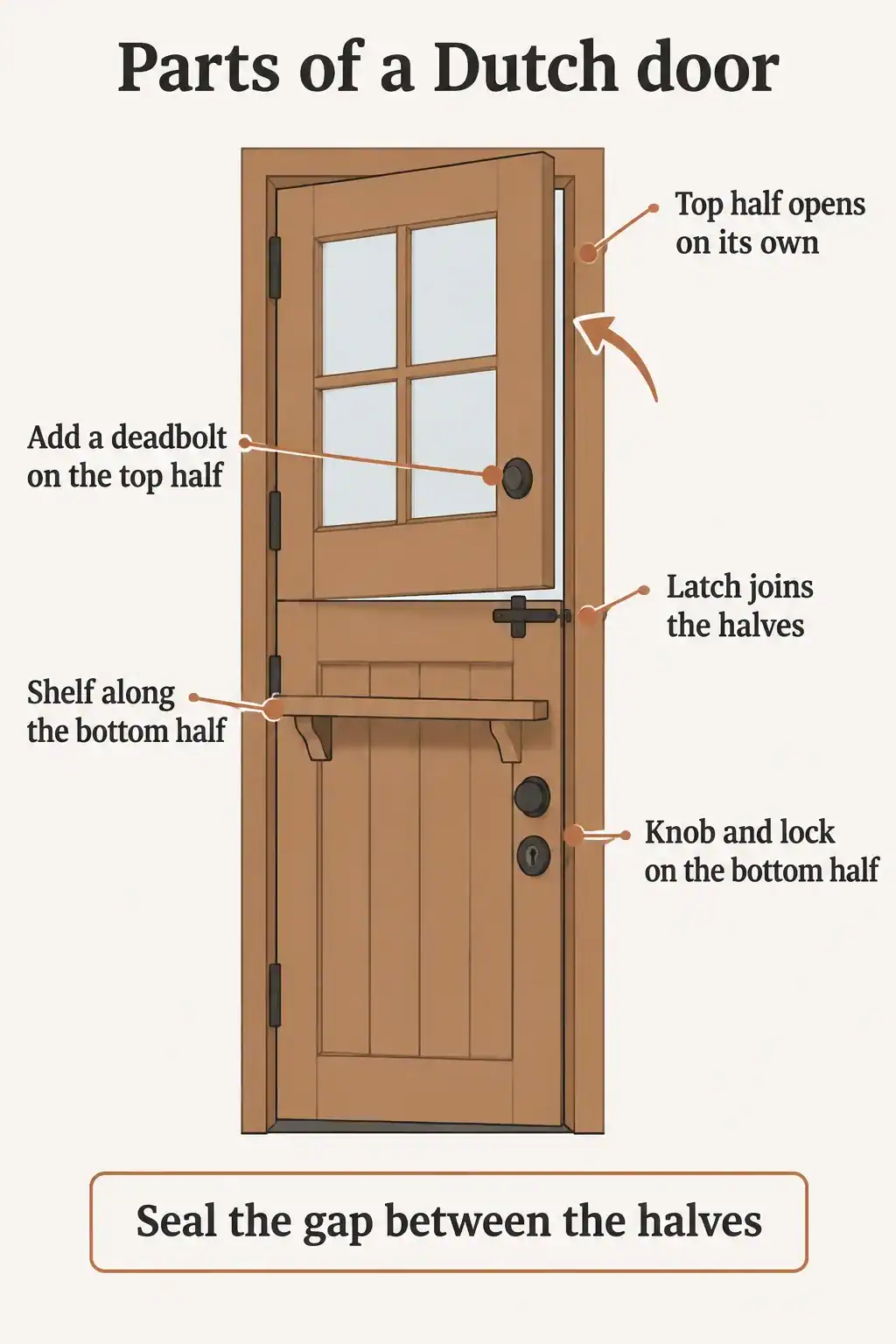
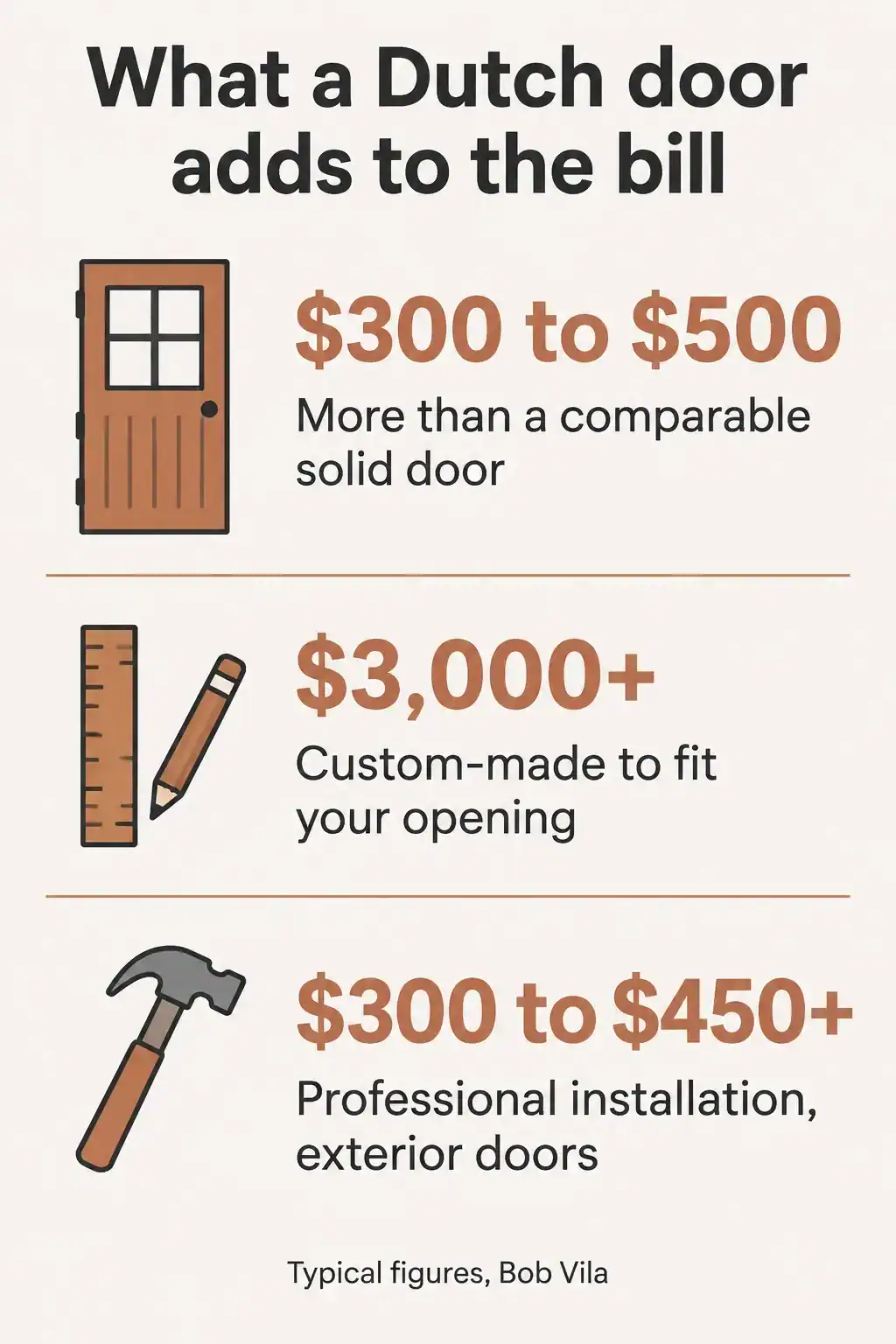
A Dutch door costs more than a standard door and needs more hardware: extra hinges, knobs, locks and a latch to join the halves. Expect to pay about $300 to $500 more than a comparable solid door from the same maker. Custom-made Dutch doors from major manufacturers can run upwards of $3,000.
For the best weathertight result, exterior Dutch doors should be professionally installed. That can add $300 to $450 or more, because both halves must align perfectly to seal out the weather (Bob Vila).
Security, bugs and pinched fingers
A split door has more weak points. On an exterior Dutch door, warped frames can open gaps around the edge as the seasons change.
The knob and lock are usually on the lower half, so a deadbolt on the top half adds security. Use every latch and lock, every time.
All that hardware needs more upkeep. In an area with many insects, an open top half invites them in, and a retractable screen can help. Small children get twice as many chances to pinch fingers, so teach them to open and close the halves slowly.
Our take · Octopus Doors
A Dutch door earns its place on a kitchen or back door you open all day. We would not put one on a street-facing front entry unless you commit to the locks and the seal. A good deadbolt on the top half is the one upgrade we would not skip.
Can you convert a door you already have?
Yes, with the right door. This Old House says to check that the door is not damaged or warped, and that solid wood is easiest to cut, while hollow-core doors are too flimsy once they are cut in half. Raised panels are tricky, because you want to cut between panels, not through them (This Old House).
Metal and fiberglass doors need special tools and skills. The conversion needs a track saw, hinges and a latch, and a barrel latch is one of the options used.
Before you order
- Decide whether it is interior or exterior, and single or double.
- Ask for a weathertight seal between the halves if it faces outdoors.
- Plan a deadbolt on the top half, and a latch that joins the halves.
- Budget for a retractable screen where insects are a problem.
- Get a professional to fit an exterior door.
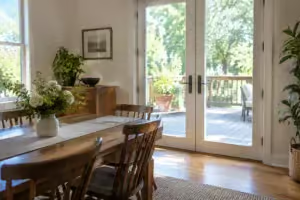
If you want the same glass-and-light feel without the split, compare French doors and hinged doors, or see the overview of door types.
Related posts
 10 Dutch Door Ideas Made For Mudrooms And Pet Friendly Homes
 Types of Doors in Perth
 Front Doors
 Sliding Doors
 Bi-fold Doors Perth
 Doors Shorter Than 80 Inches: A Complete Guide
 Door Facts: A Historic and Cultural Journey Through the World of Doors
 ENERGY STAR Doors Explained: What the Labels Mean and What to Ignore