
Is steel right for your door?
Yes, if budget, durability or security comes first and you are not near the coast. Buy a 24-gauge skin or thicker, a foam core, and plan to repaint every 3 to 5 years.
Steel doors are a metal skin over a core, and the details of that sandwich decide whether you get a door that lasts or one that dents and rusts. This guide covers what to check before you buy.
What a steel door is made of
A residential steel door is not solid steel. It is sheet steel skins around a frame of wood or an engineered composite, with steel frames on higher-end or safety doors (Fine Homebuilding). The frame is the part that resists warping, and engineered or composite frames are more stable than solid wood.
Between the skins sits a foam core. It is either sheet polystyrene, which often leaves air pockets, or sprayed polyurethane foam, which expands to fill them. Choose sprayed polyurethane if energy efficiency matters.
Some cores also help a door reach a high fire rating, which matters in high fire zones or multifamily housing. If that applies to you, ask for the fire-rating label, not a verbal promise.
Skin thickness: why gauge matters
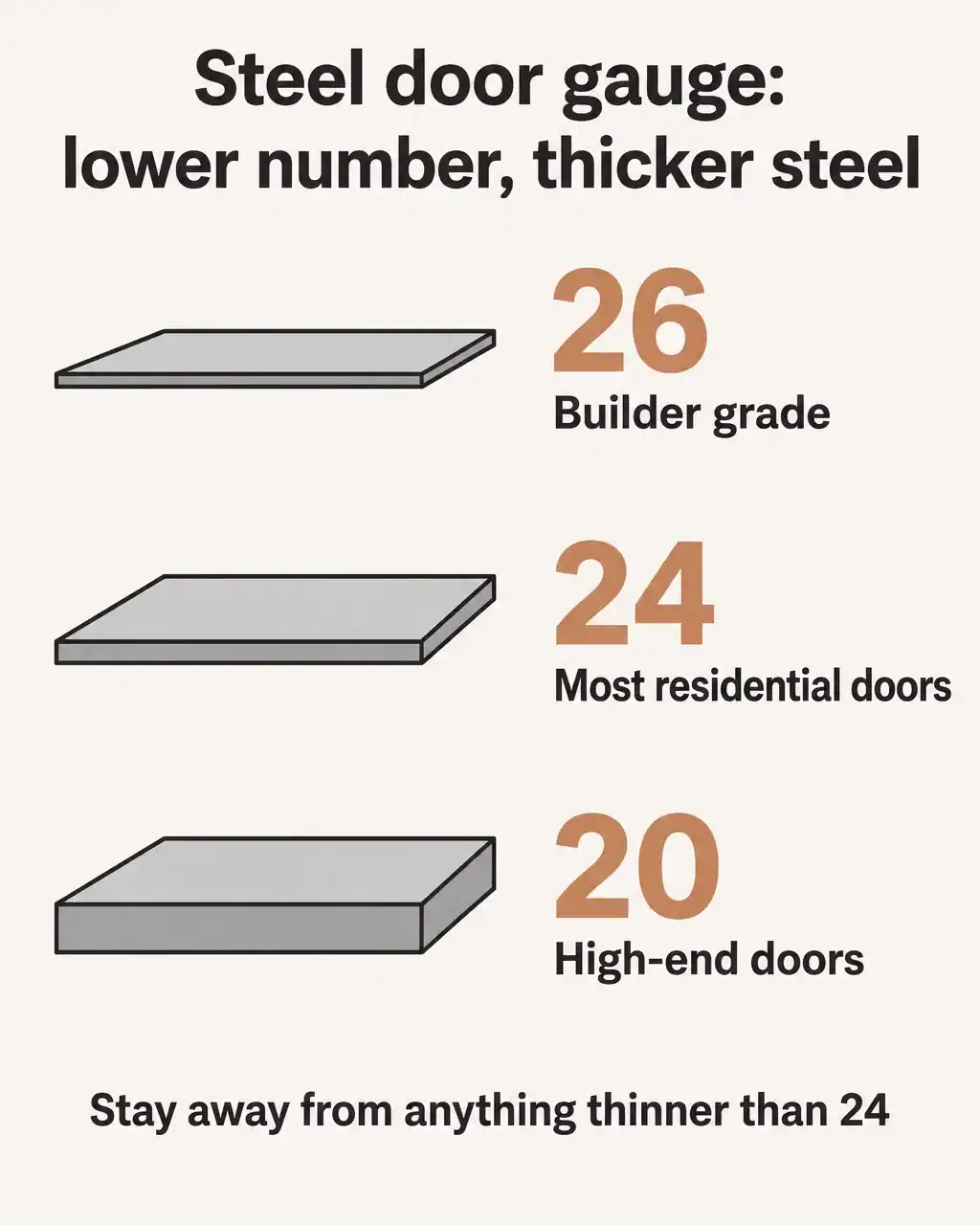
Gauge is the one number on a steel door that tells you about the metal. Most residential models use 24-gauge steel, builder grades are often 26 gauge, and high-end doors can be as thick as 20 gauge. Stay away from anything thinner than 24.
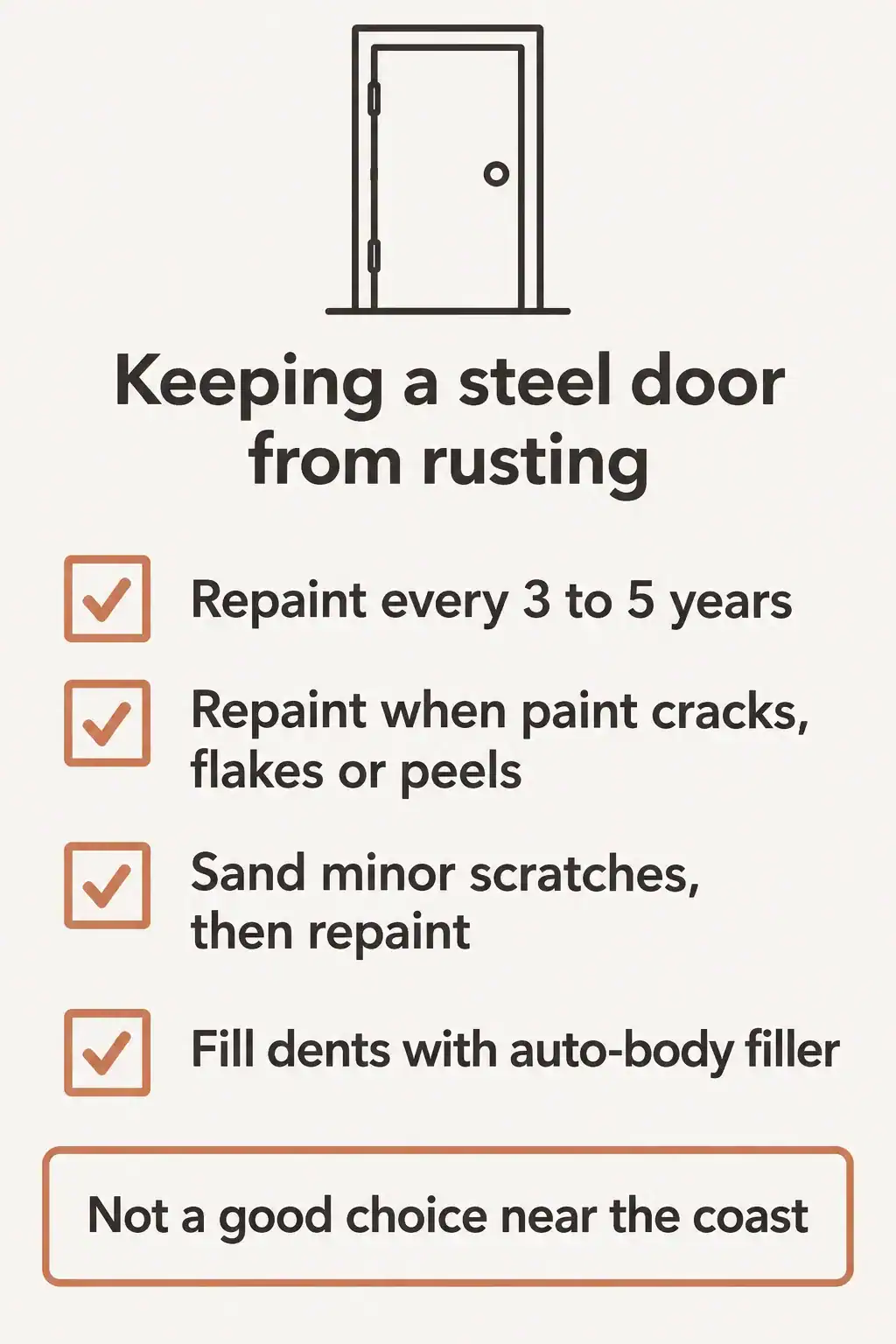
Thicker skins are less likely to dent. When one does, auto-body filler repairs it, and minor scratches can be sanded out and repainted.

Security: strong skin, weak hardware
Hit hard, a steel door may dent but will rarely break or warp, which makes it one of the strongest front doors for security. Adding windows reduces that advantage (Bob Vila).
The skin is only half the story. Higher-end entry doors have multipoint locks that secure two or more sides of the door to the frame, which is both more secure and better at preventing twisting. For a standard lock, use a deadbolt with a throw bolt at least 1 inch long and a strike plate fixed with screws 3 inches or longer (This Old House).
Our take · Octopus Doors
A steel door with a cheap lock is a cheap door. If security is the reason you are buying steel, put the extra money into the lock and frame before you move up a gauge.
Will a steel door rust?
Yes, if the finish is broken. Once the surface finish is compromised the steel deteriorates quickly, so repaint whenever the coating begins to crack, flake or peel. Depending on finish quality and exposure, the average steel door needs repainting every 3 to 5 years.
Steel is not a good choice in any coastal environment, because corrosion is a concern there. A yearly coat of linseed oil or car wax on the surface gives extra protection elsewhere.
How well does a steel door insulate?
Close to fiberglass. Bob Vila, citing the US Department of Energy, puts windowless steel and fiberglass doors at R-5 to R-6 or higher, against roughly R-2 to R-3 for windowless wood.
Air leaking around the door is the biggest threat to efficiency, so the frame, threshold and weatherstripping matter as much as the core. A prehung door arrives with the frame hung and weatherstripped.
What a steel door costs, and what it needs
Steel is the least expensive door material. Contractor estimates run $150 to $1,400 (This Old House, using Angi data), and $200 to $1,000 is typical (Bob Vila). Once you add the frame, sidelites and hardware, a steel entry system can cost about as much as wood (Fine Homebuilding).
With proper care a steel door can last as long as 50 years, but a mid-level door typically carries only a five-year warranty. Read the warranty for its terms on finish and rust.
Before you buy
- Ask for the skin gauge in writing: 24 or thicker.
- Ask whether the core is sprayed polyurethane or sheet foam.
- Check the frame material and whether the door is prehung and weatherstripped.
- Look for a multipoint lock or a deadbolt with a 1-inch throw bolt.
- Read the warranty for finish and corrosion terms, especially near the coast.
Comparing materials? Read our pages on fiberglass doors and aluminum doors, or the overview of front door materials and styles.
Related posts
 Door Materials Compared: Wood, Steel, Fiberglass and More
 Defying Decay: The Surprising Truth About Steel Doors and Rust
 Fiberglass vs. Steel Front Doors: Which One Is the Better Investment?
 Aluminum Doors
 Fiberglass Doors
 Front Doors
 Hollow Core Doors
 Unlock the Secrets to Perfectly Cutting Hollow Core Doors