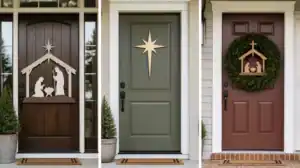
Deciding when to refinish a wood front door instead of replacing it is a common dilemma where a wrong choice leads to wasted money and recurring repairs. This guide narrows the process down to 9 ideas worth your attention so you can choose with confidence. Let’s start with the material itself.
1. Wood quality
Distinguishing between solid timber and veneer is the first step toward a lasting restoration.
As an Amazon Associate I earn from qualifying purchases. Affiliate links may earn me a commission at no extra cost to you.
Before you commit to the labor of stripping and refinishing, you need to know exactly what you are working with. Not all wood doors are created equal, and the construction method determines whether your door is a long-term asset or a temporary fix.
Solid wood doors, typically crafted from dense species like oak or mahogany, are built to last for decades. Because the material is consistent throughout the entire slab, these doors can handle multiple cycles of stripping and sanding without losing their structural integrity. If you have an original door with a heavy, substantial feel, it is almost certainly a prime candidate for restoration.
The Veneer Warning
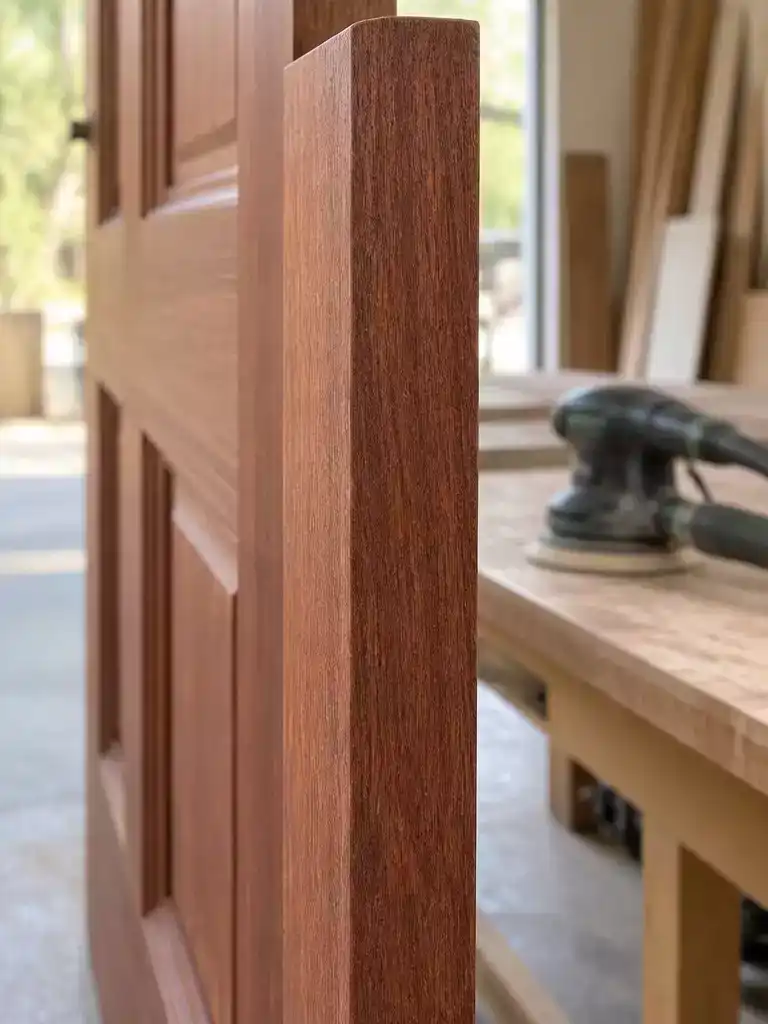
Modern or mass-produced doors often use an engineered core covered by a very thin layer of wood veneer. You can identify this by inspecting the door edges for visible seams or layers that indicate a non-solid construction.
If you attempt to aggressively sand a veneer-faced door, you will quickly breach that thin outer layer, permanently ruining the finish and the aesthetic of the door. If your inspection reveals a composite or veneer-faced core, it is a replace candidate; restoration efforts will likely cause more harm than good.
To verify your door’s potential, check the top or bottom edges where the wood may be exposed. If you see a uniform grain pattern that continues through the entire thickness of the door, proceed with confidence. If you see horizontal gluelines or a different material beneath a surface layer, it is time to start looking at new door options rather than investing in a refinish.
⭐ Top Quality Wood Doors to Consider
✨ Editor’s Pick
Solid Wood Core Double Entry Doors
Pine Dutch Style Front Entry Door
Modern White Oak Solid Core Door
🧰 Ask Before You Hire
- Veneer assessment: Ask the pro to verify if the door is solid wood or veneer-faced before they start sanding.
- Stripping methods: Confirm if they use chemical stripping or aggressive sanding, which could destroy thin wood layers.
- Finish compatibility: Ask if their chosen finish is suitable for your door’s specific wood species, such as oak or mahogany.
Structural integrity
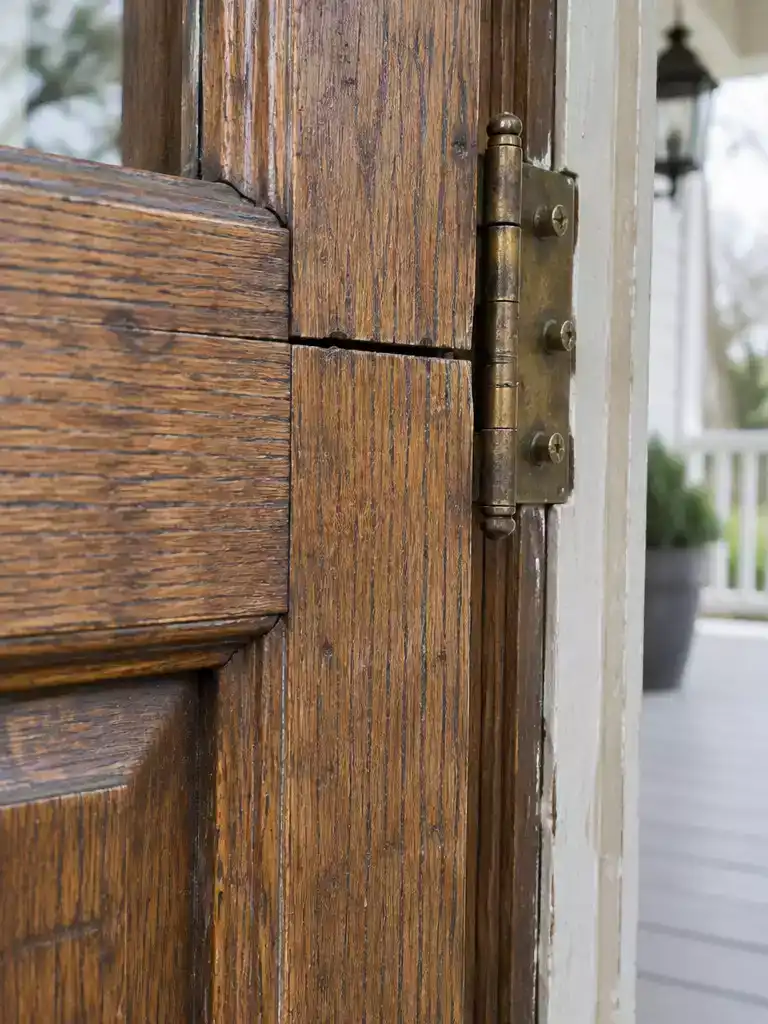
Evaluating the hidden framework that keeps your home secure and your door functional.
Traditional exterior doors rely on mortise-and-tenon joinery, a method where the ends of the horizontal rails are fitted into deep slots in the vertical stiles. This connection is the backbone of your door’s stability. When these joints are tight, the door swings square and holds its shape regardless of temperature or humidity swings.
However, years of thermal expansion and contraction can eventually take a toll. You need to look past the surface-level finish and examine how the door holds together under pressure.
Structural Red Flags
- Loose or opening joints: If you can see light through the seam where the rail meets the stile, the glue has failed and the joint is no longer providing support.
- Rattling panels: If the decorative wood panels move or rattle when you push on them, they have shrunk away from their housing, which can lead to air leaks and water intrusion.
- Stripped hinge screws: If the screws in your hinges spin freely or pull out easily, the wood fibers inside the door have likely disintegrated, making it impossible to keep the door hung straight.
- Systemic shifting: If the entire frame-to-door system is out of alignment and the door is binding at multiple points, the integrity of the unit has likely reached its limit.
The decision to repair or replace often comes down to the scale of the failure. If you find a single loose joint or a panel that has shifted, a skilled professional can often clamp and re-glue the assembly to restore its original strength.
If the failure is systemic – meaning the joints are failing at multiple corners, the hinge side is soft, or the door slab itself no longer sits square in the frame – you are likely looking at the end of the door’s structural life. At that point, attempting to force a repair is often a temporary fix that will inevitably lead to a full replacement once the wood continues to shift and settle.
⭐ Best Frame Repair Kits for Doors
Heavy Duty Steel Door Jamb Repair
✨ Editor’s Pick
Penetrating Epoxy Resin Wood Sealer
Miter Corner Clamp for Woodworking Trim
🧰 Questions for Your Installer
- Joint reinforcement: Can you effectively re-glue and clamp these mortise-and-tenon joints, or is the wood fiber too degraded to hold?
- Hardware anchoring: If the hinge screws are spinning, do you suggest a wood plug repair or a full hinge-side stile replacement?
- Structural longevity: Given the current shifting in the frame, will a repair provide a lasting seal, or is replacement more cost-effective?
3. Rot or moisture damage
Distinguishing between minor surface weathering and deep structural decay is the first step toward restoration.
Before you commit to a refinishing project, you need to determine if the wood is still solid or if it has succumbed to moisture. The most reliable way to check this is the “Awl Test.” Take a screwdriver or an awl and firmly probe the bottom rails and the lower corners of your door, as these are the areas most prone to water collection.
If the tool meets firm resistance, you are likely looking at surface-level weathering that can be sanded and sealed. However, if the tool sinks into the wood with little effort, or if the material feels spongy or crumbles under pressure, the structural core has likely been compromised by decay.
The 30% Rule:
If your probe reveals that rot covers more than 25–30% of a structural piece, epoxy or wood filler will not provide the necessary strength to hold the door together. At this point, the integrity of the door is permanently lost, and replacement is the only safe path forward.
It is important to differentiate between cosmetic issues and structural failure. Surface-level weathering, checking (small cracks in the finish), and minor discoloration are all manageable through standard sanding and professional refinishing. These are expected signs of age and do not necessarily mean the door is failing.
Conversely, deep core decay is a different story. If the moisture has reached the interior of the wood, the door will continue to deteriorate even after you apply a fresh coat of sealant. If you find deep rot, you are essentially painting over a ticking time bomb, and it is almost always more cost-effective to replace the unit rather than attempting a repair that won’t last through the next season.
⭐ Effective Weatherstripping for Door Bottoms
Silicone Door Draft Stopper Gap Filler
Vinyl Replacement Threshold Strip for Doors
✨ Editor’s Pick
Fixed Kerf Double Bubble Door Sweep
💡 Practical Tips for Field Testing:
- Check the hardware: Inspect the area directly behind strike plates and hinges, as these spots often trap moisture and hide early rot.
- Test the threshold: Feel for softness around the door sweep and bottom jamb, where water frequently pools during heavy rain.
- Monitor visual cues: Look for peeling paint or darkened wood grain near the base, which often signals moisture is already trapped underneath.
Protecting the long-term value of your home doesn’t require overhauling every detail of your entry. Assessing the structural health of your existing door slab often reveals that restoration is a far more sound financial strategy than a complete replacement.
Focusing on the fundamental condition of your wood core ensures you invest only in repairs that genuinely preserve your property equity for years to come.
4. Door straightness
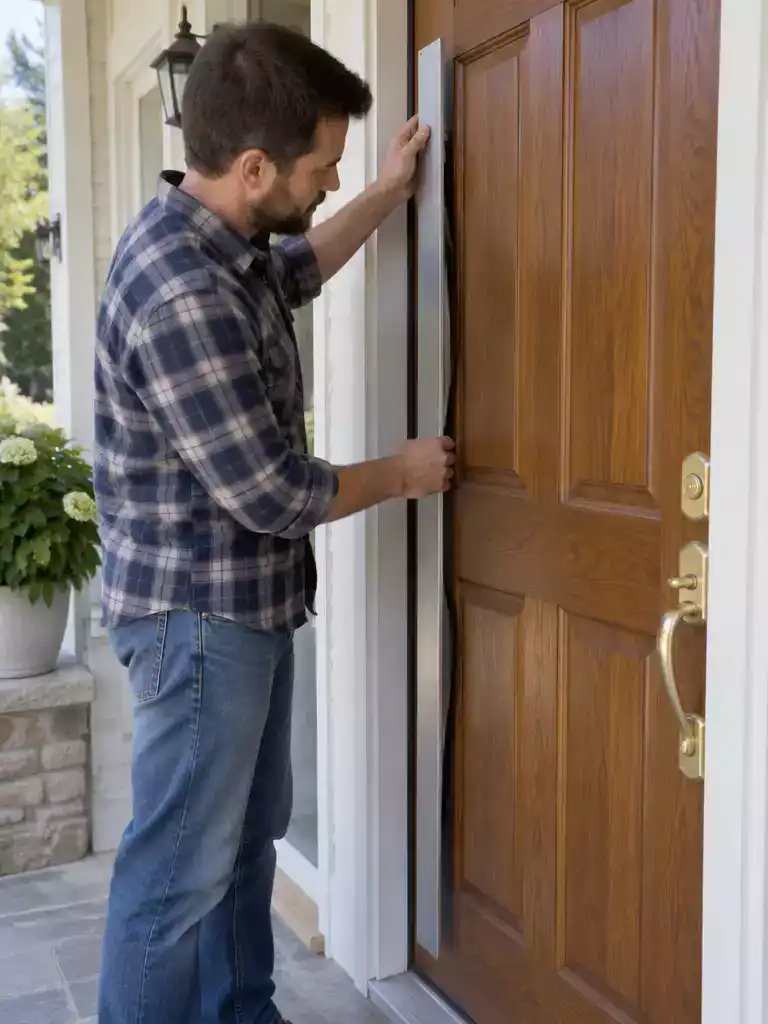
Ensuring your door hangs true is the difference between a functional entrance and a drafty headache.
Before you commit to the labor of stripping and refinishing, you need to confirm that the slab is actually flat. Wood is a living material that reacts to seasonal moisture, and over time, it can develop a permanent warp that no amount of sanding or staining will fix.
The standard test is straightforward: use a long, rigid straightedge or a taut string held vertically across the face of the door. If you find a deviation of more than 1/4 inch, you are likely looking at a door that will never seal properly against your weatherstripping again.
Signs your door has reached its limit:
- The door consistently binds against the frame, requiring force to open or close.
- The latch or deadbolt fails to align with the strike plate, even after you attempt to adjust the hinges.
- You can see daylight through the gaps when the door is latched.
- The door refuses to stay flush with the stop, appearing bowed or twisted even when the hardware is tightened.
If your door exhibits these symptoms, it has likely lost its structural stability. While minor seasonal movement is normal for wood, a permanent warp indicates that the internal tensions of the wood fibers have shifted beyond recovery.
Attempting to fix a warped door with new finish is simply throwing good money after bad. If the slab doesn’t sit flat, it will continue to leak air and moisture, which will inevitably damage your new finish and the surrounding frame in short order.
⭐ Essential Hardware for Door Straightness
✨ Editor’s Pick
Heavy Duty Hidden Pivot Door Hinge
Sliding Barn Door Hardware Track Stopper
Hidden Bookcase Door Pivot Hinge Kit
💡 Why This Matters for Home Value:
A warped door isn’t just an aesthetic flaw; it compromises your home’s thermal envelope and security. While a minor tweak might satisfy a quick inspection, long-term performance issues will eventually force a full replacement. Investing in a sound, straight door preserves your entry’s integrity and ensures your home remains energy-efficient and weather-tight for years to come.
Resale Reality: Buyers prioritize functional, draft-free entryways; a binding or warped door is an immediate red flag.
5. Frame condition
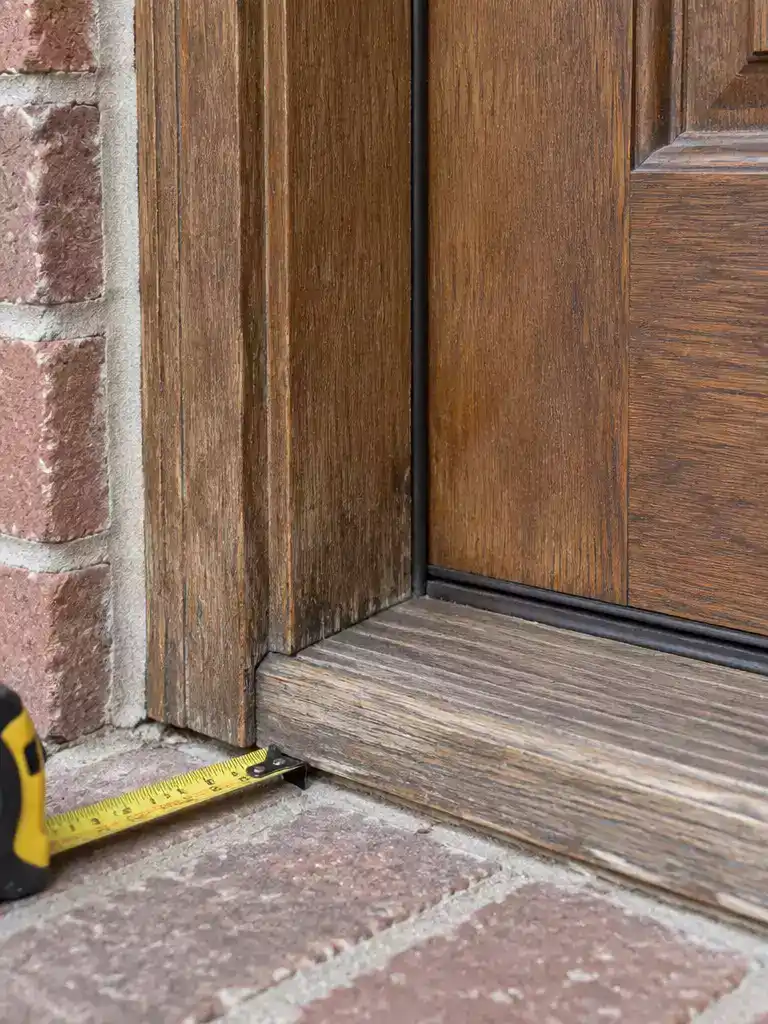
Assessing the frame’s health ensures your door overhaul is a lasting solution, not a temporary patch.
When you evaluate your entryway, think of the door slab as the passenger and the frame as the vehicle. You can have a beautiful, perfectly restored slab, but if the frame is the limiting factor, the entire system will eventually fail.
Before committing to a refinish, you need to determine if your frame issues are localized or systemic. If the problem is just a bit of rot at the very base of the jamb – often caused by years of rain splashing off the porch – you can usually handle this with a “dutchman” repair. This involves cutting out the decayed section and splicing in new, pressure-treated, or rot-resistant wood that is then sanded and painted to match the rest of the trim.
The Frame Dealbreaker
If the rot has traveled high up the jambs, or if the threshold is failing to the point that water is seeping into your subfloor, stop. At this stage, the frame is compromised structurally; replacing the entire pre-hung unit is the most logical and cost-effective path forward.
To perform your own check, use a screwdriver or an awl to probe the wood at the bottom of the jambs and the threshold. If the tool sinks into the wood with little resistance, you are likely looking at core decay rather than surface weathering.
If you find that both jambs are soft or that the frame is no longer square, simply working on the door slab is a waste of your time and money. A door that hangs in a failing frame will never seal correctly, meaning you’ll lose all the energy efficiency you might have hoped to gain. When the frame is the root of the problem, replacing the door slab is usually the more logical move to ensure your home remains secure and weather-tight.
⭐ Refinishing Potential for Old Doors
All in One Wood Refinishing Paint
✨ Editor’s Pick
Water Based Satin Wood Varnish Sealer
Durable Satin Finish Front Door Paint
🔢 The Right Sequence for Frame Rehab
Tackling a frame repair requires a specific order of operations to ensure your door hangs square and seals against the elements. If the door sits near the sea, salt air speeds up wear on the finish and hardware, so see our beach house door maintenance routine.
- Inspect the threshold: Verify the subfloor is dry before attempting any wood splicing or jamb repairs.
- Stabilize the frame: Secure the jambs into the surrounding studs to ensure the door opens without binding.
- Weatherproof the connection: Apply high-quality caulk and flashing to seal the new splice before applying final paint.
6. Refinishing potential
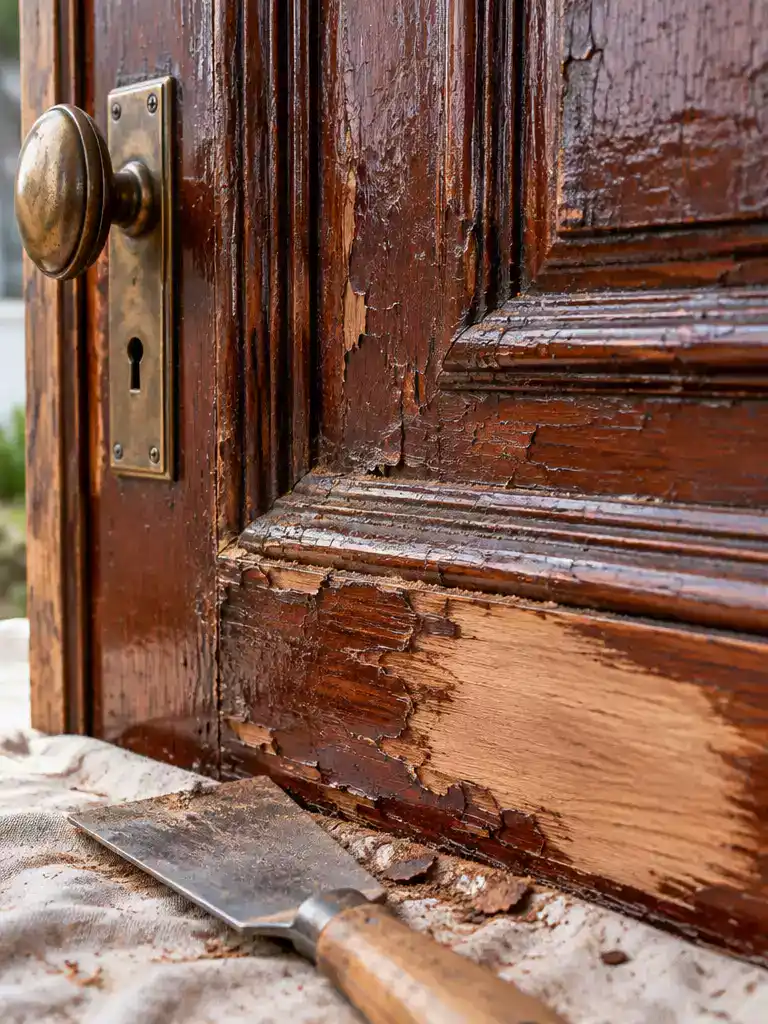
Assessing the layers of history to determine if your door’s original beauty can be restored.
Before you commit to a full restoration, you need to determine if your door has been “loved to death” by previous refinishing attempts. If your door has been painted or stained dozens of times over the decades, the sheer thickness of the accumulated finish can become a major liability.
When finish layers are excessively thick, removing them requires aggressive sanding or heavy chemical stripping. This process often reaches into the wood itself, potentially damaging the intricate carvings, sharp corners, and delicate molding profiles that give the door its character. If those details are already obscured or rounded off by years of heavy-handed maintenance, the labor required to strip it back to a clean, workable state may quickly exceed the cost of purchasing a new, high-quality replacement door.
You should also evaluate the condition of the wood underneath those layers. If the surface is too pitted, scarred, or inconsistently sanded from past projects, it may never accept a new stain or finish uniformly. This often leads to a “blotchy” or uneven appearance that fails to deliver the high-end look you are likely aiming for.
If you find that you cannot strip the door without risking the integrity of the wood profiles, the most logical path is to accept that the door has reached its functional end-of-life. In these cases, prioritizing a replacement is often the most cost-effective way to regain a clean, professional aesthetic without pouring money into a project that may not yield a quality result.
⭐ Restoration Potential for Historic Doors
✨ Editor’s Pick
Vintage Solid Brass Barrel Bolt Latch
⚠️ Where This Can Go Wrong:
- Over-sanding profiles: Aggressive power sanding often flattens crisp molding details, permanently stripping the door of its architectural character.
- Chemical saturation: Heavy chemical strippers can seep into wood joinery, potentially weakening the glue and causing panels to shift.
- Uneven finish absorption: Pitted or scarred wood surfaces often absorb stain inconsistently, resulting in a blotchy, amateur-looking final appearance.
7. Historic character
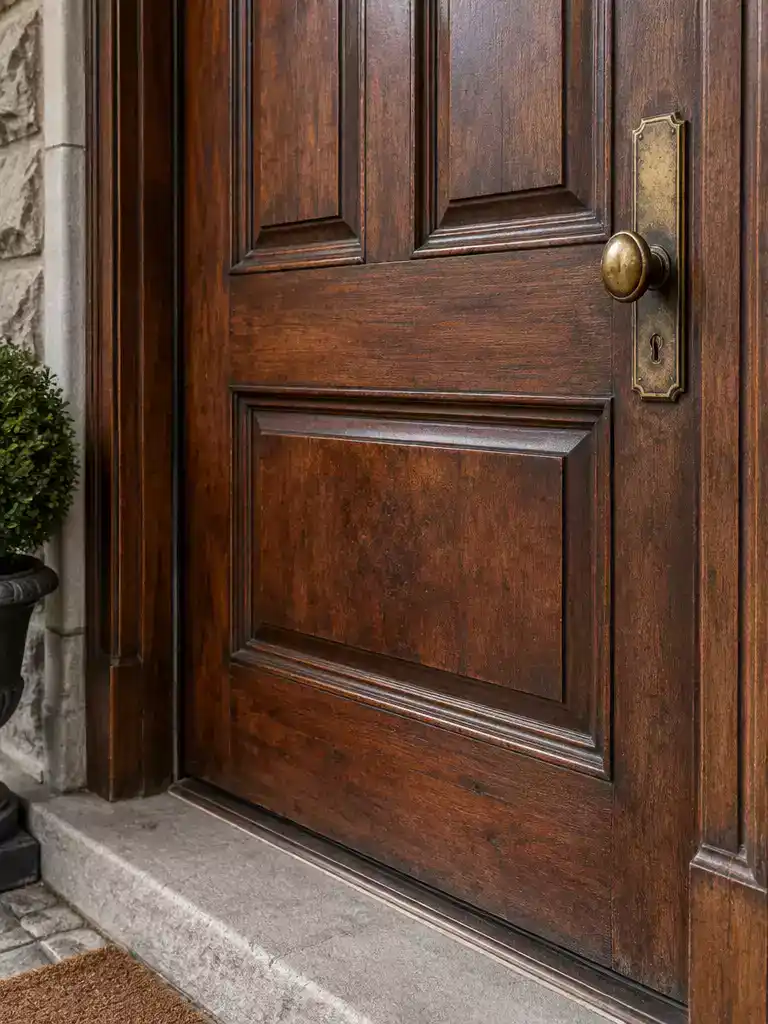
Preserving original architectural character maintains the unique integrity and value of your historic home.
If your home was built decades ago, there is a high probability that your front door was crafted from old-growth lumber. This material is fundamentally different from what you find at a standard building supply store today; it is significantly denser and more rot-resistant than modern mass-produced wood.
When you are deciding whether to refinish or replace, the age and architectural significance of your door should be your primary filter. If the door is original to the home, it possesses a structural and aesthetic soul that modern factory-made units simply cannot replicate.
Preservation Priority: If the door is architecturally significant and original to your home, aim to keep it. The cost of labor to strip and restore an antique door is often a smaller investment than the price of a custom-built, historically accurate reproduction.
There are rare instances where a historic door is damaged beyond reasonable repair. If you reach this point, do not simply swap it for a generic “off-the-shelf” model from a big-box retailer.
A replacement must match the original in scale, detail, and profile to maintain your home’s market value and curb appeal. You will need to seek out a custom millwork shop that can replicate the specific molding profiles and panel dimensions of your existing unit.
The Replacement Caveat
If you must replace a historic door, be prepared for a significant budget jump. Custom, historically accurate replacements can range from $3,000 to $15,000, as they are not mass-produced and require specialized labor to achieve the correct look.
Before you commit to a replacement, look for a local professional who specializes in historic restoration. They can often breathe new life into original wood that looks unsalvageable to the untrained eye, effectively preserving the unique character that defines your home.
⭐ Modern Handlesets for Entry Doors
✨ Editor’s Pick
Matte Black Square Privacy Door Levers
Matte Black Exterior Door Lock Set
Rounded Matte Black Interior Door Hinges
📈 The Long-Term Payoff
Original, old-growth wood doors are increasingly rare assets that modern, mass-produced replacements simply cannot replicate. Preserving these doors protects your home’s architectural pedigree and historical value. While restoration requires a higher initial investment than a cheap steel swap, it prevents the value-diluting “generic” look that often hurts curb appeal during future home sales.
Resale Strategy: Buyers prioritize authentic character; keeping an original door often yields better long-term equity than modernizing.
8. Energy performance
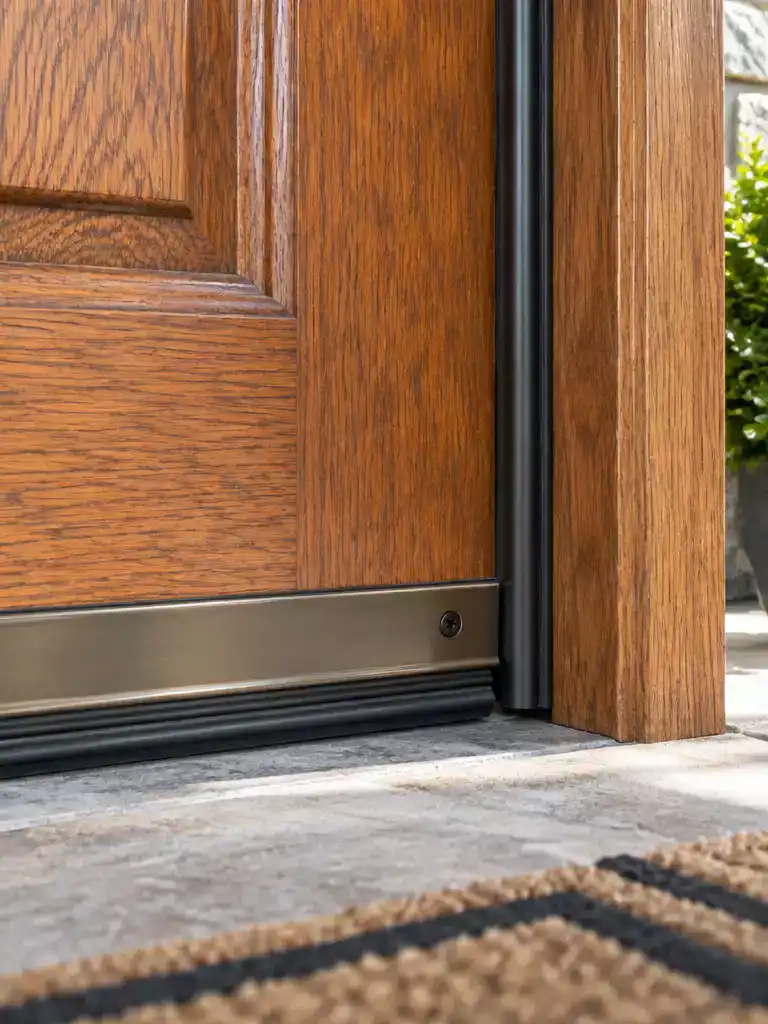
Improve your home’s thermal comfort by understanding the real limits of your existing door.
When you are weighing the decision to keep an original wood door, energy efficiency is often the biggest point of friction. It is important to be realistic about what a wood slab can and cannot do compared to modern building materials.
Older solid wood panel doors typically have a U-factor of roughly 0.50. In contrast, modern insulated steel or fiberglass doors are engineered to hit a U-factor between 0.15 and 0.40, providing a significant jump in thermal performance.
The Weatherstripping Limit: Adding high-quality weatherstripping and a heavy-duty door sweep will effectively reduce air leakage and drafts, but it does not change the U-factor of the wood slab itself. You are stopping the breeze, but you are not changing the thermal conductivity of the wood panels.
If your primary goal is to lower your utility bills or fix a drafty entry, you need to decide if you are chasing air infiltration or thermal transfer:
- Focus on air sealing: If you love the look and quality of your existing door, stick with it. Install professional-grade weatherstripping and a solid door sweep to stop the drafts. This is a cost-effective way to make the entryway feel much more comfortable.
- Focus on thermal insulation: If your home feels cold near the door because the material itself is radiating chill, no amount of weatherstripping will solve the problem. In this case, a modern insulated unit is the only way to achieve significant energy gains.
Before you commit to a replacement for energy reasons, verify if the heat loss is coming from the door slab or the frame. If the frame is the culprit, replacing the door might not give you the performance boost you expect unless you also address the gaps where the frame meets the house wall.
⭐ Energy Efficient Door Hardware
Heavy Duty Matte Black Privacy Levers
✨ Editor’s Pick
Matte Black Entry Door Handleset Set
Modern Square Front Door Lock Set
Cost difference
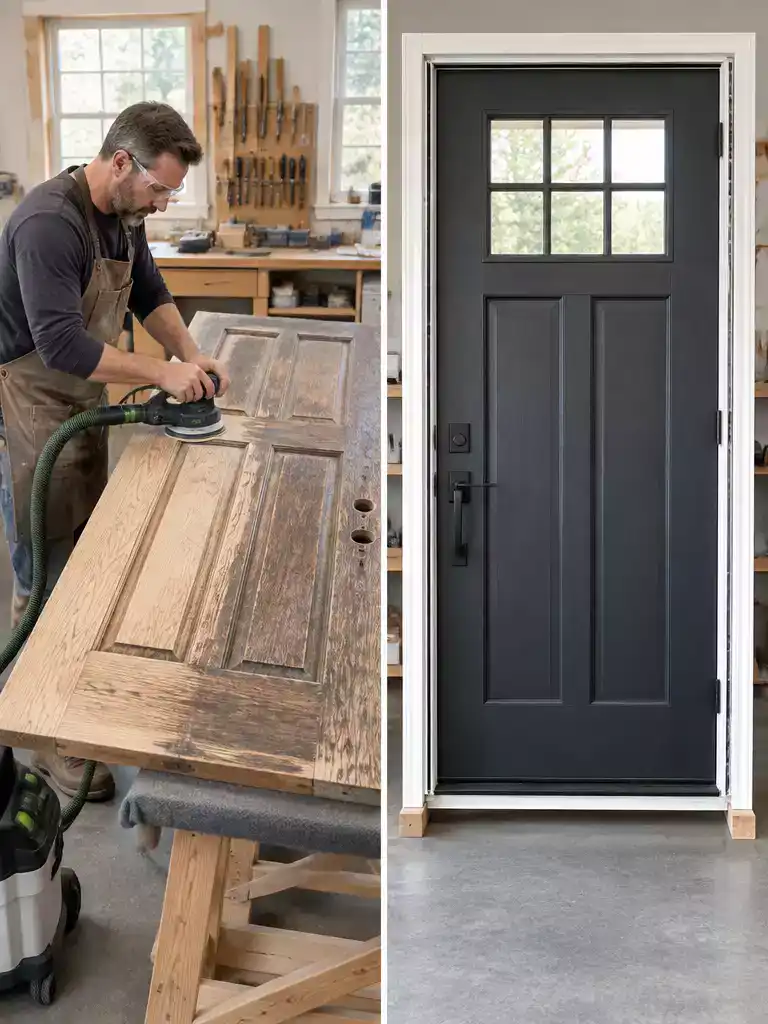
Compare the long-term value of restoring your original door versus a professional replacement.
When you sit down to crunch the numbers, the financial gap between refinishing and replacing is usually the deciding factor for most families. Refinishing is almost always the more budget-friendly route, but it only offers true value if your door is structurally sound enough to survive another decade of exposure.
It is easy to get caught up in the cost of the door slab itself, but remember that replacement costs are rarely limited to just the slab. When you opt for a new unit, you are looking at the price of a pre-hung set, professional installation labor, and the potential need for new hardware if your old locksets don’t fit the modern bore pattern.
The Hidden Cost Trap
If you choose to refinish a door that has deep structural decay, you are essentially throwing money away. If the door requires significant repairs – like epoxy work or joint reconstruction – on top of the stripping and staining, you might quickly find your “budget” refinishing project creeping toward the price of a mid-range replacement door that would perform better and last longer.
Refinishing is a high-value, low-cost option only if the door is fundamentally sound. If you are doing this to save money, be honest about the door’s condition first; spending $500 on a professional finish only to have the door warp or rot through the next winter is a classic case of paying twice for the same result.
⭐ Cost Effective Door Hardware Upgrades
Black Exterior Entry Door Handle Set
Matte Black Privacy Keyless Door Knobs
✨ Editor’s Pick
Matte Black Interior Privacy Door Levers
💰 What This Really Costs
- The professional range: Expect to pay between $171.84 and $575 for professional refinishing, depending on the door’s condition.
- Hidden installation fees: Remember to budget for new hardware or custom fitting if your existing lockset doesn’t align with modern standards.
- Smart investment: Spending on a professional finish is only cost-effective if the door is structurally sound and lacks deep decay.
With all nine criteria now in front of you, the path to deciding on your front door is far more straightforward. Prioritizing the structural health of your door slab will do more for your home’s value than any cosmetic update. While it is easy to feel the weight of a major decision, you do not need to address every factor at once to reach the right conclusion.
Download the on-site assessment checklist and start by evaluating the structural core and potential for warping. If you get those two calls right, the choice between keeping a historic asset or investing in a modern replacement becomes a simple matter of math and longevity. Focus on the foundation, and you can move forward with total confidence.
Related posts
 We Changed the Entryway Paint Instead of Repainting the Front Door
 What to Know Before Replacing a Front Door
 Innovative Trim Alternatives: Using a Door Stop Instead of Quarter Round
 Bifold Closet Doors Rebuilt With Shaker Style Faces Instead of Flat Slabs
 Replacing Static Caravan Doors with Stylish French Doors: What You Need to Know
 12 Wood Front Door Color Ideas for Timeless American Homes
 How to Maintain a Wood Front Door (And When It’s Not Worth It Anymore)
 Fiberglass vs Wood Front Doors for Full Sun