As an Amazon Associate we earn from qualifying purchases.
You feel it before you see it: a cold stripe of air across the floor, a curtain that moves when the door is shut, a whistle on windy nights. Learning how to weatherstrip a door fixes most of that in an afternoon, as long as you seal the right gap with the right material and the door still closes properly afterward. To style the door you add, see these storm doors for front door styles.
The short answer
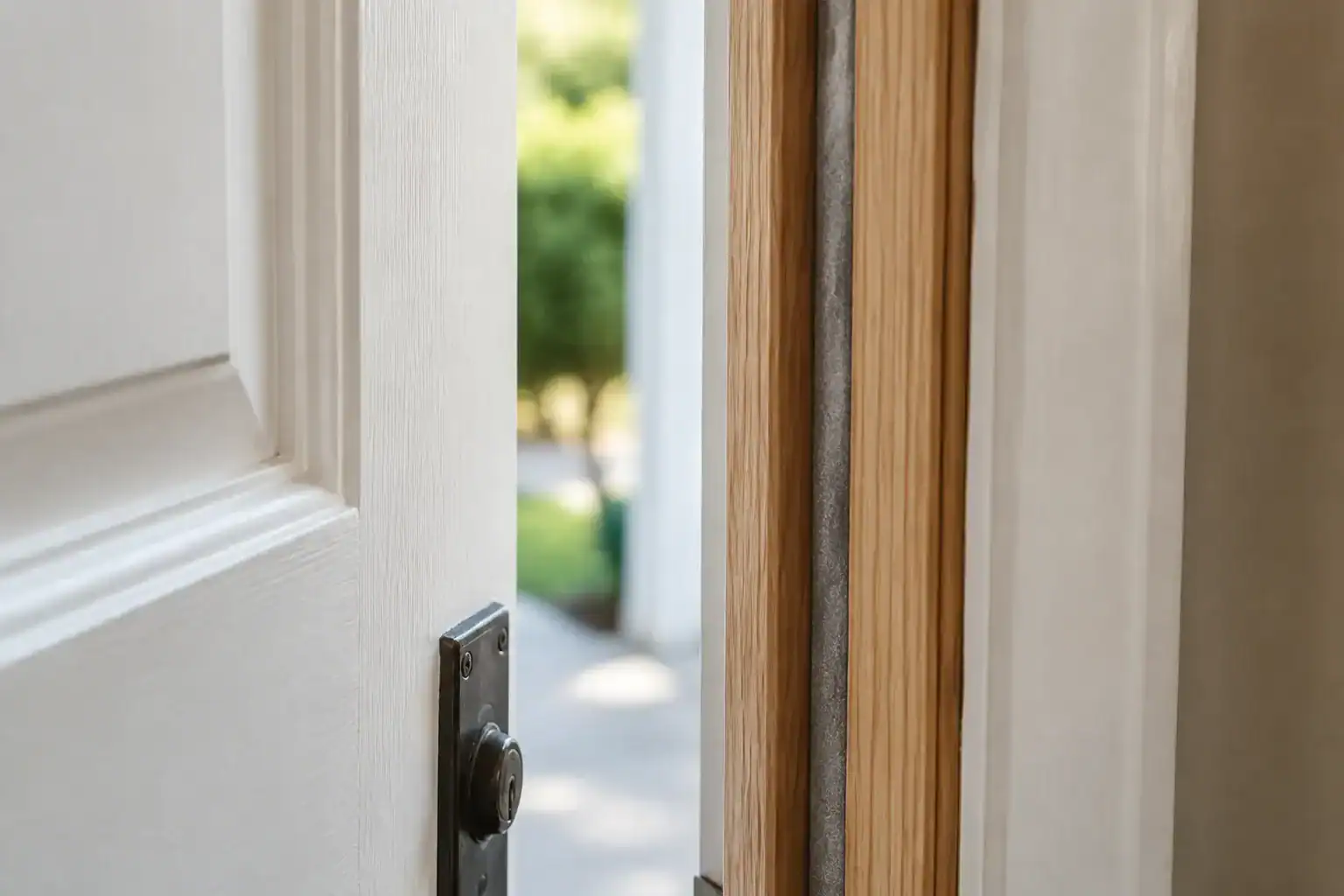
Find the leak first; a paper strip or a light test shows it. Then match the seal to the gap: a compression strip, V-strip or foam tape on the head and jambs, and a door sweep, door shoe or adjustable threshold at the bottom. To cut noise as well as drafts, see how to soundproof a door without replacing it. Clean and dry the surfaces, cut pieces square, press them in, and test that the door still latches without a shove.
250×
more air leaks through reinforced felt than closed-cell foam, inch for inch
50 mph
wind used to test how well each seal blocks air
Up to 10%
yearly energy savings from sealing and insulating a whole home
The first two numbers come from the Maryland Energy Administration’s weatherstripping test results. The third is ENERGY STAR’s estimate for air sealing plus insulation across a whole house, not for one door.
01 / Find the leak
Where is the draft around your door actually coming from?
A drafty door usually leaks in one of three places. Air slips past the head and jambs where the door closes against the frame, under the door at the threshold, or behind the trim where the frame meets the wall. Each spot needs a different fix, so spend ten minutes finding the leak before you buy anything.
The Building America Solution Center’s weatherstripping guide, run by a U.S. Department of Energy lab, suggests a few simple checks:
- Make the leaks louder. Close all windows and exterior doors, open the bathroom and laundry room doors, and run every exhaust fan. The fans pull outside air in through the gaps, so drafts are easier to feel.
- Feel and watch. Move the back of your hand or a tissue slowly around the frame. Wherever the tissue flutters, air is getting in.
- Try the light test. At night, switch on the porch light, stand inside with the room lights off, and look for light around the door. Any glow is a gap.
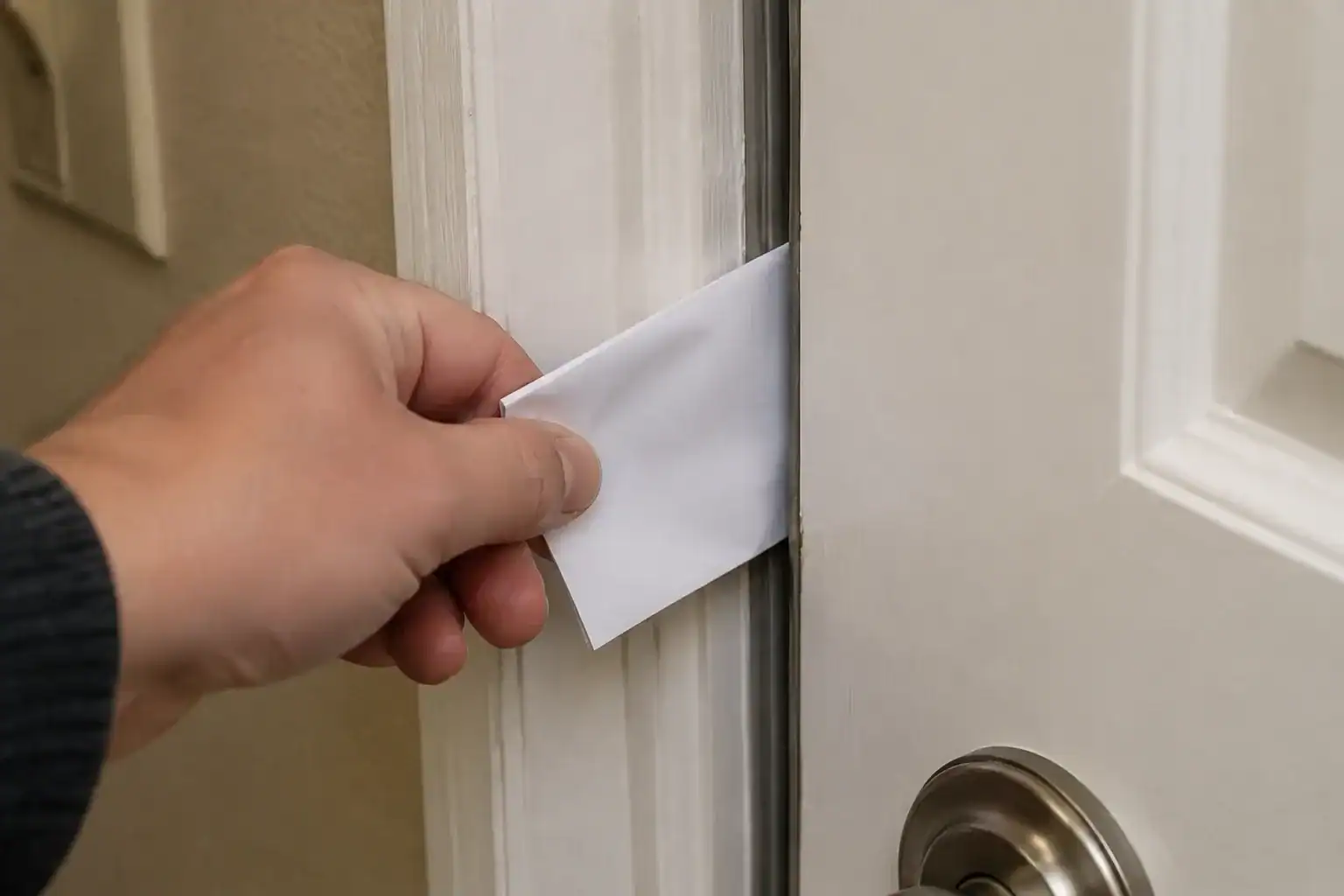
- Use the paper test. Close the door on a strip of paper or a dollar bill at several points along the frame. If it slides out easily, the seal isn’t touching the door there.
Start with the garage door
If your house has a door into an attached garage, check that one first. The Solution Center points out that sealing it helps keep car exhaust and garage fumes out of the living space, which matters more than comfort. Once it is sealed, upgrade the rest of the garage-side entry with hooks, a tray and a self-closing hinge.
02 / Match the seal
Which weatherstripping goes where on a door?
Weatherstripping is any flexible strip or gasket that closes the gap between a moving door and its fixed frame. No single type works everywhere, so most doors need two or three kinds: one for the head and jambs, one for the bottom edge, and sometimes a new threshold.
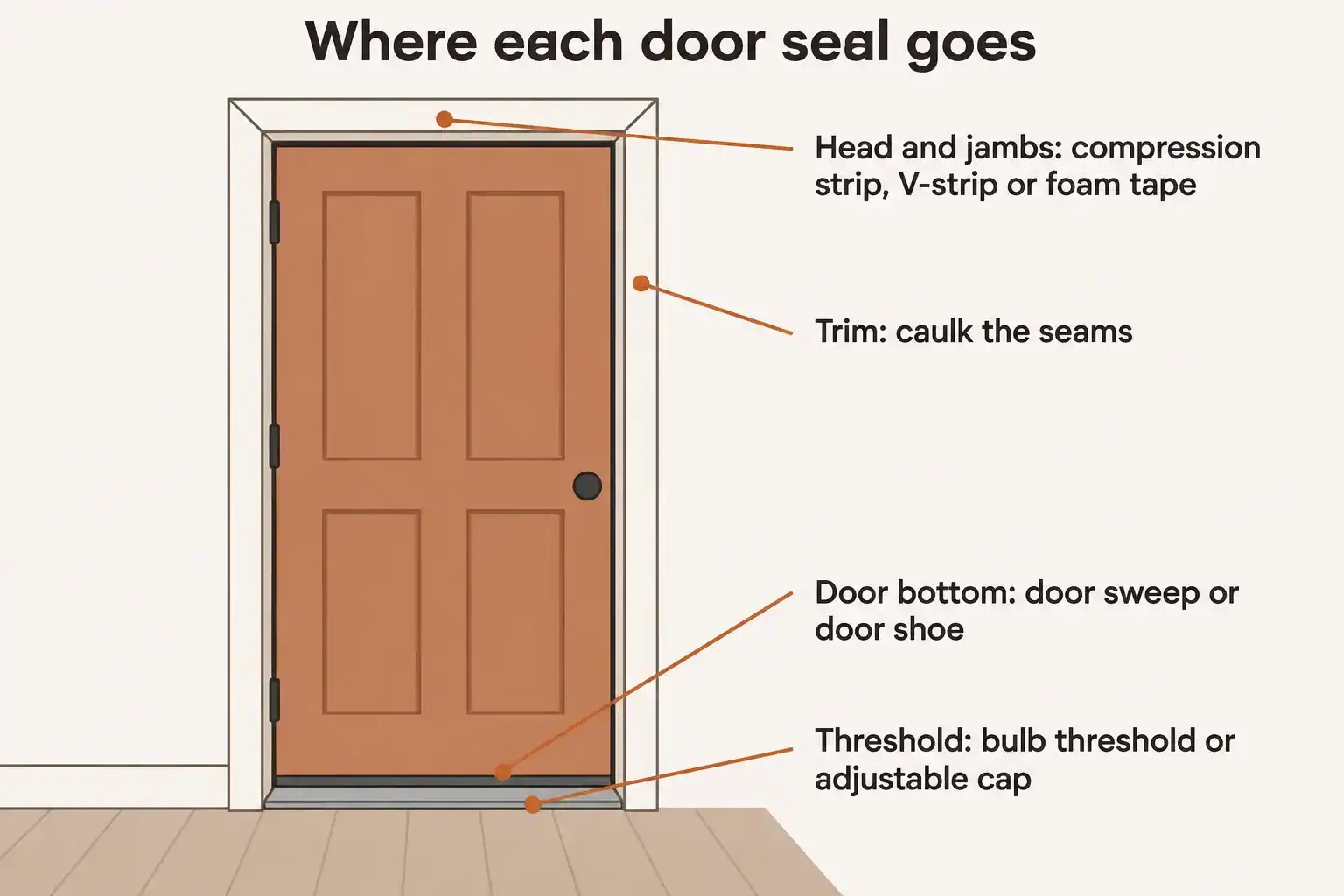
| Type | Best spot | Good to know |
|---|---|---|
| Compression strip (kerf-in) | Head and jambs of newer prehung doors | Pushes into a groove (kerf) in the frame; easy to replace with a matching profile. |
| Foam tape (closed-cell or EPDM rubber) | Head and jambs, door stops, irregular gaps | Easiest to install and seals well, but self-stick tapes don’t last as long as other types. Avoid open-cell foam. |
| V-strip (tension seal) | Hinge and latch side of the jamb | Vinyl or springy bronze folded into a V; nearly invisible. Bronze is nailed about every 3 inches. Can make the door a little stiffer to close. |
| Tubular rubber or vinyl | Around the door stop | Seals well when the door presses on it; tacked or screwed on, more work than tape. |
| Felt | Low-wear interior spots only | Cheap and easy, but the least effective and least durable. Keep it away from moisture and rubbing. |
| Magnetic | Head and jambs of metal doors | Works like a fridge gasket. Very effective, but costly. |
| Door sweep | Inside face of the door bottom | Metal strip with a rubber, vinyl or brush insert; many adjust for uneven thresholds. |
| Door shoe | Bottom edge of the door | Wraps the door bottom and sheds rain; may need the door bottom planed. Fairly expensive. |
| Bulb or frost-brake threshold | Floor under the door | A bulb threshold combines threshold and seal; a frost-brake threshold adds a thermal break but means replacing the threshold. |
Which material lasts matters as much as which seals best. In the Maryland tests, closed-cell foam and rubber tapes and strips with a rigid gasket blocked air best, while open-cell foam tape dried out and turned brittle and powdery. Tension seals, felts and silicone gaskets held up well over 600 hours of testing.
Our take · James Davis
Buy weatherstripping by the gap, not by the brand. Measure how wide the gap is with the door shut, then pick a profile that compresses into it. On a newer prehung door with a groove in the jamb, I’d always replace the kerf strip with the same shape before reaching for foam tape. Tape on top of a worn kerf strip rarely seals well and makes the door hard to latch.
03 / Install it
Shop this idea
Stripping for the frame gaps
- WEATHERSTRIPPINGHolikme Weather Stripping Door SealShop on Amazon
How do you weatherstrip a door, step by step?
Installing weatherstripping on a door takes a tape measure, a utility knife or scissors, mild soap and water, and the seal itself. Work from the top down so the corners meet neatly, and test the door after every side.
- Remove the old seal. Pull worn strips out along their length. Pry out stubborn bits of a kerf strip with a small flat screwdriver or needle-nose pliers without gouging the frame.
- Clean and dry the surfaces. Wash the jambs and head with dish soap and water and let them dry completely. Adhesive tape won’t stick to dust or old residue.
- Measure and cut. Cut each piece square so the ends butt tightly. For kerf-style strips, Endura’s replacement instructions for kerf-style weatherstrip cut the head piece to the full width first, then each side piece to the jamb length minus 1/8 inch.
- Install the head piece first. Push it into the groove (or press the tape on) along its full length, starting tight against one corner.
- Add the side pieces. Seat each side piece snugly against the head piece at the top corner and press it in all the way down.
- Test the door. Open and close it several times. The seal should stay in contact all around, and the door should still close and latch without a hard push. Redo the paper test to confirm.
Groove or no groove?
Newer exterior doors usually have a narrow groove, called a kerf, cut into the jamb. Kerf-in weatherstrip simply pushes into it. Older doors usually have no groove, so you use adhesive foam tape, a V-strip, or a strip that is nailed or screwed to the door stop.
04 / The bottom gap
How do you seal the gap under a door?
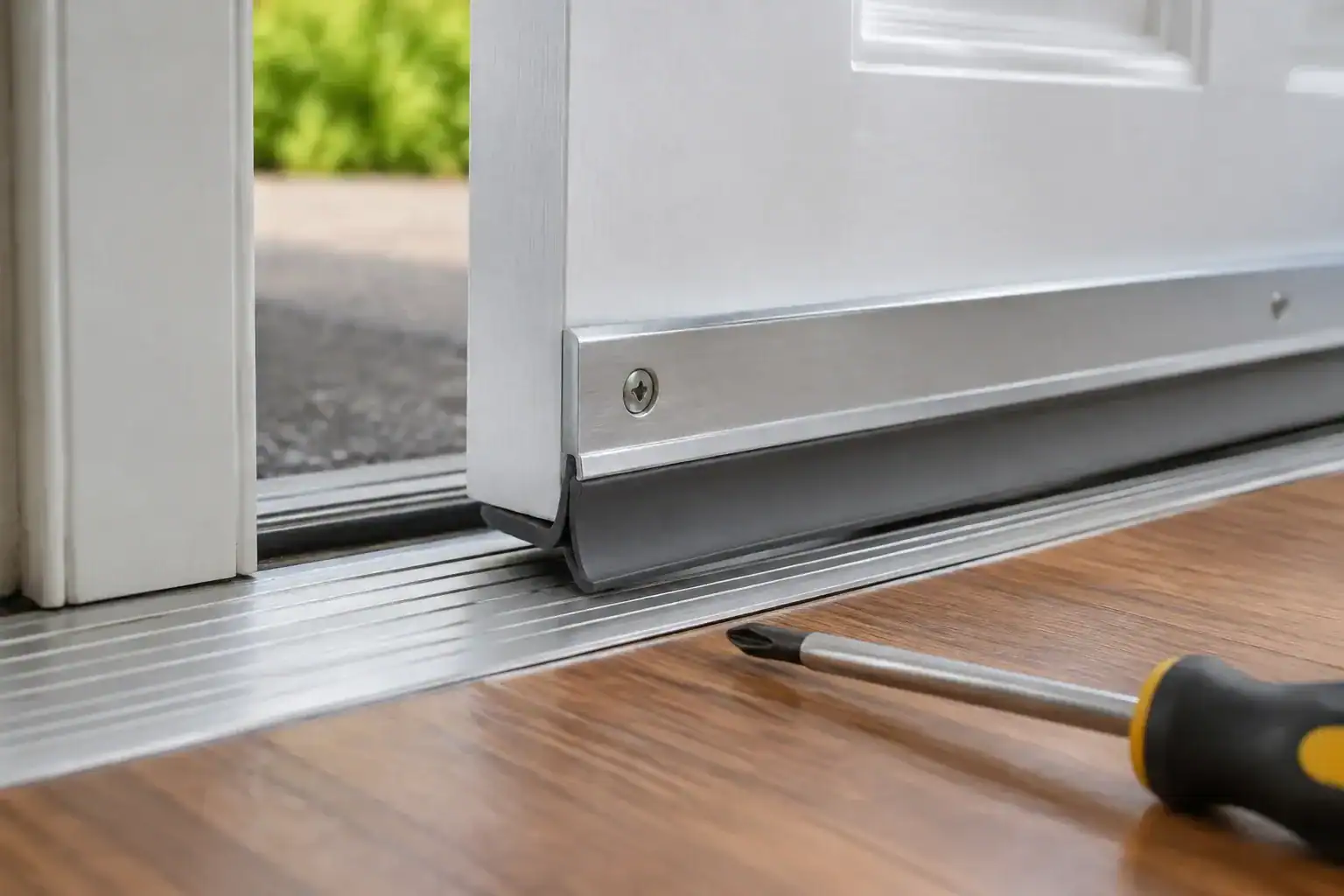
The gap under an exterior door is sealed with a door sweep, a door shoe, a new threshold seal, or a combination. Most homes start with the threshold that’s already there: many prehung entry doors have an adjustable threshold cap that can be raised with a few screws until it meets the door bottom.
- Sweep Screws to the inside face of the door. The rubber, vinyl or brush insert should just touch the threshold. Choose an automatic (retracting) sweep if it drags on a rug.
- Door shoe Wraps the bottom edge and sheds rain. A good choice for doors hit by weather, but you may need to trim the door to fit it.
- Bulb A threshold with a built-in rubber or vinyl bulb. Seals well but wears from foot traffic, so check it every year.
- Frost-brake A threshold with a thermal break for cold climates. Effective, but it’s a threshold replacement, not a quick fix.
For the seal itself, the Maryland tests favored vinyl door seals with several sealing edges of equal length over felt or brush seals. Brush sweeps still make sense on uneven floors or where the door has to clear a rug.
Our take · James Davis
Before you add a sweep, try raising the threshold cap. If the door has one, a small turn on each screw often closes the bottom gap for free. Add a sweep when the cap is already at its limit or the floor is uneven.
05 / When it isn’t the seal
Shop this idea
The sweep for the bottom gap
- DOOR SWEEPAdjustable Door Sweep Draft StopperShop on Amazon
When won’t weatherstripping fix a drafty door?
Weatherstripping can only seal a gap of fairly even width. If the door is out of square, warped or loose in its frame, or if air is coming from behind the trim, a new strip won’t stop the draft. Check these before you replace good seals a second time:
- The door sags. A wedge-shaped gap that is wide at the top on the latch side and tight at the bottom usually points to loose hinges. Tighten the hinge screws first, then decide whether to repair or replace a sagging door.
- The door sticks in some seasons. Wood doors swell in humid weather and shrink in dry weather, which opens and closes gaps. Thicker seals can make that worse; see why a front door sticks in humidity.
- Cold air comes from the trim. If you still feel cold air around the frame, the gap between the frame and the wall framing may never have been insulated or air-sealed. Caulk the trim seams, and if that’s not enough, pull the trim to check what’s behind it.
- The threshold is worn or loose. A cracked bulb or a loose threshold lets air in under even a perfect sweep.
- The door itself is the problem. An old, uninsulated door can feel cold even when it’s sealed. If you’re replacing it, what ENERGY STAR door labels actually mean helps you compare.
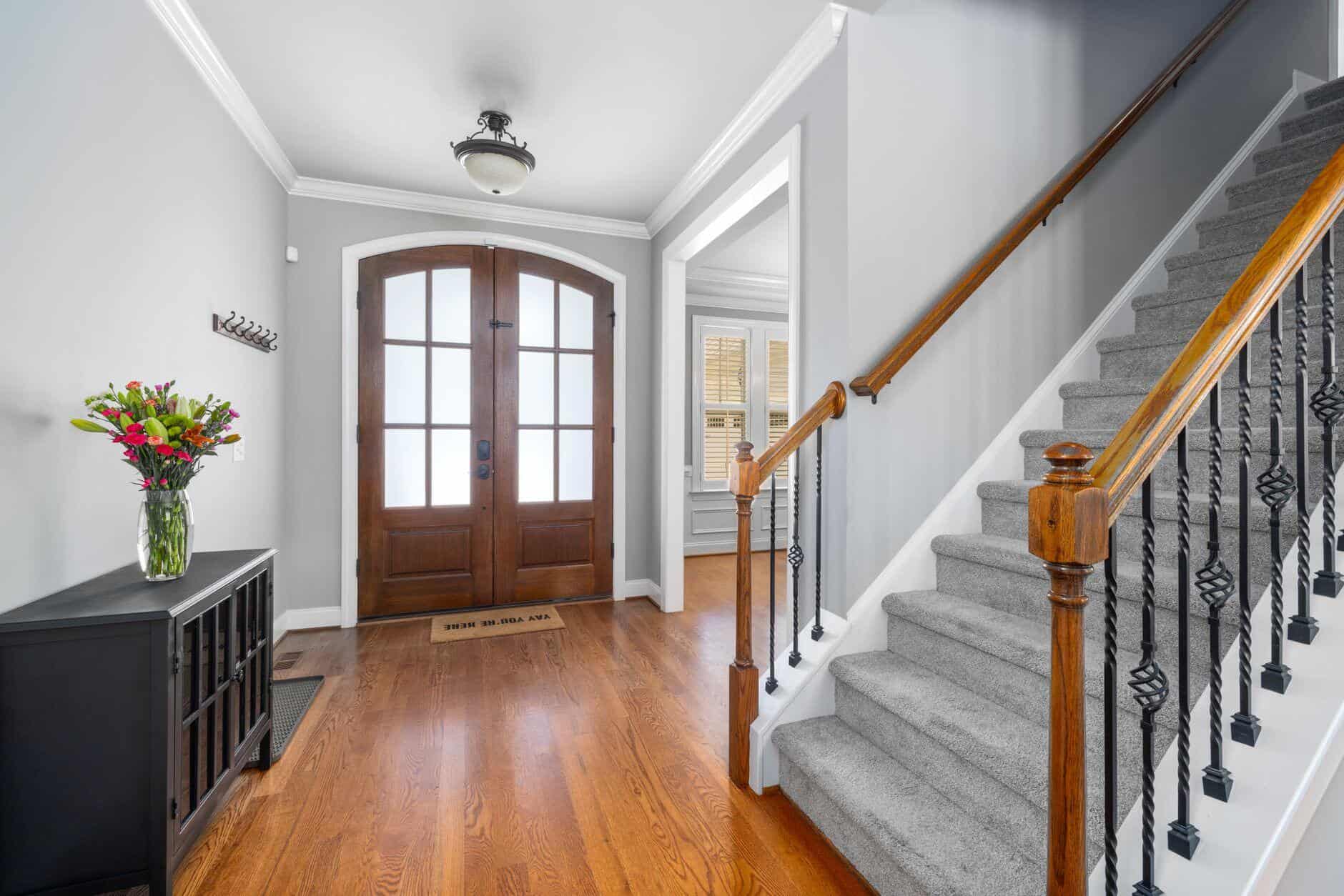
Weatherstripping is mostly about comfort. It stops the cold stripe across the floor, and a room that isn’t drafty is easier to heat.
Does weatherstripping a door save money?
Weatherstripping a door saves some energy, but its biggest payoff is comfort. The Maryland Energy Administration notes that drafts around doors and windows add up to only a small part of a home’s total heat loss. A draft-free room can still save energy indirectly, because you’re less likely to turn up the thermostat to make up for it.
The bigger savings come from treating the whole house. ENERGY STAR’s seal-and-insulate guidance puts the savings from sealing air leaks and adding insulation at up to 10% of annual energy bills. Weatherstripping your doors is the easy first step; the attic is usually where the larger job is.
Mistakes to avoid when weatherstripping a door
- Sticking new tape over old, dirty or crumbling weatherstrip.
- Choosing a seal so thick the door has to be slammed to latch. Snug is right; strained is not.
- Using open-cell foam or felt on an exterior door that gets rain and daily use.
- Leaving gaps at the top corners, where the head and side pieces meet.
- Fitting a sweep so low that it drags hard on the threshold and wears out in a season.
- Ignoring the trim: caulk the seams in and around the frame as part of the same job.
Frequently asked questions
How long does door weatherstripping last?
It depends on the material. Self-stick tapes seal well but don’t last very long, and open-cell foam breaks down fastest. Tension seals, silicone gaskets and rigid strips last longer. Check the seals every fall and replace any that are flattened, cracked or loose.
Should weatherstripping touch the door?
Yes. Weatherstripping only seals when the closed door presses lightly against it. If a strip of paper slides out easily, the seal isn’t touching. If you have to push hard to latch the door, the seal is too thick.
Is foam or felt better for a door?
Closed-cell foam or rubber is better for an exterior door. In tests summarized by the Maryland Energy Administration, reinforced felt let about 250 times more air through than closed-cell foam, inch for inch, and felt doesn’t handle moisture or friction well.
What do you use for the gap at the bottom of a door?
Use a door sweep, a door shoe, or a threshold with a built-in seal. Start by adjusting the threshold cap if your door has one, then add a sweep if a gap remains.
Can you weatherstrip a door without removing it?
Yes. Jamb and head seals, kerf strips and most door sweeps go on with the door in place. A door shoe or a new threshold may need the door taken off its hinges.
The takeaway
Find the leak, match the seal to the gap, and keep the door closing easily. Most drafty doors need fresh jamb seals plus a bottom fix, and five minutes with a strip of paper tells you whether it worked.
Related posts
 Innovative Trim Alternatives: Using a Door Stop Instead of Quarter Round
 How To Stop French Doors Blowing In The Wind
 How to Stop French Doors Slamming
 How to Make Sliding Closet Doors Stop Jumping Off the Track
 The Comprehensive Guide to Painting Door Hinges: Should You Do It?
 Pull Up Bars: The Hidden Threat to Door Frames
 Should You Repair or Replace a Sagging Door?
 How to Keep a Front Door Looking Good in Salt Air