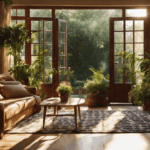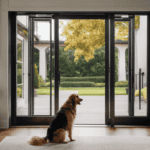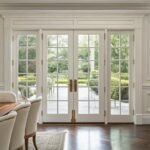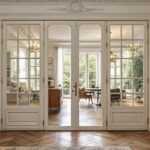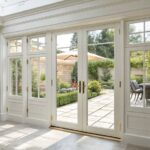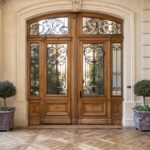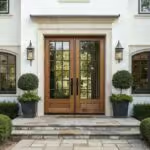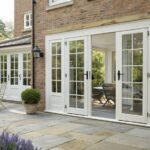
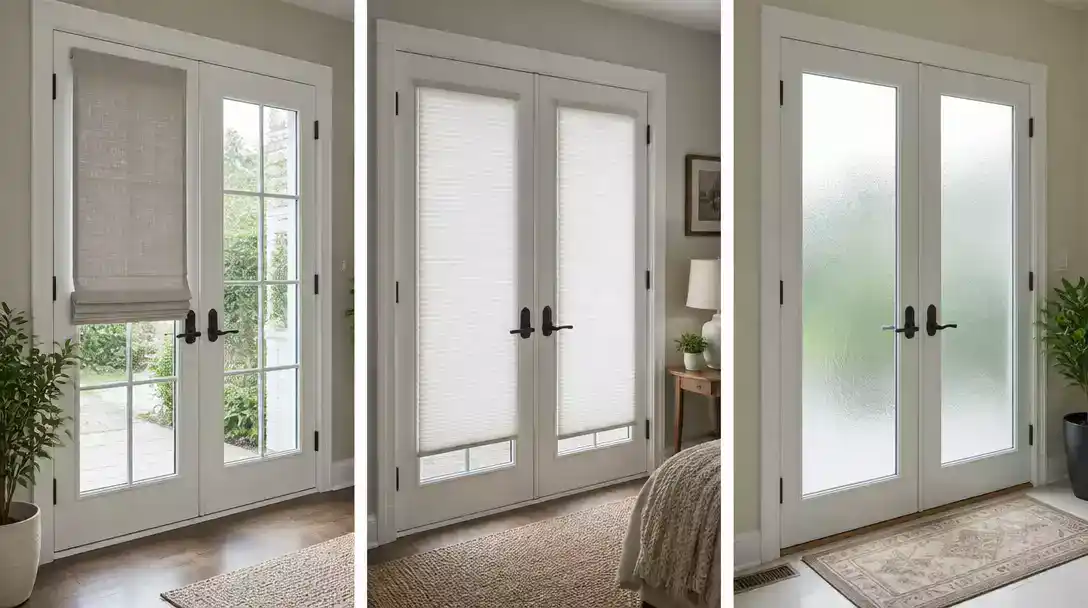
Window covering ideas for French doors need to balance privacy and sun control with shallow frames, projecting hardware, and doors that swing freely. These 17 ideas are worth saving for comparing coverage, light, and style; find a fit for your home, starting with the first option.
Roman shades
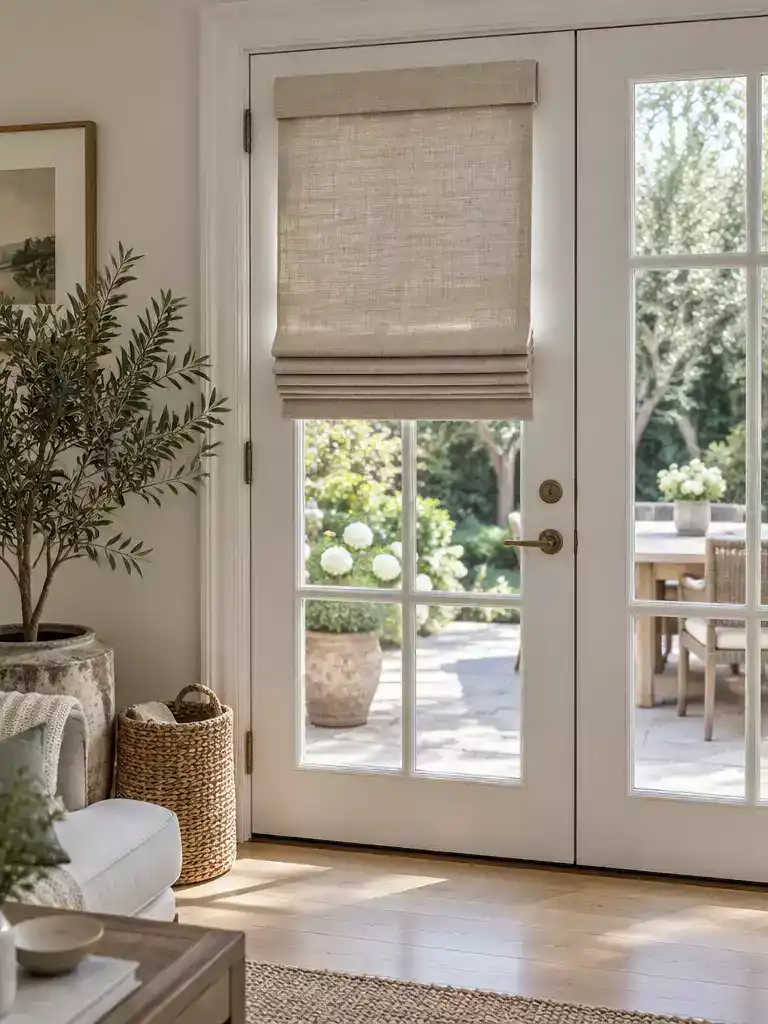
A tailored fabric fold that gives French doors privacy with a soft, structured finish.
As an Amazon Associate I earn from qualifying purchases. Affiliate links may earn me a commission at no extra cost to you.
Roman shades are the fabric-forward pick: chosen because the folded textile is part of the room’s look, not just a way to shut the glass. Lowered, the shade reads as a flat pleated face across the pane; raised, that fabric gathers into a visible stack above it.
That stack is exactly what makes it a door decision rather than a window decision. Folded fabric collects above the glass and projects deeper than a rolled shade, so it can crowd a lever handle, a deadbolt, the casing above the pane, or the arc of the door swing. This is not the lowest-profile option on this list.
Check before you order: mounting-depth requirements differ from model to model, so pull the spec sheet for the exact shade instead of assuming a standard recess will do. A frame or door mount only works when there’s enough depth and the shade still clears the hardware.
Right for you if
Coordinated fabric matters at the entry and the shade can spend most of the day raised without blocking the handle. Think of a dining room or living-room door where the folded stack reads as part of the decor.
Skip it if
You want a compact, near-flush treatment, or the door has barely any clear space above the glass for the raised stack to sit in.
Four things to confirm with the specific shade before it ships:
- The model’s stated mounting-depth requirement, since dependable depth figures vary by product.
- Whether your frame or door face can support a frame or door mount at that depth.
- Clearance between the fully raised shade and the handle, lock, and molding.
- The door’s swing path with the shade in place – no catching, no rattling.
Measure twice: size each door on its own – a pair of French doors is not always identical – and check the shade in its raised position, not only when it hangs closed. The closed fit is the easy half.
💡 Why the Fabric Detail Works
French doors can read as a broad expanse of glass and hard trim. A Roman shade brings a softer surface into that view, helping the doorway feel connected to nearby upholstery, rugs, or other textiles without adding loose curtain panels.
Style takeaway: Echo one fabric tone already in the room for a coordinated look that feels intentional, not overly matched.
Roller Shades
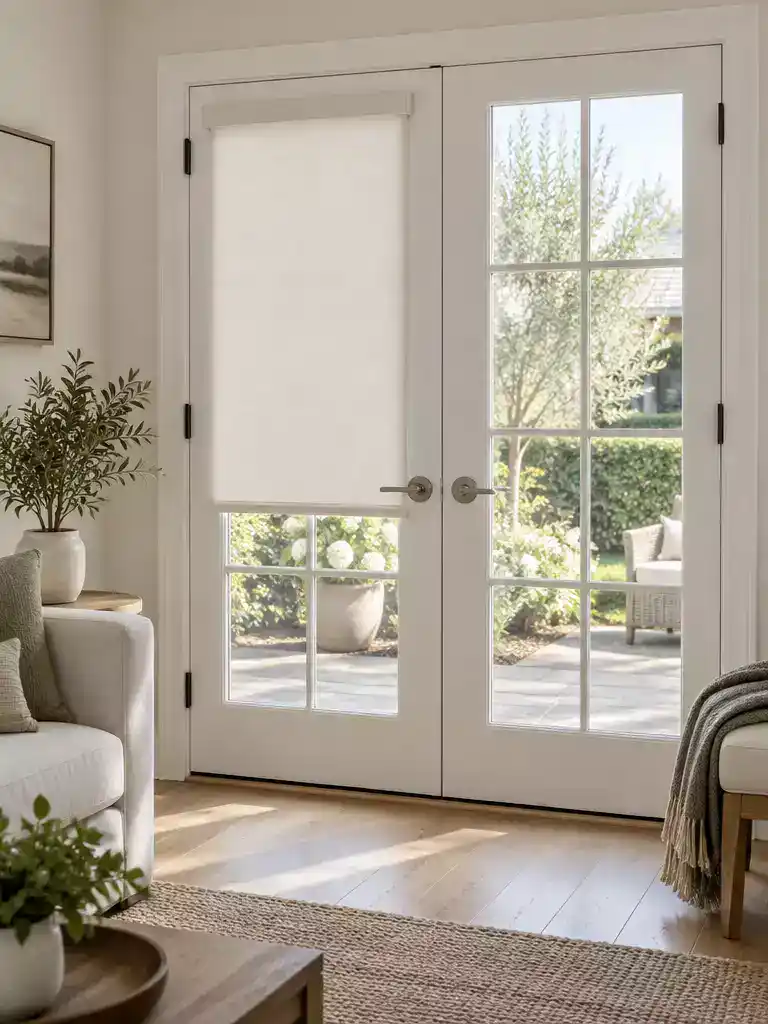
Close-to-door glare control and everyday privacy without cords in the handle path.
A cordless roller shade rides a slim tube near the top of the glass and hugs the door face when it’s down. On a French door you actually open ten times a day, that flat profile is the whole argument – nothing swings, nothing dangles, and the stack above the pane stays compact.
It’s also one of the simpler treatments to live with: pull it down, push it up, done. No folds to stack, no slats to tilt around a lever handle.
Fabric choice changes what you get back. The frame and hardware stay basically the same – opacity is the variable you’re actually shopping.
Room-darkening is not blackout. Unless the specific fabric is rated for it, expect less light coming through – not a dark room.
Check these hostel three things before you order:
- Cassette or headrail depth – measure the recess, because a shallow frame often rules out an inside mount.
- Mounting location – an outside or door-frame mount buys you coverage when the recess is tight, as long as it clears the molding.
- Handle and lock clearance – check the shade in its raised position, plus the full door swing, not just the closed door.
- Measure each door separately; a pair of French doors is rarely identical.
Reported starting cost:
$120–$250 per door for custom manual roller shades before installation, with premium fabrics and hardware running higher. Professional installation typically adds roughly $50–$200+ per door depending on the product and your area.
DIY is realistic here when your measurements are accurate, the mounting depth works out, and the brackets are straightforward – a simple outside-mount layout that avoids the handle is the easy version. For glare control and everyday privacy at a working entry, this is the strongest cost-to-convenience pick in the group.
⭐ Roller Shades Worth Buying
✨ Editor’s Pick
Cordless Outdoor Roller Patio Shade
Roll-Up Shade for Outdoor Patios
💰 Budgeting for a Pair of Doors:
- Two-door starting point: The reported $120–$250 per-door range works out to $240–$500 for a pair, before installation.
- Room to upgrade: Premium fabrics and hardware can raise the total, so compare quotes using the same options.
- Budget by finished setup: Decide which fabric and hardware matter most, then weigh those choices against the complete project quote.
Cellular Shades
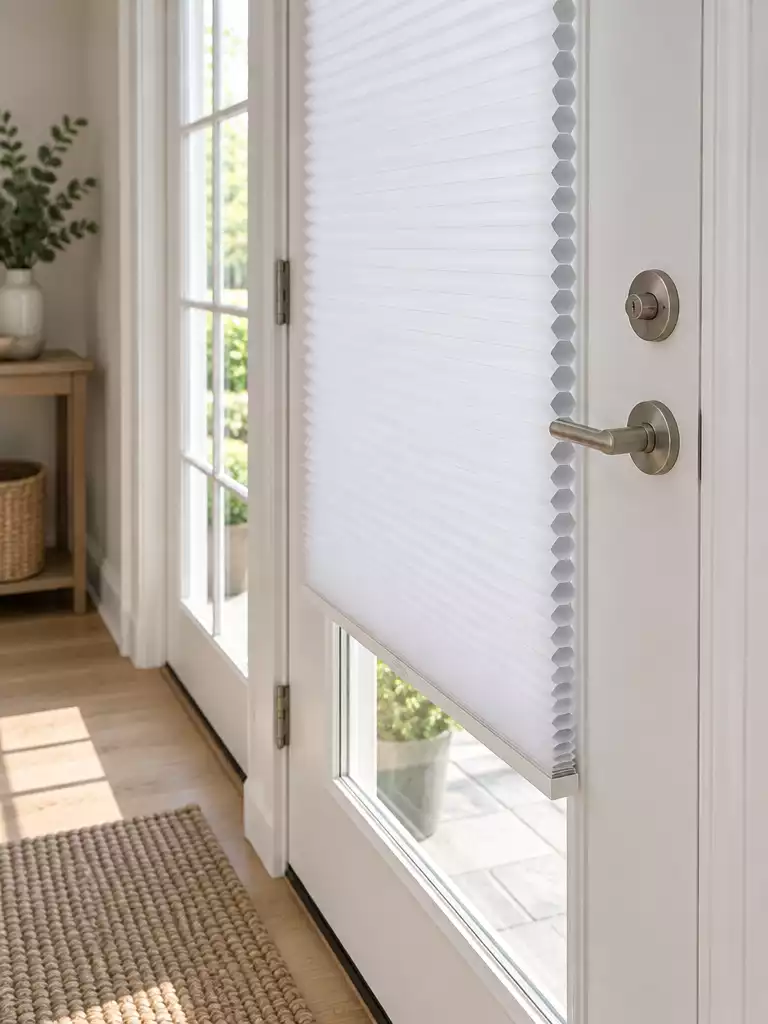
Trapped air pockets turn a cold glass door into a warmer room.
The honeycomb side profile is the whole argument here. Those一刀-cut air pockets trap a layer of still air against the glass, which is why cellular shades are the clearest candidate in this list when a drafty French door needs insulation, not just coverage.
Cordless is the version to look at for a door. Lift cords dangling in front of glass get snagged every time Likely the door swings, and a cordless shade pulled close to the door face stays out of the handle’s path.
Depth is the deal-breaker.
Cited guidance puts common inside-mount needs at about 1–2 inches of clear depth, depending on cell size. Verify the exact product spec rather than treating that range as universal – a slim roller shade can squeeze into a recess a two-cell honeycomb won’t.
Then check the shade in motion, not just at rest. Open and close the door with the shade down: it needs to travel freely without swinging, catching on the molding, or rattling against the glass as the panel moves.
- Measure each door separately – paired doors are rarely identical.
- Confirm the headrail and cell stack clear the lever handle and deadbolt through the full swing.
- Ask whether the frame geometry allows a close-to-door mount, or if an outside mount is the only fit.
- Decide whether an outside mount’s extra coverage offsets the added projection from the door face.
Reported cost: custom honeycomb-style shades start around $120–$250 per door before installation, with premium fabric and hardware running higher. Professional fitting adds roughly $50–$200+ per door depending on the treatment and location.
Take this one if the door runs cold and insulation beats having the slimmest possible profile. Skip it when the frame can’t meet the product’s stated depth requirement – no amount of fabric choice fixes a recess that’s too shallow.
💡 Why Cellular Shades Help With Comfort:
When a French door sits beside a favorite chair or dining spot, chilly glass can make that part of the room less inviting. Cellular shades address comfort at the glazed surface, not simply how much light reaches the floor, making them worth considering where the door-side area gets regular use.
Best match: A room where the area near the door feels uncomfortable and insulation matters more than a minimal profile.
Solar Shades
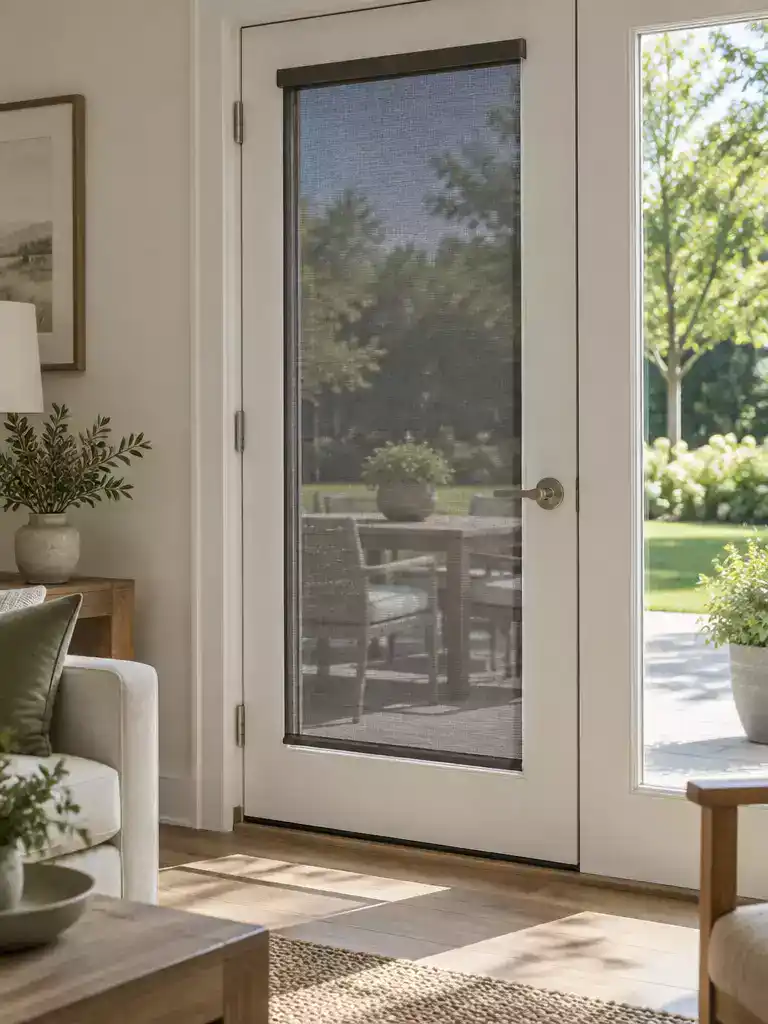
Cut the afternoon glare while the view straight through your glass stays intact.
A solar shade is a fine mesh screen that takes the edge off direct sun while leaving the yard visible through the fabric. On a west-facing French door, that means the 4 p.m. glare drops without turning the glass into a blank panel.
It reads as a minimal fabric screen sitting over the glass – no slats, no gathered folds, no stack of material bunched above the frame. That slim, flat profile is exactly why it’s a realistic candidate for a door that opens and closes all day.
The part most people get wrong: a solar shade is a daylight tool, not a privacy shade.
It manages sun and sightlines from outside during the day. After dark, with your lamps on, it generally does not give you strong privacy.
If the door faces a street or sidewalk and you need concealment at night, plan on a second layer: a privacy film, a curtain panel, or a room-darkening shade that works alongside it.
Check these three things before ordering:
- Mounting depth – confirm the headrail fits your frame, or plan an outside or door-frame mount if the recess is shallow.
- Handle and lock position – the shade needs clear space where the lever, deadbolt, and latch actually sit.
- Door movement – open and close the door with the shade down and check it stays controlled instead of swinging or catching.
No dependable French-door-specific price figure exists for this treatment, so collect quotes for the exact fabric and hardware you’re considering rather than budgeting from a guess.
Right for: a sunny room where keeping the daytime view matters more than hiding the glass after dark.
Skip it if: the door is street-facing and needs privacy once the lights come on – that’s a job for an opaque shade or a privacy film.
🔢 Plan the Day-and-Night Setup:
Thinking through how you’ll use the door at different times helps you avoid asking one treatment to solve two different needs.
- Decide whether you’ll usually keep the solar shade lowered during sunny hours or raise it for a clearer view.
- Check the door’s nighttime sightline from outside with your usual interior lights on.
- If you want concealment, choose a separately operated privacy layer so it can close without changing your daytime setup.
French-door coverings ask you to choose what matters most in everyday use: a clear daytime view, privacy after dark, softer glare, or better insulation. Seeing that priority clearly can narrow the field; these French-door privacy ideas offer another way to think through the balance without treating one option as perfect in every setting. Handle clearance and mounting depth then help confirm which candidates make practical sense, rather than deciding by appearance alone.
You don’t need an answer that wins on every measure; one that fits your main need and door geometry is enough.
Woven Wood Shades
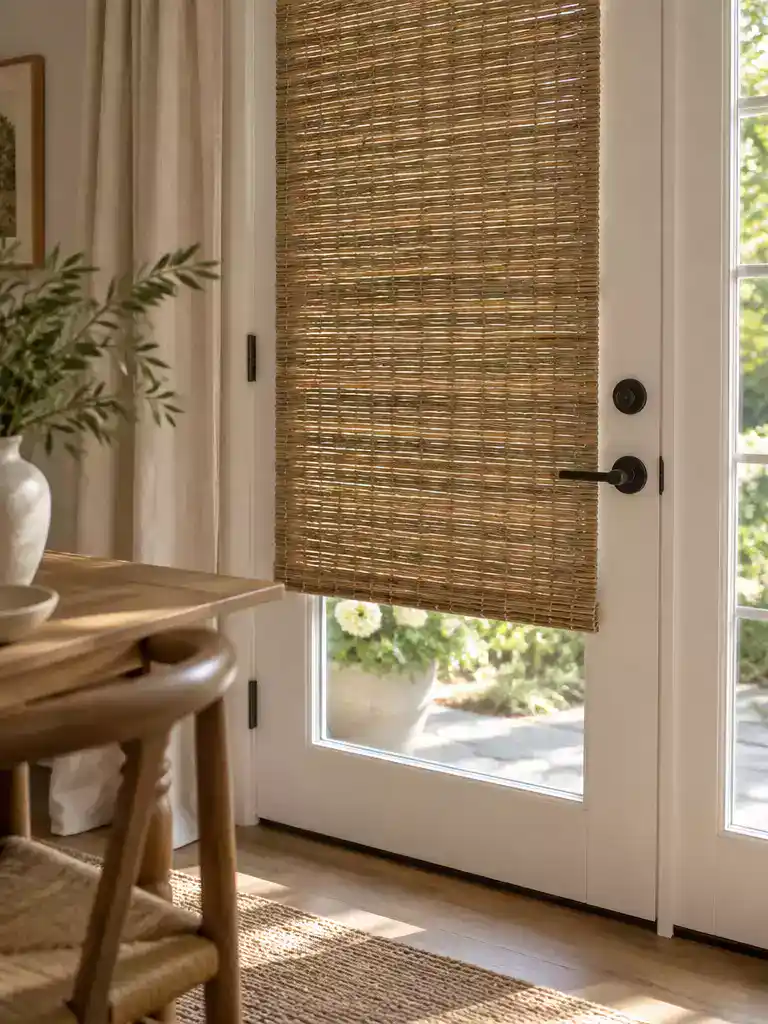
Natural texture and filtered daylight for doors where the weave matters most.
Woven wood shades put an actual material on the glass – cane-, grass-, or reed-like strands laid horizontally, with small tonal shifts from one strand to the next. On a French door, that pattern becomes the room’s main texture rather than a flat plane of fabric.
The same construction is the catch. Strands never knit together tightly enough to fully block light or sightlines, so daylight comes through in fine slivers and shapes on the other side can read through the weave.
Privacy reality check:
Gaps in the weave admit light and partial visibility, so this is less precise for privacy than an opaque shade. Don’t count on it for nighttime concealment without a tested liner or a written product specification that says otherwise.
Order a material sample before you commit, then hold it against the actual door at two very different moments: bright daylight from outside, and warm room lighting after dark with the lights on inside. How much of the yard you can still make out at night tells you whether the weave level is acceptable.
Where this pays off – and where it doesn’t
- Good fit: a room where tactile texture and softly filtered daylight matter more than a fully obscured view.
- Skip it: any door where passersby must not see through the glass – pick an opaque shade instead.
- Check first: the exact product’s depth and mounting requirements, plus clearance from the handle, lock, and door swing.
- No fixed numbers: dependable French-door-specific figures for depth, cost, and lifespan aren’t available, so verify all three against the product’s own spec sheet.
Like the other shade styles here, the weave’s raised stack and headrail still take up space near the top of the door, so confirm the shade clears the handle when it’s rolled up and doesn’t catch as the panel swings. Measure each door separately – a pair of French doors rarely matches to the millimeter.
Bottom line: choose woven wood when the material itself is the point. If the room needs the view sealed off after sunset, an opaque roller or blackout treatment is the honest answer.
💡 Let the Weave Set the Palette:
Because the strands already bring plenty of visual character, keep nearby patterns quieter so the door feels considered rather than busy. For a connected look, echo one of the weave’s natural tones in a nearby basket, rug, or cushion; the match can be subtle, not exact.
Venetian Blinds
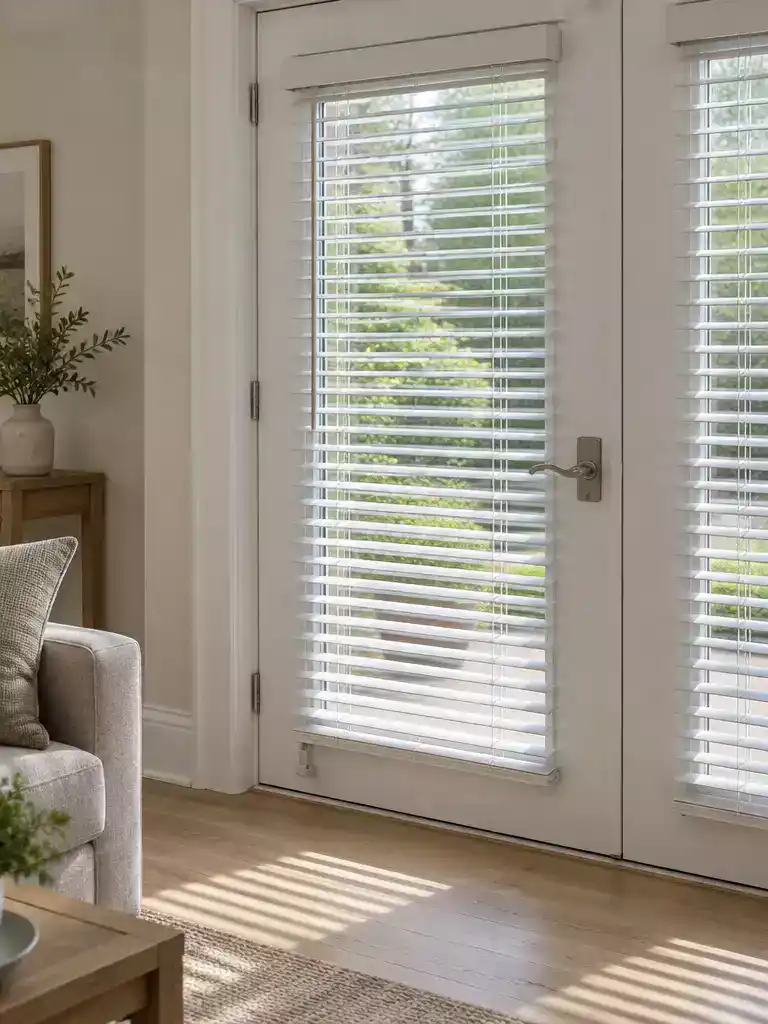
Angle the slats to steer light and sightlines without lifting a thing.
Venetian blinds put a row of tiltable slats right across the door glass, and that tilt is the whole argument for them. You angle the slats to bounce light up at the ceiling or cut a glare line, then adjust how much of the street you can see – all without raising the blind an inch.
This is the pick for a French door where you want visibility you can tune throughout the day rather than a shade that is either open or closed. Roller and cellular shades give you two states; slats give you a continuous range.
Now the door-specific part. A lever handle that projects into the slat field can physically block the tilt path, and a blind sitting too proud of the door face can catch the handle or deadbolt the moment the door swings.
Watch the handle arc.
Mark where the handle travels as the door opens and closes, then tilt the slats both directions before you commit to a mount position. A blind that clears the glass but fouls the lever is a blind you will regret.
French-door installs here usually go one of three routes: an outside mount, a door-frame mount, or a frame mount with a special handle cutout. Hold-down hardware at the bottom keeps the slats from rattling as the door moves.
- Check molding width and projection first. The molding has to be wide enough to carry the brackets you plan to use.
- Confirm frame depth if you are considering an inside mount; shallow French-door frames often cannot take it.
- Tilt the slats fully in both directions at the height where the handle sits, not just at the top of the blind.
- Open and close the door with the blind in its intended position and watch for collision, catching, or rattle.
- Decide on a cutout early – it changes bracket placement and cannot be added after the blind is hung.
Who installs this
DIY works when the fit is straightforward, the clearance is generous, and the brackets screw into sound molding. Bring in a pro for measuring when a custom cutout, a tight margin, or projecting hardware is involved.
Skip Venetian blinds if the lever handle sits squarely in the middle of the glass or the door has almost no clearance to the side – that is where a low-profile roller shade will save you the headache. Choose them when you want to change the view and the light without leaving your seat.
⭐ Venetian Blinds Worth Considering
✨ Editor’s Pick
Cordless Vinyl French Door Blinds
Aluminum Horizontal Venetian Mini Blinds
💡 A More Unified Look
On a pair of French doors, matching the slat angle across both panels helps the glass read as one considered treatment, rather than two separate blinds. You can still adjust the angle as the light shifts, without the sharp open-versus-closed contrast of a raised shade. That balance works especially well when the doors are a focal point.
Styling tip: Start with both blinds at a shared angle, then adjust them together when you want the room to feel visually calm.
Faux Wood Blinds
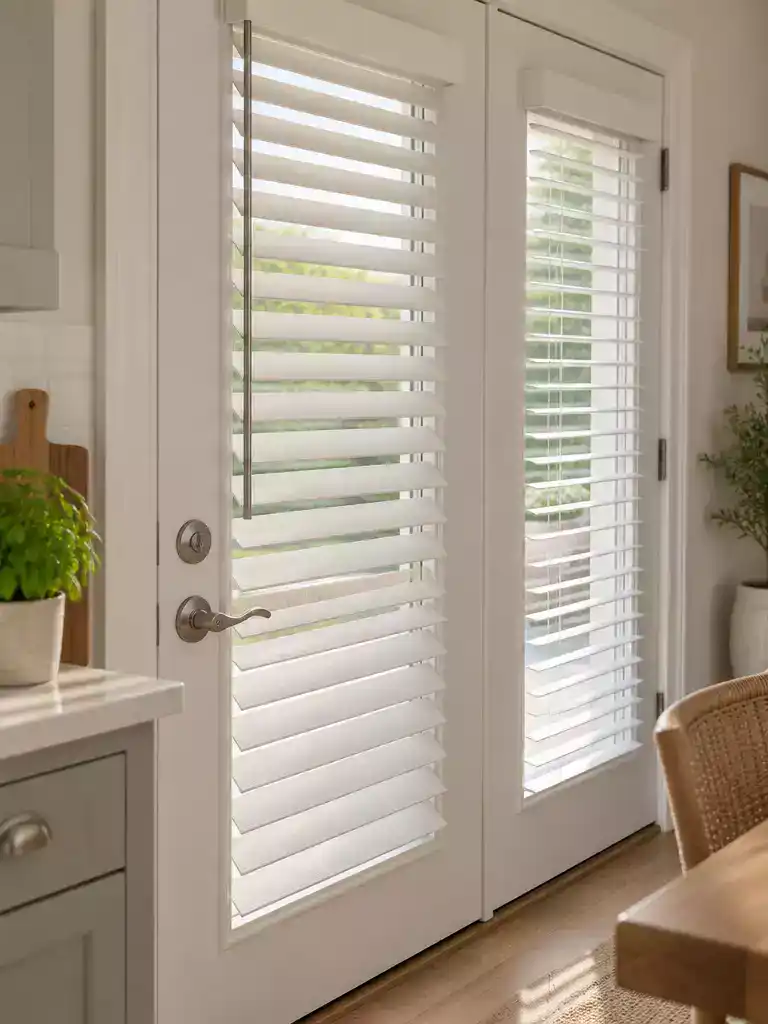
A wood-look slat with the practical side of a synthetic material.
Faux wood blinds are the wood-look pick for a door where moisture is part of the deal – a kitchen entry, a bath-adjacent hallway, a French door that opens onto a humid patio. The slats read like painted timber, but they’re a synthetic composite, and that’s exactly why people swap real wood out for them here.
The research doesn’t quantify how much more moisture-resistant these are than real wood, and neither should you assume a specific number. Compare the finish and construction listed for the exact product if dampness is your main worry, because some faux wood formulations hold up better than others.
What the material choice buys you on a door is also what it costs you. The same slat stack, tilt range, and headrail projection that makes a wood-look blind look substantial also take up real space near your handles and deadbolt.
The door-specific test: the blind has to stay clear of the handle and lock in two separate states – while the slats are tilted in both directions, and while the door itself is moving. A blind that looks fine closed can still jam a lever when the door swings toward it.
Before you order, measure molding width and mounting depth and mark where the handle and deadbolt actually project relative to the glass. Check each door separately – a pair of French doors can differ more than you’d expect.
That check matters more than usual here, because the wood-like finish is the whole reason to choose this option. If the slat stack crowds the hardware, the material decision stops paying off.
Right for: doorways where a wood-like appearance and a moisture-conscious material choice both count – a kitchen entry, a utility door, a damp-adjacent hallway. Skip it where the slat stack or tilt path would crowd the handle, lock, or door swing.
✨ Small Details That Pull the Look Together:
Once the fit is settled, a restrained finish around the blinds helps their slatted texture feel intentional rather than visually busy on the door.
- Color relationship: Match the blind to the door trim for a quieter look, or echo its tone elsewhere.
- Hardware harmony: Let nearby metal finishes complement the slats without competing for attention around the door.
Plantation Shutters
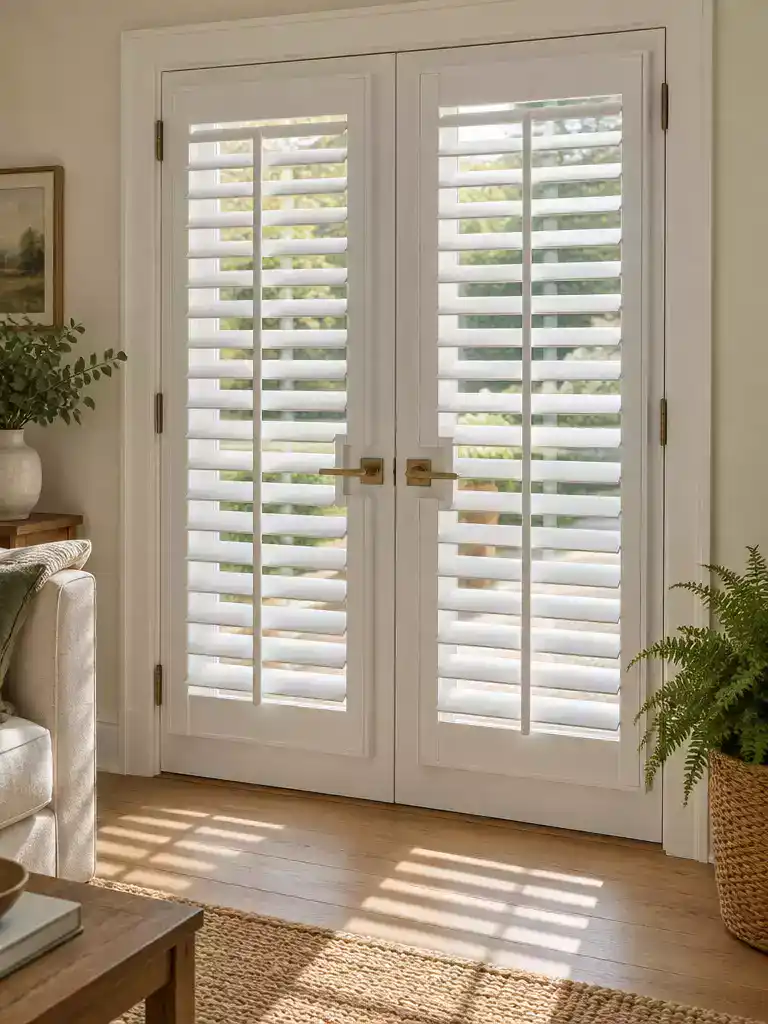
A framed louvered panel that makes the door itself part of the room’s design.
Plantation shutters are a framed, louvered assembly fitted straight onto the door, so the frame and hinged panels read as part of the door’s joinery instead of something hung above the glass. Tilt the louvers to steer light and sightlines up or down without raising anything – there is no fabric stack to plan around.
This is the most architectural treatment on the list, and that is exactly why the fitting matters. The frame is built around hardware that will not move, so a small measurement error shows up as a panel that will not close or a louver that will not turn.
Measure the door, not just the glass
- Molding width and projection. The molding has to be wide enough to support the shutter frame – narrow or decorative trim often is not.
- Handle and deadbolt position. Projecting hardware usually calls for a custom cutout, planned either centered on the handle or between the handle and deadbolt.
- Swing clearance. Hinged panels must clear locks as they open, and both doors still need to swing freely once the frame is in place.
Cost note: Reported custom plantation shutters run roughly $800–$2,500 per door, a source-specific estimate and one of the highest figures in this list. Budget for professional fitting on top of the panels themselves.
Right for: homeowners who want a built-in finish with adjustable privacy, and who are comfortable paying more for a treatment that stays part of the door’s look year-round.
Skip it if: the molding is too narrow to carry the frame, the hardware projection leaves no room for a cutout, or the budget needs to stay closer to the $120–$250 shade range.
Pro tip: Book professional measurement and installation for shutters. Narrow or decorative molding, projecting hardware, irregular doors, and cutouts are all cases where a millimeter-scale mistake is expensive to fix.
💡 Make the Shutter Finish Feel Intentional:
Before settling on a finish, compare a sample beside the door and surrounding trim in daylight. A close match helps the shutters blend into the joinery; a deliberate contrast makes the louvers a stronger feature. If the nearby room has prominent wood tones or painted millwork, consider how the shutter color will relate to both.
Café Curtains
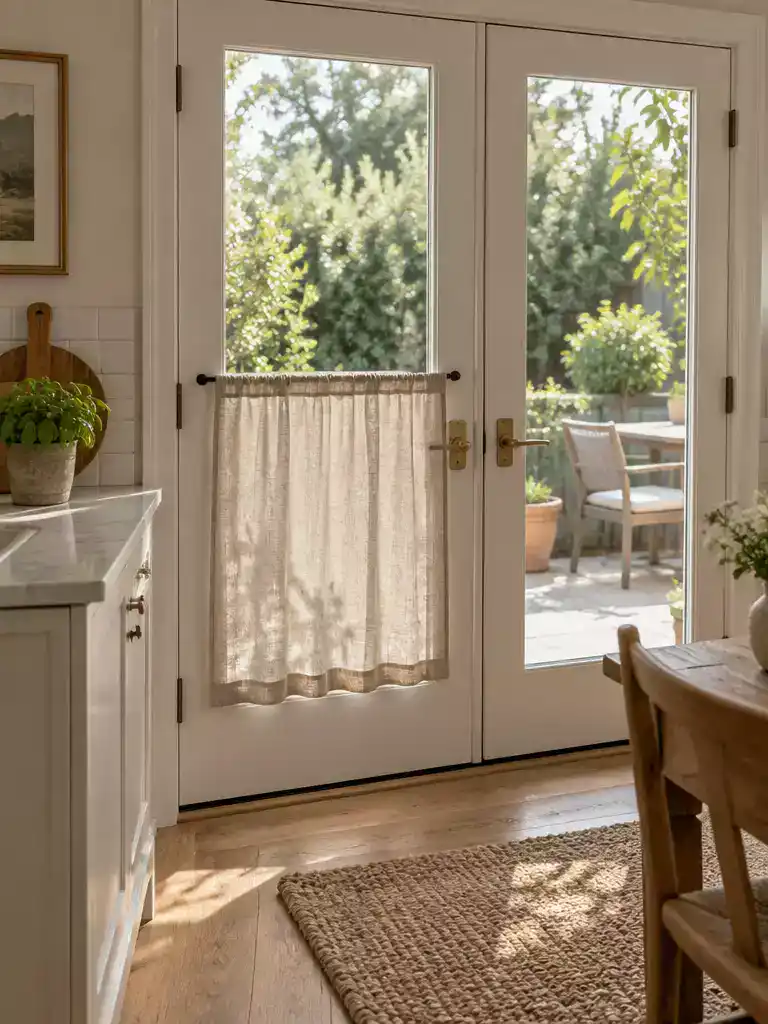
Soft fabric low on the glass, daylight open to the sky above.
A café curtain covers only part of the glazed area and leaves the rest of the pane exposed. It reads as a fabric accent first and a privacy measure second, which is exactly why it works on a French door where covering the entire panel would fight the glass.
Picture the scene clearly: a narrow linen panel hung across the lower section of one door, with morning light pouring through the uncovered glass above it. That open upper pane keeps the room feeling connected to the outside instead of boxed in.
Here is the tradeoff, stated plainly. Partial coverage means partial privacy – a lower panel can screen a seated sightline while still leaving the upper glass, and everything beyond it, fully visible from outside.
Privacy reality check. A café curtain cannot promise concealment at every viewing angle, and it offers no security benefit once the fabric is down. If passersby must not see into the room, this treatment is the wrong tool.
Decide which section of the glass you are actually trying to cover before you buy anything. A panel across the lower pane screens a seated view; a panel across the upper pane handles low-angle sightlines instead – and one does not substitute for the other.
Placement of the curtain and its hardware is the whole ballgame on a moving door. Position them so nothing catches the frame, the lock, or the swing path, and check the door with the panel in place while it opens and closes.
Right for you if: partial screening plus a fabric detail is genuinely enough, and you want daylight and the view to remain the main event.
Wrong choice if: the entire glazed panel needs privacy, or the door needs to stay dark at night – a full-length shade or a film on the glass will serve you better.
One caution on sourcing: the available guidance does not establish dependable French-door-specific installation specs for café curtains. Treat any measurement advice you find elsewhere as general, and verify it against your own doors, handles, and swing before hanging anything.
⭐ French Door Sheers We Love
✨ Editor’s Pick
Semi-Sheer French Door Curtain Panels
💡 Why This Can Feel So Light:
A café curtain gives the doorway a softer, lived-in finish without turning the glazed doors into a wall of fabric. That lighter visual weight can be especially welcome when nearby upholstery, rugs, or cushions already bring plenty of pattern into the room.
Style takeaway: Echo a color from nearby textiles, but keep the curtain’s pattern quiet enough for the glass to remain a feature.
Sheer Door Panels
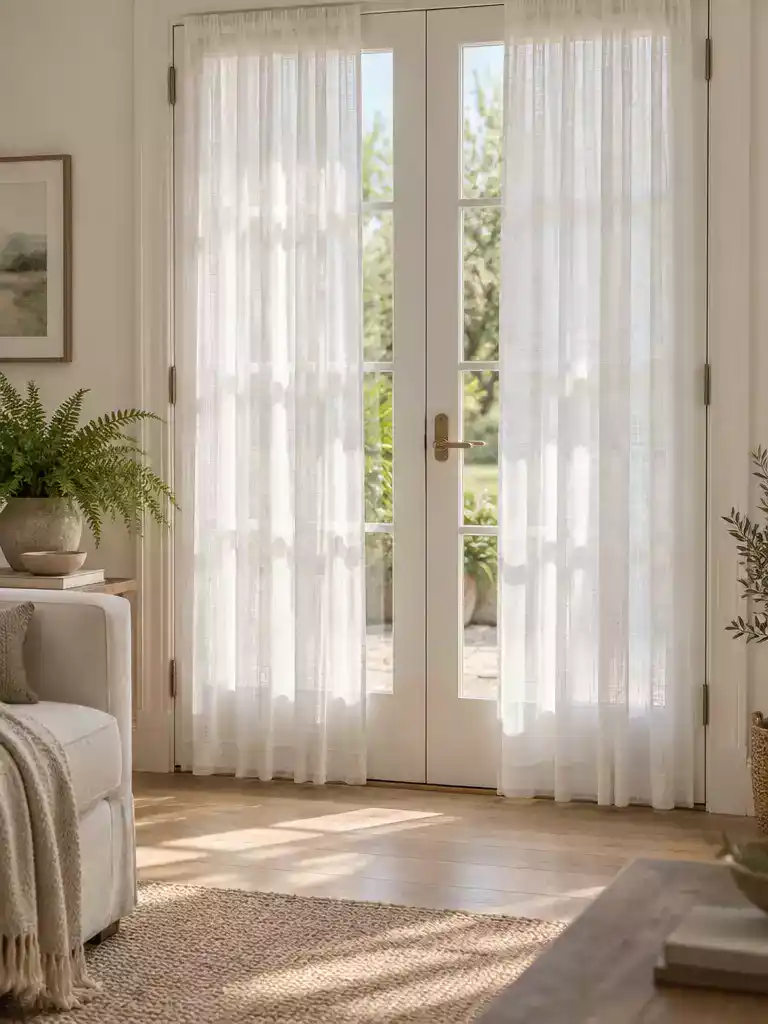
Soft daylight and an airy feel with full-length sheer panels.
A sheer door panel is a full-length translucent sheet of fabric hanging across the entire glazed door – the opposite of a café curtain, which stops partway down and leaves glass exposed. It reads as one continuous soft veil over the whole panel.
The point of a sheer is daylight. It takes the glare out of direct sun and softens the view outside while keeping the room feeling open instead of closed in.
Privacy, straight: sheers give modest concealment at best. In daylight they soften sightlines; once it’s dark inside and lit outside, shapes and movement are still visible through the fabric.
Loose fabric is the real trouble on an active door – panels drift, catch on hardware, or swing along with the door as it moves. Run this check before you commit:
- Set the panel at its intended length, then swing the door fully open and closed and watch where the fabric lands each time.
- Look for contact with the handle, lock, and deadbolt in both positions – a panel clear when shut can still snag when open.
- Note where the hanging hardware sits relative to the door edge and molding, since that determines whether the panel can move at all.
Test before finalizing. Open the door all the way with the panel hanging and check the fabric’s position again – length and hardware placement have to work in motion, not just with the door shut.
Sheer panels suit a sheltered entry where atmosphere outranks concealment: a garden-facing door, a quiet patio door, an interior-facing glazed door. The look and the light are the whole appeal there.
A street-facing door that needs actual privacy is a poor fit for this treatment. Point that door toward opaque blackout panels or frosted privacy film instead.
⭐ Sheer Door Panels Worth Seeing
✨ Editor’s Pick
Vintage Lace Curtains 80 inch Length 2 Panles for Doorway
Achart Macrame Curtains Macrame Valance Doorway Window Curtain Panels
🔢 Choose the Look in the Right Order:
A sheer is an atmosphere-first choice, so decide how it should relate to the room before settling on fabric and hardware.
- Choose a tone that relates to nearby textiles or wall color; it needn’t match the door.
- View a fabric sample against the glass in daylight and under room lighting before choosing.
- Then select a hanging style that feels in scale with the doorway and surrounding decor.
Blackout Panels
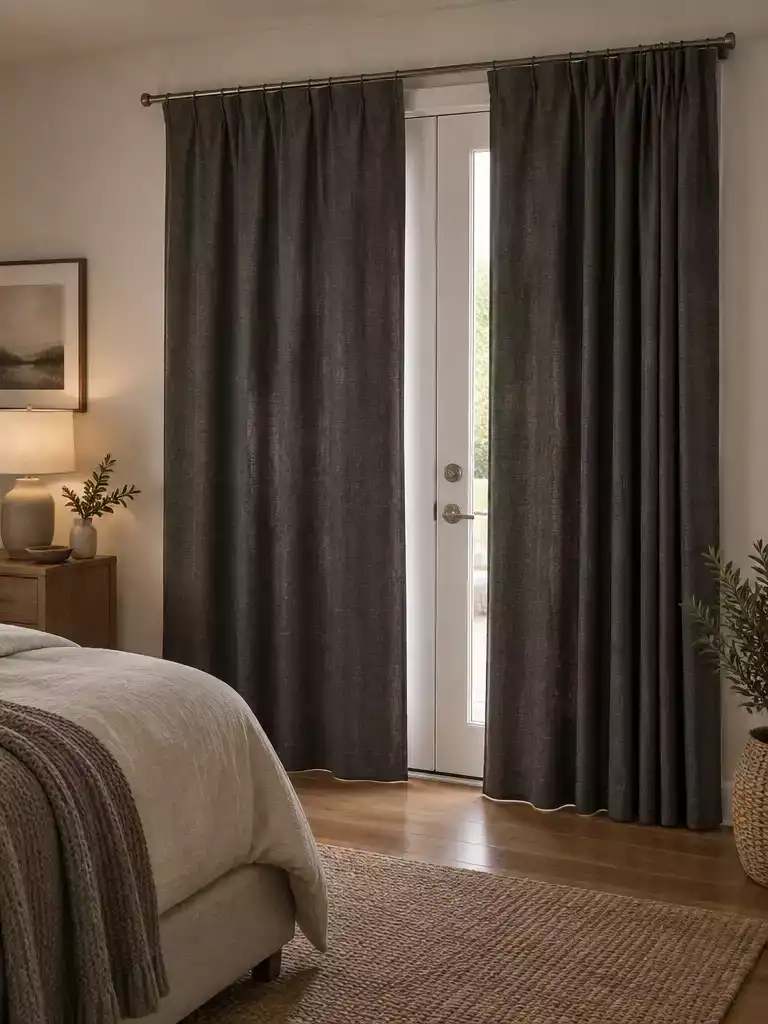
Trade the glass view for real darkness and full-strength privacy.
Blackout panels are the heaviest treatment on this list: full-length fabric panels hung across the glazed doors and drawn closed when you want the room dark. They suit a bedroom, a nursery, or a media room – anywhere concealment and darkness outrank showing off the glass.
The tradeoff is the glass itself. Once those panels are closed, the doors stop working as a daylight feature: no view out, no sun coming through, just a fabric wall.
No panel guarantees total darkness.
How dark it actually gets depends on the fabric, the panel width, and how completely the panels cover the glass and edges – skip any product that promises a fixed blackout percentage without you seeing it first.
Door-specific sizing is where panels succeed or fail. The panels have to bypass projecting handles, locks, and deadbolts, and the stacked fabric at each side must clear the door, the adjacent wall, and the hardware when everything is in motion.
Run these checks before brighter ordering – each one catches a different problem:
- Close the panels fully and confirm they cover the entire glass opening without a bright gap down the middle.
- Gather them to the sides and check the stack doesn’t collide with the handle, the lock, or the wall beside the door.
- Swing each door fully open and closed, watching for fabric that catches, drags, or blocks your grip on the handle.
- Measure each door separately – a paired set can differ enough that one panel bunches while the other falls short.
Right for: a bedroom or dark-wanted room where privacy and sleep win over an open-glass look, and there’s wall space beside the doors for the stacked panels.
Skip if: you want the French doors to read as a bright, view-facing feature, or the hardware and wall geometry leave no room for a panel stack.
⭐ Blackout Panels That Darken Doors
Wide Blackout Room Divider Curtain Panel
✨ Editor’s Pick
Extra Wide Linen Look Blackout Panel
Extra Wide Sliding Door Blackout Curtain
💡 Why Panels Work for Changing Routines:
Unlike a fixed treatment on the glass, panels let you change the room’s privacy as the day shifts: close them when you want concealment, then draw them aside to bring back the French doors’ view. That flexibility can be useful in bedrooms that serve more than one purpose.
Best fit: Choose panels when privacy needs change throughout the day, rather than staying constant.
Tie-Up Shades
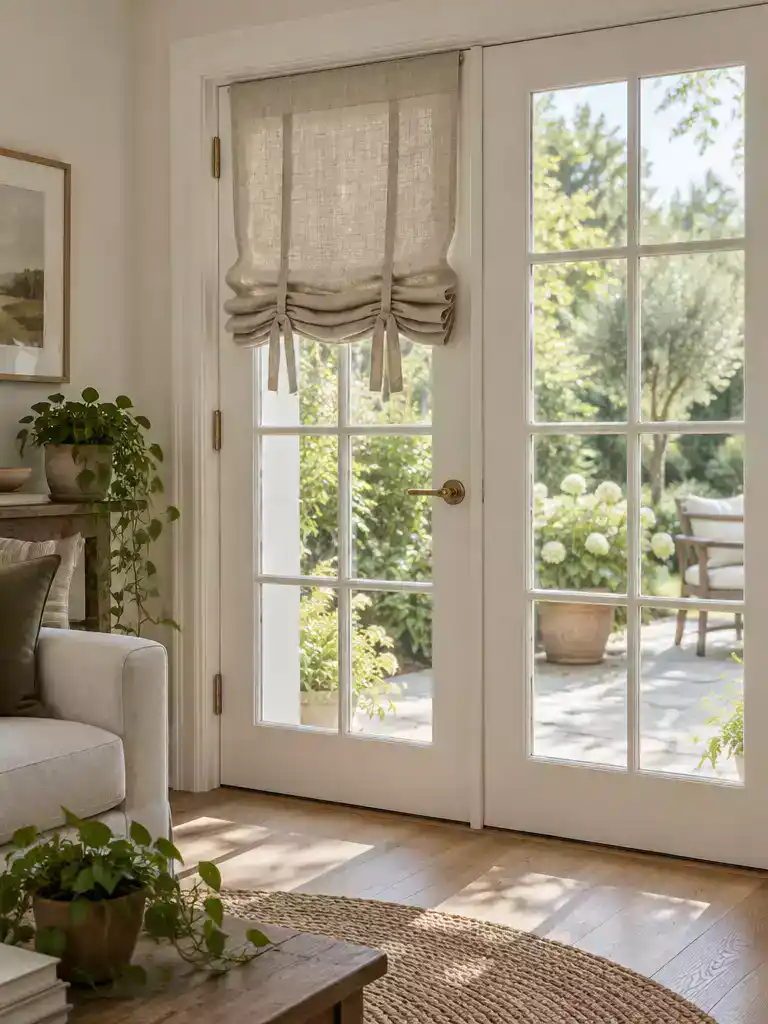
A gathered roll of fabric turns door glass into a soft, casual focal point.
A tie-up shade is a flat panel of fabric raised by straps that tie at intervals, so the material bunches into a soft roll and holds there. On a French door, that bunching is the point – the shade reads as a textile feature, not a compact roll tucked against the frame.
Coverage is where it gives ground. Gathered fabric leaves more variation at the edges than a shade that rolls up evenly, so privacy and light control are less consistent than with roller or cellular shades.
The raised position is the real test – not the closed one.
- Tie the shade fully up, then check the bunched fabric and the strap tails against the handle, lock, and upper door.
- Open and close the door with the shade tied. Watch for loose ends or fabric edges catching the frame or adjacent wall.
- Confirm the gathered bulk doesn’t sit where your hand reaches for the handle.
Good fit: a casual, fabric-forward room where the shade’s look matters more than precise coverage, and the door stays usable with the shade tied up.
Skip it: when you need dependable privacy or a close-to-glass profile – gathered fabric and hanging ties fight both.
Product-specific durability figures and required mounting depth aren’t available for tie-up shades, so confirm those details with the exact seller before ordering.
⭐ Tie-Up Shades to Consider
✨ Editor’s Pick
Tie-Back Blackout French Door Curtain
Tie-Up Blackout Door Window Shade
🔢 Choose the Fabric in This Order:
A tie-up shade changes its look as fabric gathers, so judge the material in context before settling on a pattern or color.
- Start with a fabric swatch beside the door trim and the room’s nearby textiles.
- Compare solid colors and patterns against the door’s existing visual details, not in isolation.
- Choose a fabric that still feels balanced when gathered, as well as when spread across the glass.
Magnetic Door Shades
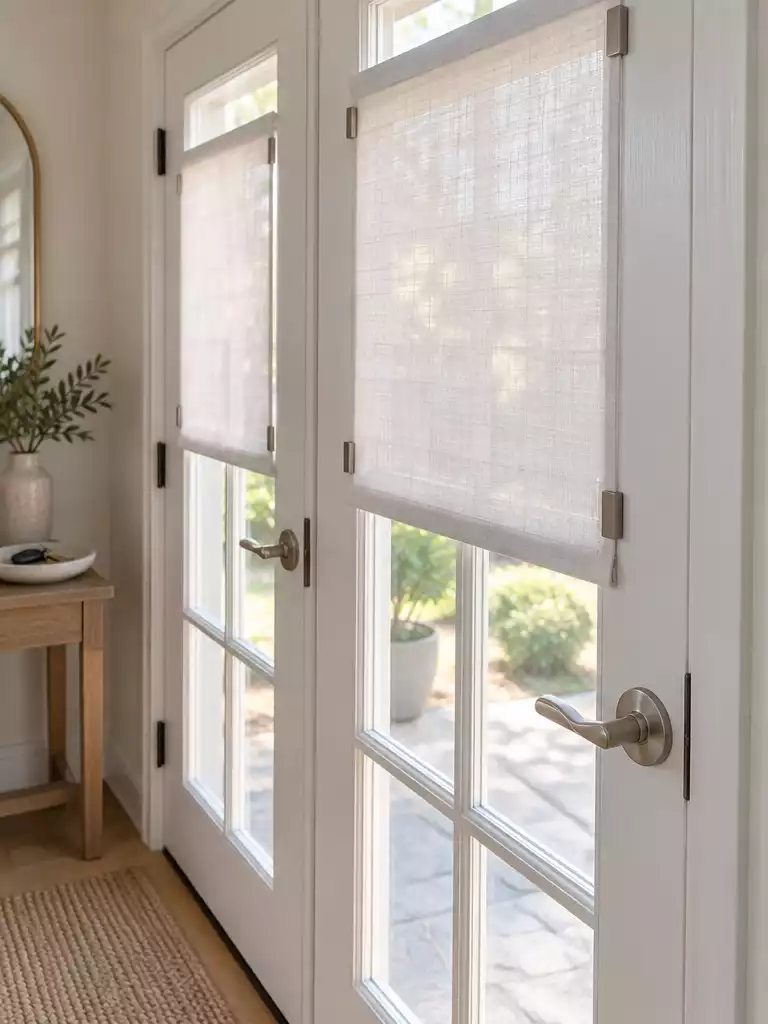
A no-drill shade that hugs the door and skips brackets entirely.
Magnetic door shades are the lightweight retrofit of this list: a shade that grips the door surface with magnets instead of brackets, screws, or a headrail screwed into the frame. For a French door where the frame is too shallow to accept any conventional treatment, that’s the whole appeal – it sits close to the door and installs without drilling.
It’s worth saying plainly that magnetic attachment only works where the product is designed for it and where your door surface cooperates. Confirm the door itself supports magnetic hold – some painted or composite surfaces and non-ferrous trims won’t grab – and check that the magnets stay put through repeated opening and closing rather than creeping with each pull.
Stability is the one test that decides this purchase. A shade that shifts, peels away at a corner, rattles, or slides a centimetre into the lever handle’s path is worse than no shade at all, because it fails while the door is moving.
- Ask the seller directly how the specific product is secured and whether it is intended for active, frequently opened doors – not just stationary windows.
- Confirm the magnets contact a surface they can actually grip on your door frame or panel.
- Open and close the door several times with the shade installed and watch for creeping, sliding into the handle arc, or edge lift.
- Check that the shade stays clear of the lock and deadbolt throw when the door is latched.
Honest gap: dependable French-door-specific figures for performance, price, and lifespan simply aren’t available.
Treat any longevity or savings claim you see in a listing as unverified, and let your own door test decide.
Consider a magnetic shade when a low-profile, no-drill retrofit is exactly what you want and you can verify the attachment method before buying. It’s a poor bet as a proven solution for every French door – where the door face won’t hold magnets or the shade can’t stay out of the handle’s path, a film or a bracketed low-profile shade is the steadier call.
⭐ Magnetic Door Shades to Consider
✨ Editor’s Pick
Magnetic Folding Doorway Curtain Panel
💡 Why the Attachment Method Matters:
A magnetic shade makes most sense when drilling or fitting conventional brackets is the obstacle – not simply because the product looks easy to install. If your door can accept a standard low-profile mount, compare both approaches before choosing; the magnetic option depends on a compatible door surface and a hold that remains reliable in daily use.
Best reason to choose it: Avoiding conventional mounting is valuable enough to justify checking this product’s attachment carefully.
Between-Glass Blinds
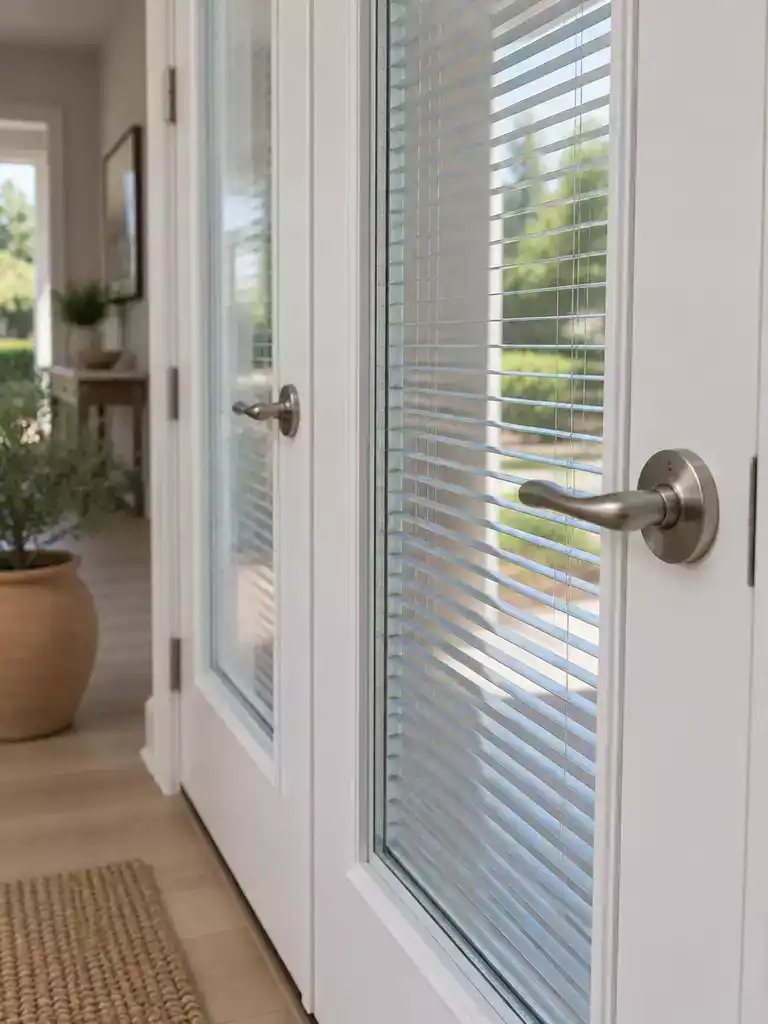
Slats sealed inside the glass, with nothing to dust or snag outside.
Between-glass blinds put the slats inside the sealed insulated glass unit, sandwiched between the two panes. There’s no headrail on the frame, no lift cord dangling near the lever handle, and nothing projecting into the door’s swing.
The appeal is everyday convenience: the slats stay protected from dust and fingerprints, and the door face stays completely clear. You get adjustable light and privacy without adding any surface-mounted hardware to the panel.
This is a glazing feature, not a covering. Between-glass blinds change the glass assembly itself, so they belong in a new-door or glass-replacement conversation – not a Saturday retrofit on the panel you already own.
That distinction matters more than anything else on this list. The magnetic shade before it sits on the door surface; this one is manufactured into the pane, so it can’t be added to an existing glazed panel as a treatment.
Because the blind is part of the unit, ask the supplier these questions before you order:
- Which configurations and slat sizes are offered for French-door glass, and what operation method is used.
- Whether the unit is rated for doors that open and close daily, including the handle-side panel.
- What the warranty and service terms cover if the sealed unit or the internal mechanism ever fails.
- Lead times – this is a manufactured glazing item, not something that ships from a shade retailer.
No dependable retrofit prices or lifespan figures are available for this option, so compare quotes from the door or glass supplier directly rather than budgeting from shade pricing.
Who it suits: anyone already ordering new French doors or replacing an insulated glass unit who wants adjustable slats with zero surface hardware. If your doors are staying as they are, a film or a surface-mounted shade is the realistic path.
🔢 Plan the Glazing Choice in Order:
The project scope determines whether this integrated option is possible, so settle that before choosing a covering.
- Decide whether the project involves new doors, replacement glass units, or keeping the existing glazing.
- If the glass is changing, compare the supplier’s integrated-blind options with surface-mounted shades or film.
- Choose the glazing route before finalizing the door or glass order, rather than planning this as a later add-on.
Frosted Privacy Film
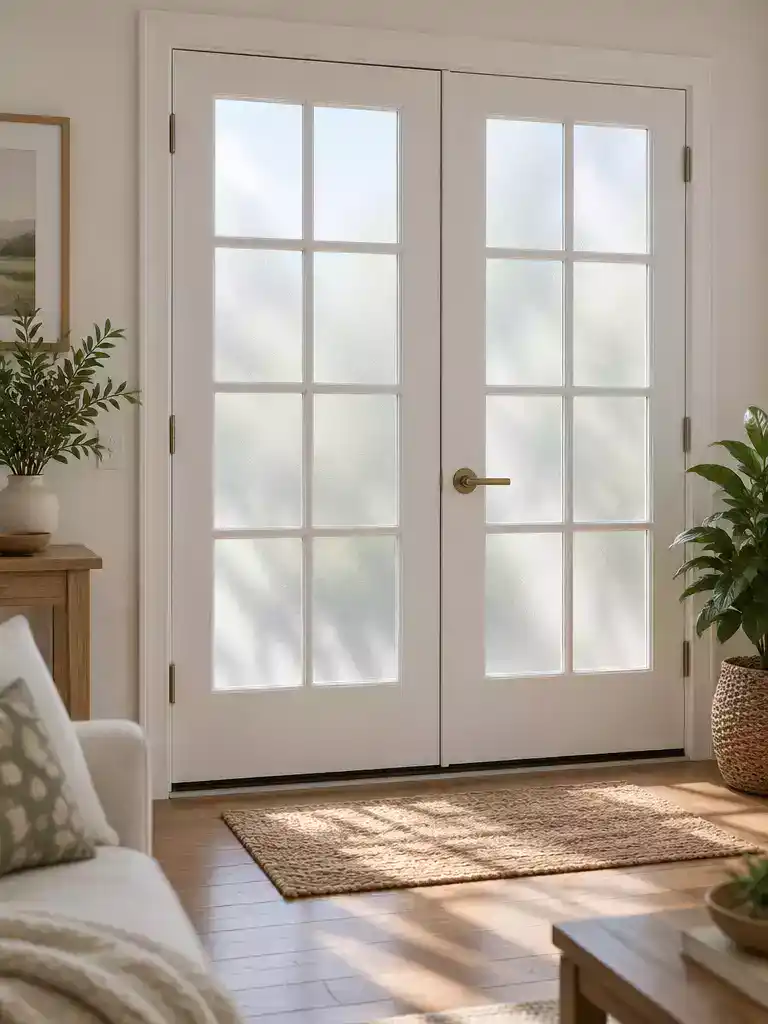
Block the view, keep the daylight, and skip every mounting headache.
Frosted privacy film sticks straight to the glass. That one detail changes everything on a French door: no shade stack, no swinging fabric, no handle clearance to solve – the treatment sits flat on the pane itself.
This is the move when your door frame is too shallow for a roller or cellular shade, or when a lever handle sits so close to the glass that every mounted option collides with it. Film sidesteps both problems completely.
Why it earns its place on a door:
Daylight comes through, but you lose the clear outward view – meaning you can’t be read from the street, and passersby can’t see in. It solves the daytime privacy problem with zero moving parts.
The tradeoff is that this privacy is fixed, not adjustable. You won’t get the raised-and-open choice of a shade or the tilted slats of a blind; once the film is on, the obscured view stays on the glass all day.
It also reduces visibility rather than blocking light. Don’t expect a darkened door or a guaranteed privacy rating – the result depends entirely on the specific film you pick and how light conditions change between day and night.
Before You Buy: The Four Film Checks
- Confirm glass compatibility – not every film is designed for every glass type, so check the product against your specific panes first.
- Prepare the surface properly. Dust, grease, or a rushed clean shows up later as visible imperfections.
- Align the film carefully. Slight misalignment or a crooked edge is obvious on a large flat pane, so take the time to get it straight.
- Check each pane separately. Paired doors aren’t always identical, and film that looks centered on one pane can read off on the other.
Common mistake: ordering film and assuming a quick DIY job on a large French door. If bubbles or edge lift are a concern – and they usually are on wide panes – professional installation is the safer call.
Cost context
One installer example reports $8–$18 per square foot installed for privacy film projects. Treat that as a single reported range, not a universal market rate or a French-door-specific quote.
Where this really shines is cost-to-convenience: for fixed privacy on a door where mounting depth or hardware rules out everything else, film is one of the most practical options in this whole list. It pairs well with a simple layout – no brackets to drill, no cords, nothing to swing out of the way.
Choose it if you want permanent privacy with the door fully operational and light still coming through. Reach for a shade instead if you need to uncover the glass during the day, control light direction, or darken the room on demand.
⭐ Frosted Privacy Films We Love
✨ Editor’s Pick
Frosted Privacy Film with Morocco Lines
Wavy Static-Cling Privacy Window Film
💡 Why the Price-per-Area Quote Helps:
Because the reported example is priced by area, it gives you a clearer way to compare proposals than treating every French door as the same job. Ask each installer to quote the same panes, so you can weigh the cost against the privacy you actually need.
Quote comparison: Match the included glass area across estimates before judging which offer fits your budget.
Stained-Glass Film
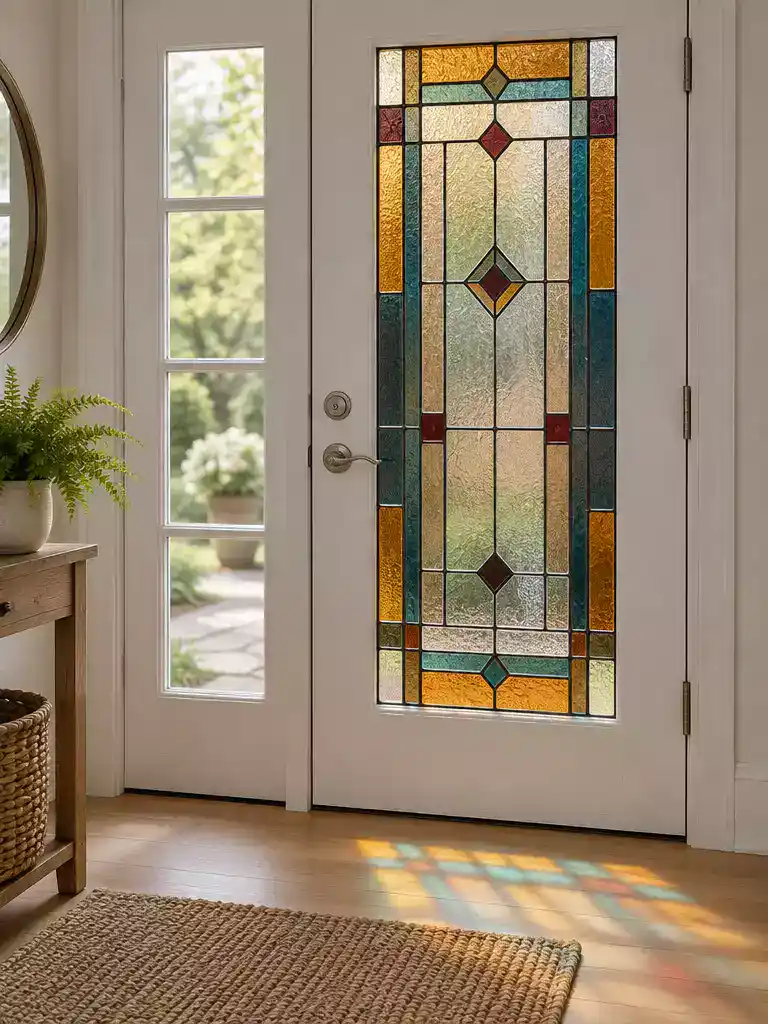
Turn the pane itself into the room’s color accent – no shade needed.
Frosted film gives you flat, even diffusion. Stained-glass film does the opposite: it lays a leadline-and-pane pattern in amber, teal, ruby or clear bevels across the glass, so the door reads as a decorative feature while direct sightlines through it break up.
The footprint story is the same as any film – it clings to the pane, so there’s no stack above the glass, nothing projecting near the lock, and nothing to catch when the door swings. That matters on French doors where a lever handle has already ruled out a shade.
Right for: an owner who wants ornament and light on a door with shallow frames, projecting hardware, or no room for a headrail.
Skip it if: you want the option to uncover the glass and keep a clear outward view – this treatment stays on the pane permanently.
Expectations matter here. The research does not specify color effect, privacy level, durability, or light transmission for any particular film, so treat those as product-by-product questions rather than guarantees.
Before you buy or apply, run these checks:
- Confirm the film is compatible with your specific door glass.
- Clean and prep the surface properly – dust and residue show fast under colored film.
- Align carefully; a crooked leadline pattern is far more obvious than a plain frosted edge.
- Consider a professional installer if bubbles or edge lift would bother you.
On cost: dependable French-door-specific prices and lifespan figures for stained-glass film aren’t available, so get quotes for your exact pattern and pane size instead of budgeting off generic film estimates.
⭐ Stained-Glass Films That Catch Light
✨ Editor’s Pick
Mosaic Stained Glass Window Film
Rainbow Lattice Stained Glass Film
Rainbow Moroccan Stained Glass Film
💡 Make the Color Feel Intentional:
Treat the film as a focal detail: choose a pattern that picks up a color already used nearby, such as in a rug, artwork, or cushions. If the doors are paired, using the same design on both panes helps them read as one considered feature. Keep nearby patterns quieter so the glass can stand out.
Etched-Look Film
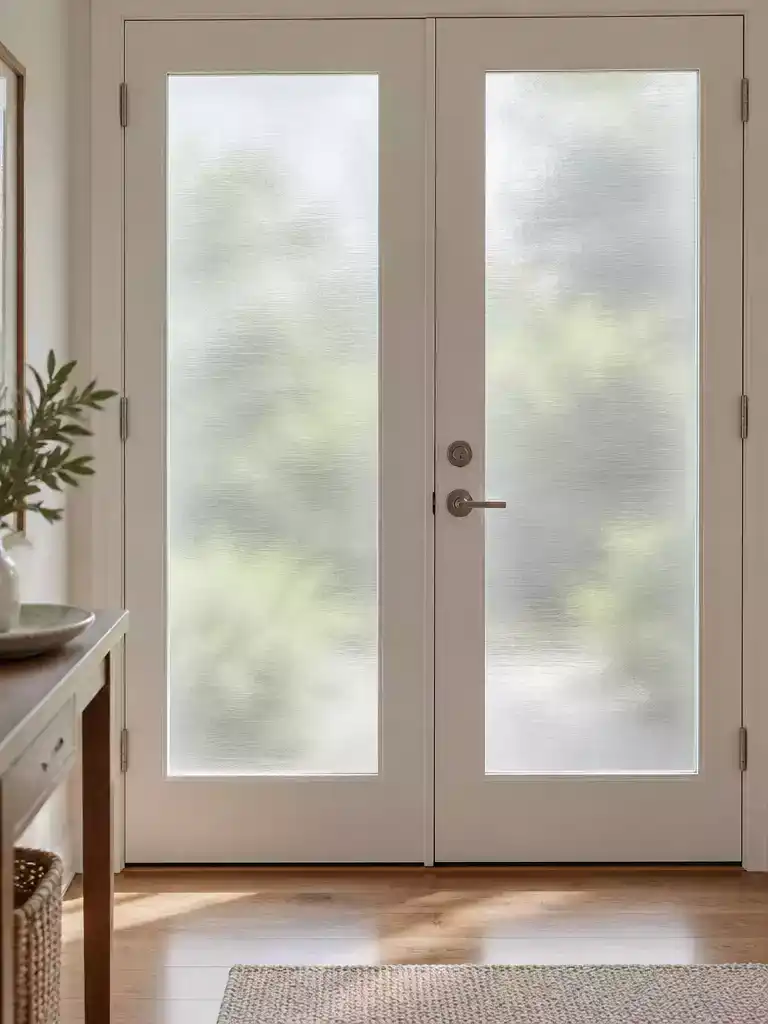
A sandblasted-glass look with zero hardware in the door’s path.
Etched-look film gives the pane a sandblasted satin finish – that soft, milky diffusion you see on a frosted bathroom lite. Unlike stained-glass film, it adds no color or pattern, just a quiet custom-made surface that lets daylight through while blocking a clear line of sight.
Because it clings flat to the glass, there is no shade stack, no headrail, nothing to clear the handle. The lever, the deadbolt, and the full door swing stay completely untouched – which is exactly why this is the pick for a shallow frame that ruled out every bracketed option earlier in this list.
Fixed by design.
Privacy stays on the glass around the clock – no tilting, no raising, no changing your mind mid-day. If you ever want the clear garden view back, this film has to come off.
Who it suits: an owner who wants a restrained, etched-glass pane and needs the door hardware left entirely alone. It reads as an upgrade to the glass itself rather than a covering hung on it.
Who should skip it: anyone who wants an unobstructed outward view, or who needs privacy to vary through the day – open for company, covered at night. That adjustment is what slats and shades deliver, and film can’t.
Before ordering, run the standard film checks:
- Confirm the film is compatible with your specific door glass.
- Clean and prep the surface thoroughly – dust shows through a satin finish.
- Align carefully; on a narrow French-door pane, a slight tilt reads immediately.
- Consider professional application if bubbles or edge lift would bother you.
No dependable price, lifespan, or privacy-performance figures exist for etched-look film on French doors – compare product specs directly rather than trusting a quoted number.
⭐ Etched-Look Films to Consider
✨ Editor’s Pick
Magnolia Film with Etched Glass Finish
Textured Leaded Glass Privacy Film
With all 17 Window Covering Ideas for French Doors in view, the choice comes down to what matters most: a close-fitting covering, draft reduction, daytime glare control, adjustable slats, or a softer fabric look. Films keep the glass clear of projecting hardware but trade adjustable coverage for a fixed finish; between-glass blinds belong in new-door or glass-unit planning, not a simple retrofit. You don’t need to combine every approach – one or two well-matched choices can shape the result.
Decide whether privacy, light, view, or insulation leads, then measure each door separately, including mounting depth, molding, handle and lock projection, and the open-door path. Compare the two options that best fit that priority and confirm the exact mounting requirements before ordering. That check narrows the field to a covering that works with the door as well as the room, leaving you ready to make a clear, confident choice.