
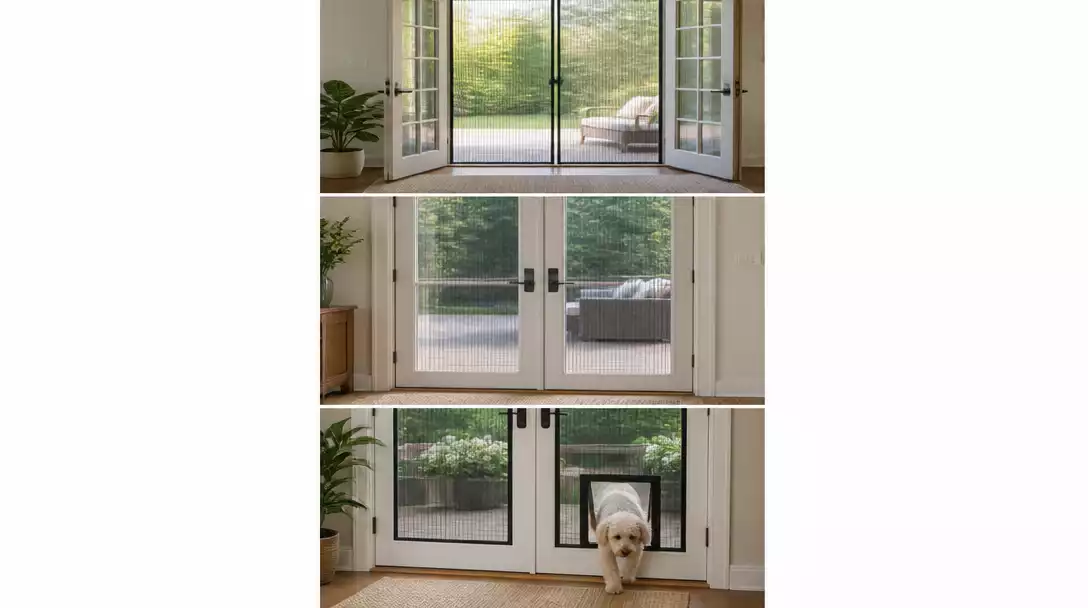
These 10 Screen Door Ideas for French Doors focus on covering the full paired opening without making either door awkward to use. Save these practical ideas for insect protection, ventilation, pets, and security, then start with a screen system that clears away when it’s not needed.
Retractable Screen Pair
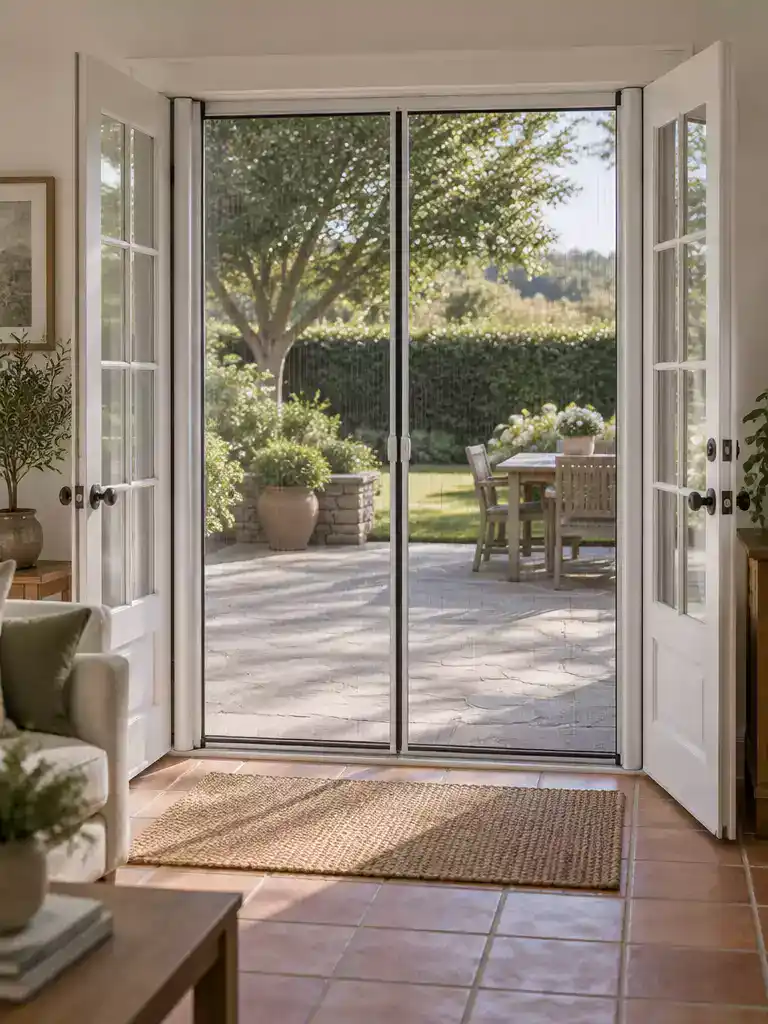
Screens that vanish when the doors are shut, so either leaf stays ready to open.
As an Amazon Associate I earn from qualifying purchases. Affiliate links may earn me a commission at no extra cost to you.
With both French doors closed, a retractable pair leaves the doorway completely clear – the mesh winds into slim housings mounted along the jambs. Pull a screen across when you need it, and it rolls away again when you don’t.
For a paired opening, the usual setup is one screen per leaf, or a coordinated double system whose edges meet at the center. Either way, each French door opens independently, and retracting both screens restores the full clear opening.
Fit is where retractable pairs are won or lost, so measure the opening itself before you shop. Run through these checks first:
Fit checks to run before you order:
- Measure jamb to jamb and sill to header – the clear opening, never the door slab dimensions.
- Check housing depth against the jamb, since the cassette needs a solid mounting spot.
- Confirm the door swing and handle hardware won’t conflict with the housings or side guides.
- Allow for track clearance along the top or bottom run of the system.
- Note the threshold height so the screen track doesn’t create an unwanted step-over.
- Extend both screens fully and confirm the meeting edges align at the center.
Pricing swings widely with sizing and customization, so treat these reported examples as orientation rather than a quote.
Installation is the weak point on this system.
A wide or uneven opening – or any doubt about housing depth or meeting-stile alignment – belongs with a professional fitter, not a weekend guess.
Day to day, the cassette, tensioning parts, and side guides are what keep the mesh running smoothly. One manufacturer claims a six-year warranty on retractable and accordion screens, but check whether mesh, wear parts, and labor are actually covered.
Best fit: You want the screen gone when the doors are shut, and you open either leaf on any given day without a fixed panel in the way.
Skip it if: The jambs can’t accept the housings, or you can’t confirm the opening measurements and center alignment with confidence.
A pleated screen pair also stores compactly – it just gathers into folds instead of winding onto a roller.
💡 Why This Works for Everyday Ventilation
When fresh air is welcome but the doorway still needs an insect barrier, a retractable pair lets you keep the screen in use without leaving a permanent frame across the entrance. That flexibility is especially helpful when household traffic shifts between one frequently used leaf and occasional full-width access.
Everyday takeaway: Choose this setup when ventilation and changing access needs matter more than a fixed, always-visible screen.
Pleated Screen Pair
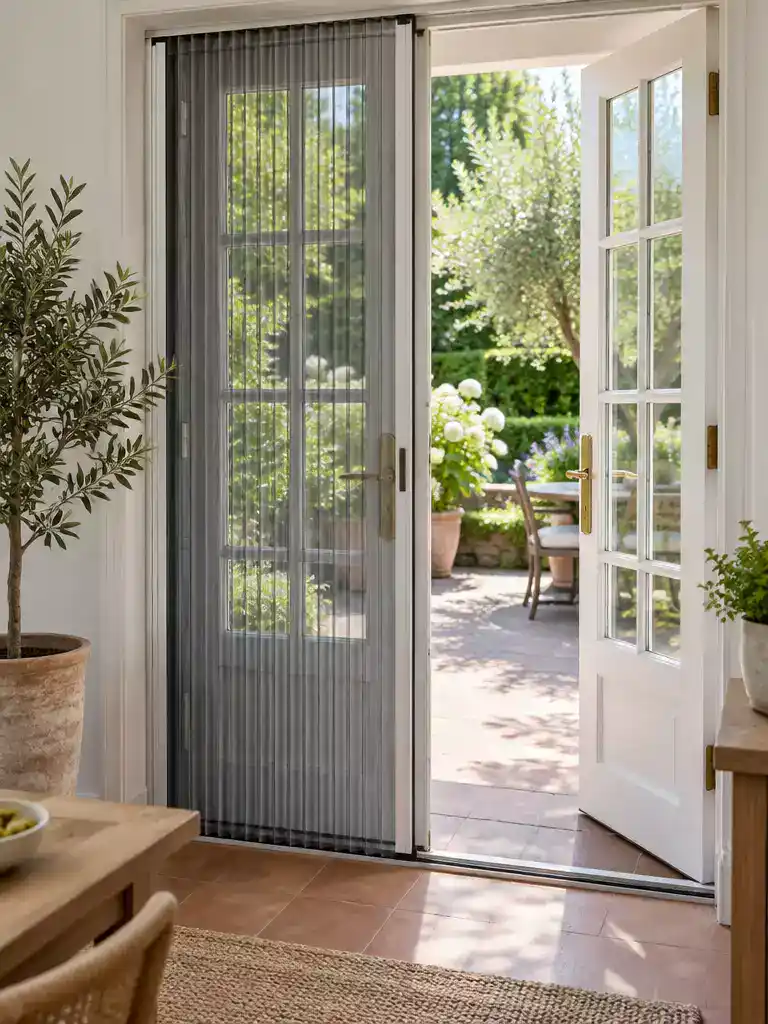
Pull it wide for airflow, slide it back, and the pleats nearly vanish.
A pleated screen pair covers a French doorway with mesh that folds like a paper fan, gathering into a slim stack at the side of the opening. Instead of winding onto a roller like a retractable screen, the folds themselves are the storage – that single detail separates this system from the previous idea.
Across paired French doors, the mesh typically travels laterally over the full opening as one continuous span rather than splitting into one panel per leaf. Tensioning cords inside the mesh pull it taut as you extend it, then compress it back into its compact accordion stack when you slide it open.
Because the screen runs sideways over the whole doorway, the fit question comes down to the opening itself. Before committing, check:
- Opening width – measure jamb to jamb and sill to header; the mesh has to cover the full clear span, not just one leaf.
- Track depth at the sill – the bottom guide rail needs room to sit without turning your threshold into a trip edge.
- Header and jamb capacity – the top cassette and the side guide rails both need mounting space.
The headline claim: one supplier says its pleated system suits openings up to 32 feet wide and 10.5 feet tall.
That’s a product-specific figure, not a universal limit. Verify it against the exact model before you plan a wide opening around it.
That wide-span capability is what this system is really for – one mesh sweep across a big paired opening, with the stored stack staying out of the way. Here’s how the reported pricing stacks up against the retractables:
Both figures are cited market examples, not guaranteed current prices. Custom sizing and track configuration move the number in either direction.
The cassette, tensioning cords, and side guides take all the daily wear, and their condition decides how smoothly the mesh runs. One manufacturer claims a six-year warranty for retractable and accordion screens, so confirm what the specific product actually covers – mesh, wear parts, and labor included or not.
Perfect for: a wide paired opening where you want the closed screen to fold into a compact stack instead of swinging or rolling.
Skip it if: there’s nowhere for the tracks and cassette to mount – a pleated screen can’t work around a header or sill that won’t accept its hardware.
Pleated mesh moves sideways, and that’s the whole personality of this system. Coming next: a hinged screen pair that gives each side of your French doors its own framed leaf, swinging instead of sliding.
⭐ Accordion Screens That Fold Away
✨ Editor’s Pick
Custom Accordion Mesh Screen Door
💡 How to Compare the Price Fairly
The $1,617 listing gives you a concrete reference, not a promise for your doorway. Custom sizing or mounting details may affect the quote, so check what each supplier includes before comparing options. That way, a listed product price won’t be mistaken for a complete, like-for-like project total.
Compare the scope: Ask whether sizing, fitting, and warranty coverage are included in each quoted price.
Your household’s daily traffic is a better starting point than trying to find one screen that does everything: note which leaf opens most, whether both need to swing freely, and how often people pass through. Once those patterns are clear, the decision is less about getting every detail perfect and more about matching a few practical requirements to the doorway.
🎯 The Calls Worth Getting Right:
- Confirm clear-opening measurements with a French-door sizing guide, not slab estimates.
- Note daily leaf use, handle swing, threshold height, and center-seam alignment.
- Choose the priority: easy passage, pet access, security, or a clear opening.
Hinged Screen Pair
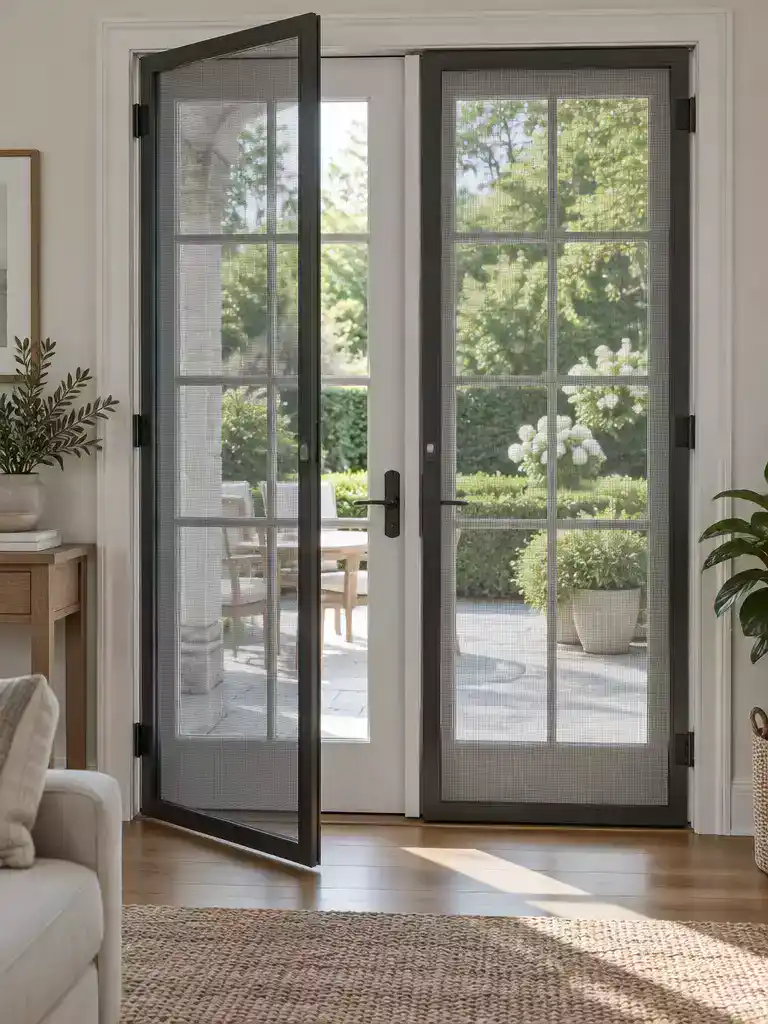
Framed screen leaves that swing with your doors – one side open, fresh air flowing.
Two slim aluminum-framed screen leaves hung beside your French doors, each swinging open on its own hinges like a lightweight twin of the door behind it. If you want a screen that behaves exactly like a door – push one side through, leave the other shut – this is the most literal version of that idea.
Magnetic catches hold each leaf closed at the center, so either side opens independently for a quick trip to the garden. One retailer’s twin setup describes aluminum frames, lift-out hinges on one side, and magnetic catches on the other – useful product details to compare against, though not every hinged pair will include them.
What one retailer lists: DIY kits start around £324, with made-to-measure versions starting around £439. These are listed examples, not a guaranteed price for your opening.
The honest tradeoff is swing space. You’re adding two more doors’ worth of swing arcs to the same entry zone your French doors already share with furniture, hallways, and whatever sits near the opening.
Walk the swing before you order. Swing an imaginary screen leaf through its full arc at the doorway – if it would clip the French doors, a sofa, or a tight entry route, this system will wear on you every single day.
A permanently swinging pair also gets old fast if you open both French-door leaves often, entertain across the full width, or move furniture through the doorway. For households like that, a screen that stores out of the swing path is the kinder choice.
DIY is genuinely workable here – this is one of the more buildable options – but only with a clearly specified kit and a square, accurately measured opening. Run these checks first:
- Measure the screen’s swing arc against both French-door leaves, handles, and nearby furniture.
- Confirm the magnetic catches line up when both leaves close – misaligned catches mean a screen that never quite seals.
- Measure jamb-to-jamb and sill-to-header yourself instead of estimating from the door slabs.
- Lift-out hinges can make seasonal removal simple – handy, but note that’s a hinge feature, not the same thing as the full lift-off screen system later in this list.
This suits someone who wants a straightforward framed screen where each side works as its own swinging leaf – no tracks, no cassettes, no mesh tensioning to maintain. Skip it if the screen’s swing would obstruct the doorway or both French doors need to open freely all day.
Prefer a screen that never swings into the room at all? The next option sends its panel traveling sideways along a track instead.
💡 Keep the Extra Frames Visually Quiet:
A hinged pair adds another set of frames around an already divided doorway. If you can choose the frame finish, coordinating it with the French-door hardware helps the screen feel like part of the entry rather than a competing layer. Keep the mesh visually simple so the paired doors remain the focus.
Sliding Screen Panels
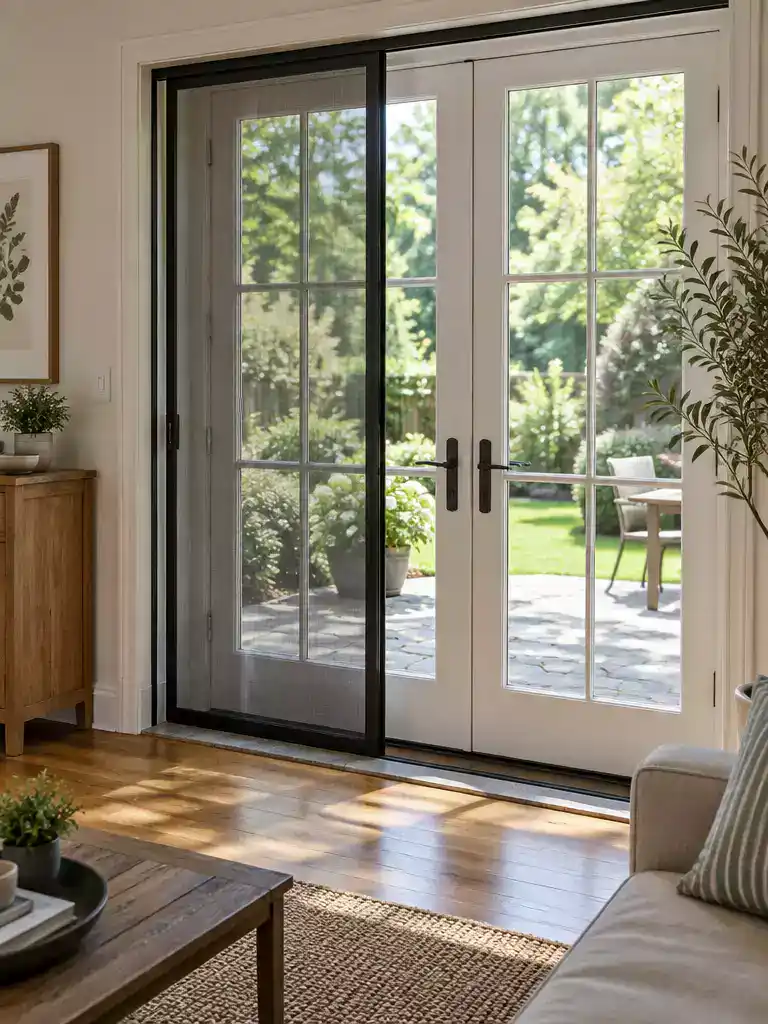
Slide the screen aside and let both French door leaves swing free.
Sliding screen panels travel sideways on a track – one or more mesh panels that park beside the opening instead of swinging on hinges or rolling into a side housing.
On paired French doors, the mechanism lives or dies on one condition: the screen needs somewhere to go. That means adjacent wall space or a bypass-style path where one panel slides past another, with the whole travel route clear of both door leaves.
Get that geometry right and the screen never swings into the room or blocks a leaf. Get it wrong and the track fights your doors every single day.
Three checks before you commit to sliding panels
- Track clearance. Confirm the track runs clear along its entire route – no clash with the sill, door sweep, or swing arc.
- Bottom-rail height. A raised rail across a doorway you cross daily is a built-in trip point.
- Full park. Slide the panel completely aside and verify it clears both open French-door leaves.
Know what you’re scoping
Reliable French-door-specific product data for sliding screen panels just isn’t out there – no standard panel counts, dimensions, prices, or performance figures were found. Treat this as a system to investigate with a supplier for your exact opening, not a category with guaranteed off-the-shelf specs.
Warranty check: one manufacturer claims 10 years for fixed and sliding screens – that’s a single company’s claim, not an industry standard. Verify what the actual product’s warranty covers, including mesh damage and labor.
The verdict: sliding panels suit an opening with a clear lateral route and enough room for the panel to park fully out of the way. Skip them if there’s no adjacent stacking space, the track would create a threshold you can’t accept, or either door leaf swings into the screen’s path.
From a panel that rides metal rails, the next option goes to the opposite extreme: no frame and no track at all – just two lightweight mesh curtains that part at the center when you walk through.
⭐ Sliding Track Screens for Wide Openings
✨ Editor’s Pick
Wide Sliding Track Screen Panel
💡 Why a Sliding Route Can Help:
Because the screen follows a fixed route, opening it doesn’t require clearing a screen-leaf swing arc. That can be helpful where nearby furniture or a narrow entry makes another swinging panel awkward – while still leaving the French doors’ own movement unobstructed.
Best-use takeaway: Choose this movement style when a predictable screen path suits the entry better than another swinging leaf.
Magnetic Center Screen
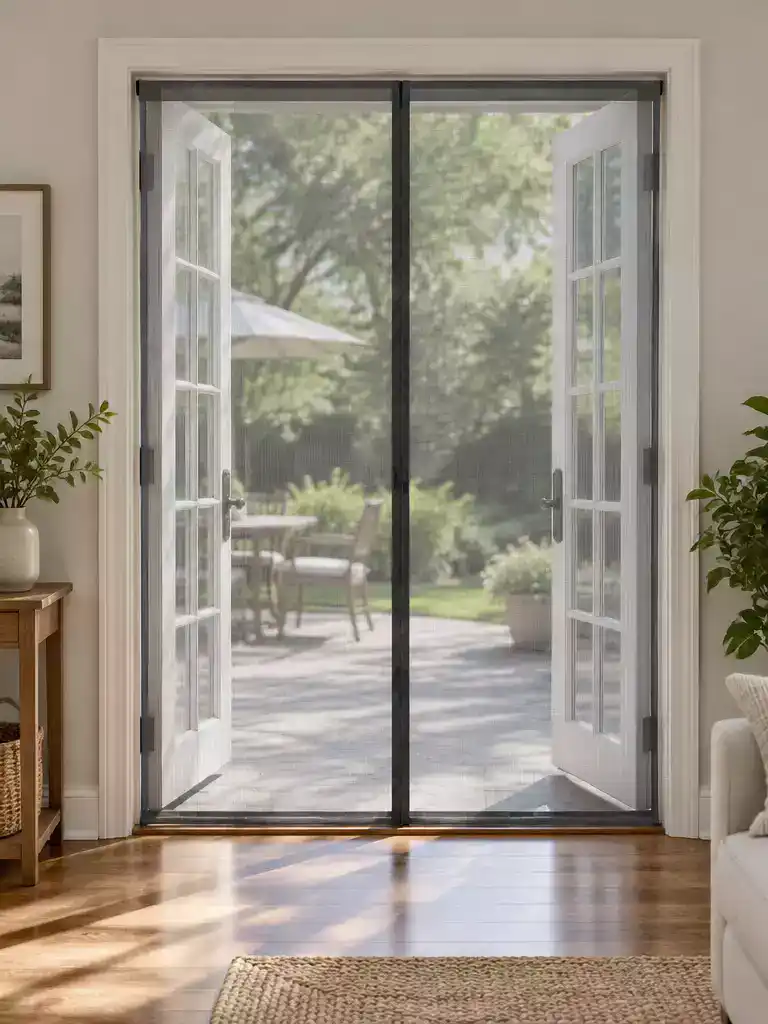
Walk through with full hands and let the magnetic seam close itself behind you.
An armful of laundry, a tray of drinks, a leash in one hand – you push through the middle and the mesh parts at the seam, then the magnets pull it shut behind you. That center seam is the entire idea behind this screen.
Two mesh curtains hang across the full French-door opening and meet at the middle, held edge to edge by magnets. Nothing swings and nothing slides – you walk straight through the mesh itself.
That hands-free passage is the draw for high-traffic routes like patio to kitchen or garden to mudroom. If your household crosses that threshold a dozen times a day, a framed screen starts to feel like one more thing to wrestle.
Know what this is – and isn’t. A magnetic center screen is a lightweight insect barrier, not a rigid framed system.
Lightweight magnetic and fabric-style mesh can blow aside in gusts and may seal less reliably than framed or tensioned screens. No verified wind-performance data exists for French-door versions, so don’t count on a number that was never measured.
Three fit checks before you order:
- The center seam lands at the doorway’s true center, so both sides part evenly when someone walks through.
- Magnets meet along the full length of the seam, not just at a few scattered points.
- The top rail and side attachments are anchored securely enough for the wind and traffic your entry actually sees.
Pricing comes with an honest gap: no verified cost or performance range exists for French-door-specific magnetic screens, so treat each supplier quote as its own case. Compare what you’re actually getting – mesh weight, magnet coverage, mounting hardware – rather than the number alone.
Everything so far handles insects and stops there. Up next, the storm-screen pair takes on a second job – weather buffering – and it only earns its spot if it can prove it does both.
⭐ Magnetic Screens That Self-Seal
✨ Editor’s Pick
Magnetic Double Door Mesh Screen
Reversible Magnetic French Door Screen
💡 Why the Shared Opening Helps:
With a center-parting screen, people can use the same natural route through the paired doorway instead of choosing which French-door leaf to open. That can make everyday traffic feel less fussy in a busy household, especially when different people are coming and going at once.
Best payoff: A shared passage point keeps routine trips simple without requiring everyone to coordinate around one active door leaf.
Storm-Screen Pair
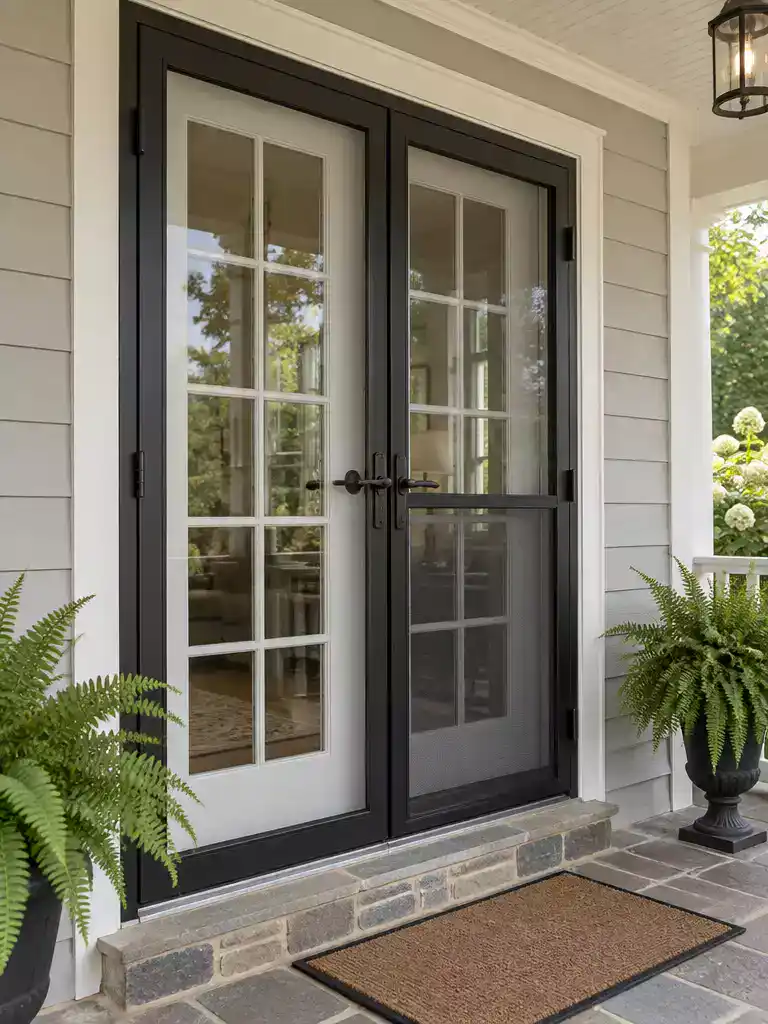
Two framed outer screens that pair over French doors for bugs and weather relief.
Search storm screens for French doors and you’ll find three different products wearing the same name. Sorting out which one a listing actually sells comes first, because each covers a different need across your paired opening.
On a French-door opening, the typical arrangement is two framed units, one aligned with each leaf, meeting near the center like the doors behind them. The purpose can reach beyond insects toward weather buffering, though no listing earns an insulation-savings promise until you’ve confirmed exactly what the product contains.
Ask the seller these three questions before ordering:
- Exactly which panels are included – screen, glass, or both?
- Does the system switch between screen and glass, and how do the panels swap?
- How do both outer leaves operate alongside the French doors – swing, catches, and clearance?
Reliable French-door-specific pricing, dimensions, and insulation-payoff figures for storm-screen pairs simply don’t exist in the source data. Treat any number a listing implies as unverified until the seller confirms the actual product and its configuration.
Once you know which product you’re dealing with, run these four fit checks on the real opening:
- Swing conflicts: both outer leaves need room to swing without clipping the French doors, trim, or nearby furniture
- Added frame depth: an outer frame sits proud of the wall, so check it against surrounding trim and handle projections
- Center meeting alignment: the two frames should meet cleanly at the middle, mirroring the doors behind them
- Threshold changes: any added bottom rail or sill creates a step-over point right at the entry
This is the option to investigate when you want seasonal weather buffering alongside insect screening – glass over the mesh when it turns cold, airflow through it in warm months. Skip it if all you need is a simple mesh barrier and the seller can’t confirm the weather function, configuration, and fit.
Weather buffering is where this option stops, though. If resistance to forced entry matters more than shelter from wind and rain, that’s the security screen pair’s territory – up next.
💡 Why Seasonal Use Is the Real Test:
A changeable screen-and-glass setup is most useful when you’ll actually switch its configuration as the seasons shift. Think through who will handle the changeover and where the unused inserts can be kept; if swapping panels feels like a chore, a simpler screen may suit your routine better.
Practical takeaway: Choose the system for the seasonal routine you’ll follow, not just the features listed on the product page.
7. Security Screen Pair
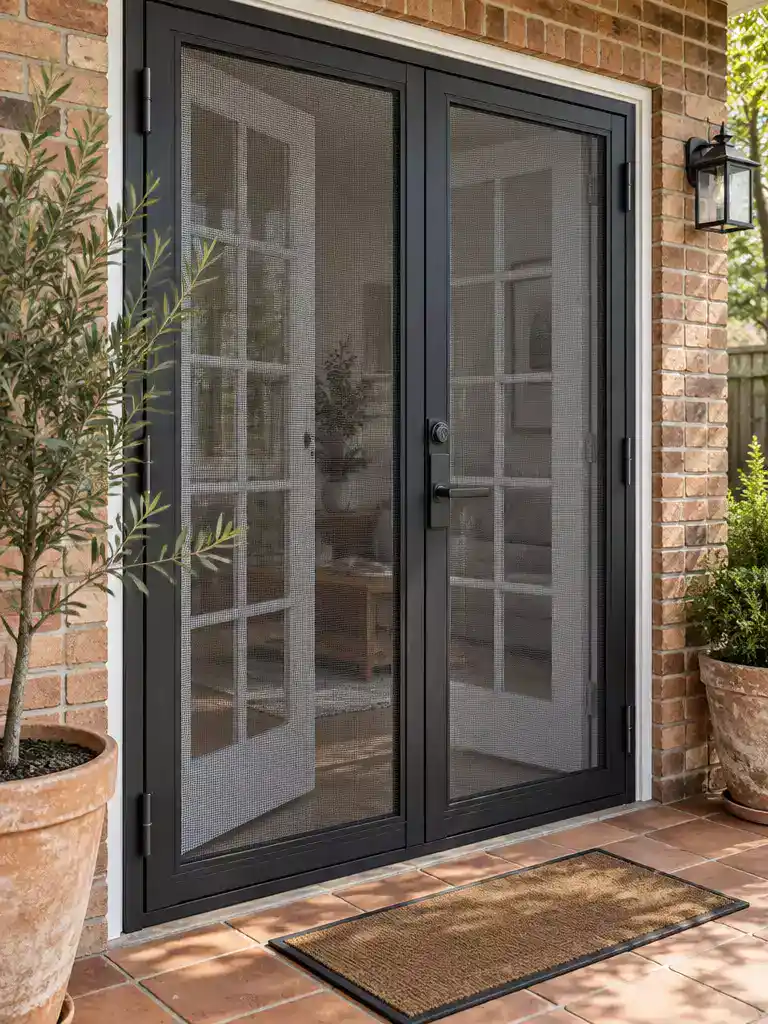
Reinforced stainless steel mesh lets the breeze in while standing firm against forced entry.
Stainless steel mesh is what separates a security screen from an ordinary fly panel. Suppliers pair that reinforced mesh with heavier frames to resist forced entry while still admitting air and light, and one manufacturer lists French doors among the opening types it covers.
On a paired opening, decide first whether both leaves need security-grade hardware or whether the primary active leaf is the real concern. Either way, the meeting stile, frame rigidity, and latch arrangement have to be addressed together – a fortified active leaf means little if the inactive leaf’s edge gives way.
The tradeoff is physical: stronger mesh and frames add weight and thickness, which affects smooth operation and tightens installation tolerances. This is one system where professional installation is the right call rather than a nice-to-have.
Before you sign off on an install, have the fitter verify:
- Full opening dimensions, measured jamb to jamb and sill to header
- Required clearances for the deeper frame and its hardware
- Latch complexity – security locks add moving parts a standard screen doesn’t carry
- Meeting-stile alignment where the two screen leaves meet at center
- How the less-used leaf operates and locks as part of the same opening
Budget example: One security-screen seller budgets a standard security screen door at about A$850–A$1,000 supplied and installed, with larger openings costing more. Treat that as one seller’s example, not a verified price for every French-door pair.
Pet flap alert: One source warns that adding a pet door to a security screen reduces its security rating and reclassifies the product as a safety door. If you need both, confirm the resulting rating with the manufacturer instead of assuming the performance holds.
A security screen pair fits homeowners whose top priority is a reinforced barrier that still lets the afternoon breeze through. If the added frame depth or latch hardware can’t be accommodated – or a pet flap is essential and the downgraded classification doesn’t sit right – this isn’t your system.
When pets are the whole reason you’re screening the doors, the next option builds the flap in from the start. That keeps a pet route separate from any security-rated build, which matters more than it sounds.
⭐ Steel Security Screens Worth Considering
✨ Editor’s Pick
Outswing Steel Security Screen Door
💡 Why the Complete Pair Matters:
A reinforced mesh description tells you about one component, not necessarily how the complete two-leaf assembly is classified. For a security-focused purchase, ask the supplier for documentation covering the exact paired configuration and its locking arrangement. That gives you a clearer basis for comparing products than relying on material labels or a broad “security” description alone.
Pair-specific proof: Get the product documentation for both leaves and their locking setup before comparing quotes.
Pet-Door Screen Pair
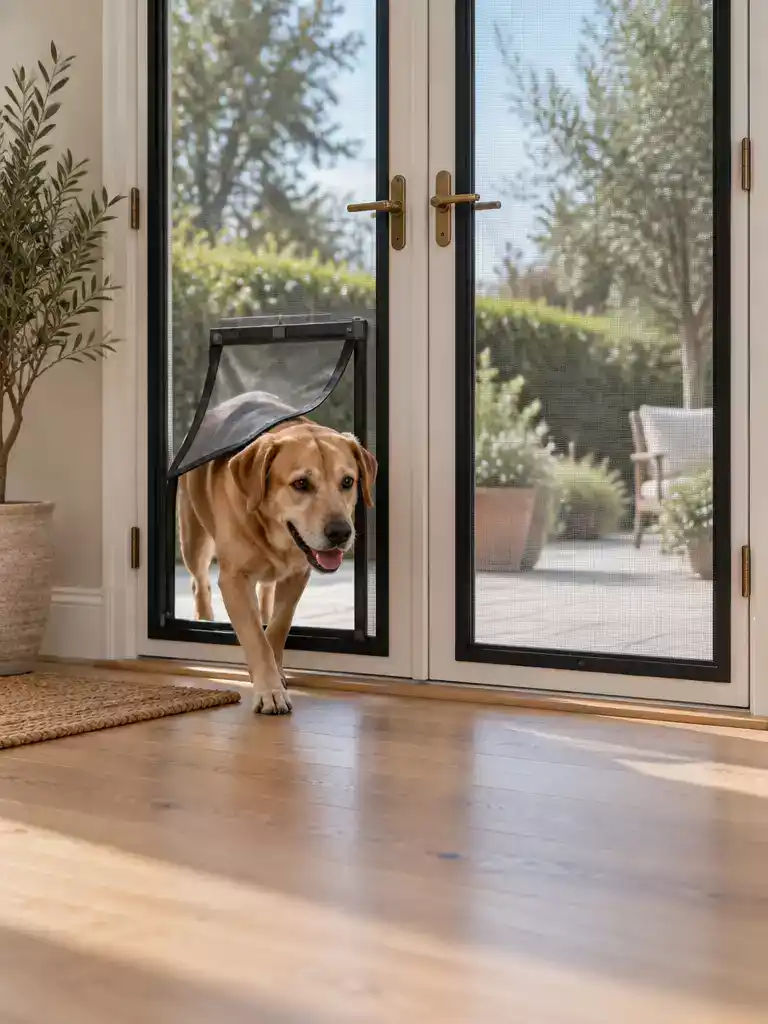
Give your pet a predictable way through while both doors stay screened.
Your dog noses the same patch of mesh every afternoon – so build the route into the screen instead of fighting it. A pet-door screen pair fits a flap into one screen leaf, while the second leaf stays an ordinary, unbroken panel.
That one-sided layout is the whole point. The flap lives on the leaf your pet actually uses, and the other half of the doorway keeps a clean screen surface that closes like any standard panel.
Pet fit decides whether this works, so check four things before ordering:
- Match the flap to your animal, not a weight chart – compare flap height and width against your pet standing at the opening, shoulders included.
- Look for stronger pet mesh, the common material in pet-resistant versions – but treat no mesh as claw-proof.
- Check that the cutout clears the screen leaf’s latch and the doorway threshold; a flap overlapping either will bind on every pass.
- Confirm the second leaf can remain a standard panel, so the other side of the doorway screens normally.
Both figures are retailer examples for hinged pet screens on French doors, not a guaranteed market price. A clearly specified kit can suit DIY when the opening is square and your measurements are accurate.
If the flap position or frame details feel uncertain, confirm them with the supplier before ordering. A made-to-measure version shifts that responsibility onto the manufacturer.
Security tradeoff: a pet cutout permanently weakens the panel it sits in. One security-screen source warns that adding a pet door compromises security standards, so never count a pet-flap screen as a security-rated barrier.
This setup suits households where a pet crosses the doorway many times a day and you want one predictable route without cutting into both panels. Skip it if the opening needs a security-rated screen, or if the flap can only fit by crowding the latch or threshold.
If your pet only needs out occasionally, a permanent flap may be more door than you need. The next system takes the opposite approach – no cutout at all, just screen panels that lift away when you want the opening clear.
⭐ Pet Screen Doors for Easy Access
Lockable Pet Flap for Screen Doors
✨ Editor’s Pick
Large Pet Screen Door Insert
Small Lockable Screen Door Pet Flap
🏡 Make the Pet Route Work at Home:
- Landing zone: Place a washable mat near the pet route to catch tracked-in grit without crowding door movement.
- Household routine: Agree which panel people use, keeping human passage predictable around everyday pet traffic.
- Upkeep: Check the mesh around the flap during routine cleaning; early wear is easier to spot before it spreads.
Lift-Off Screen Pair
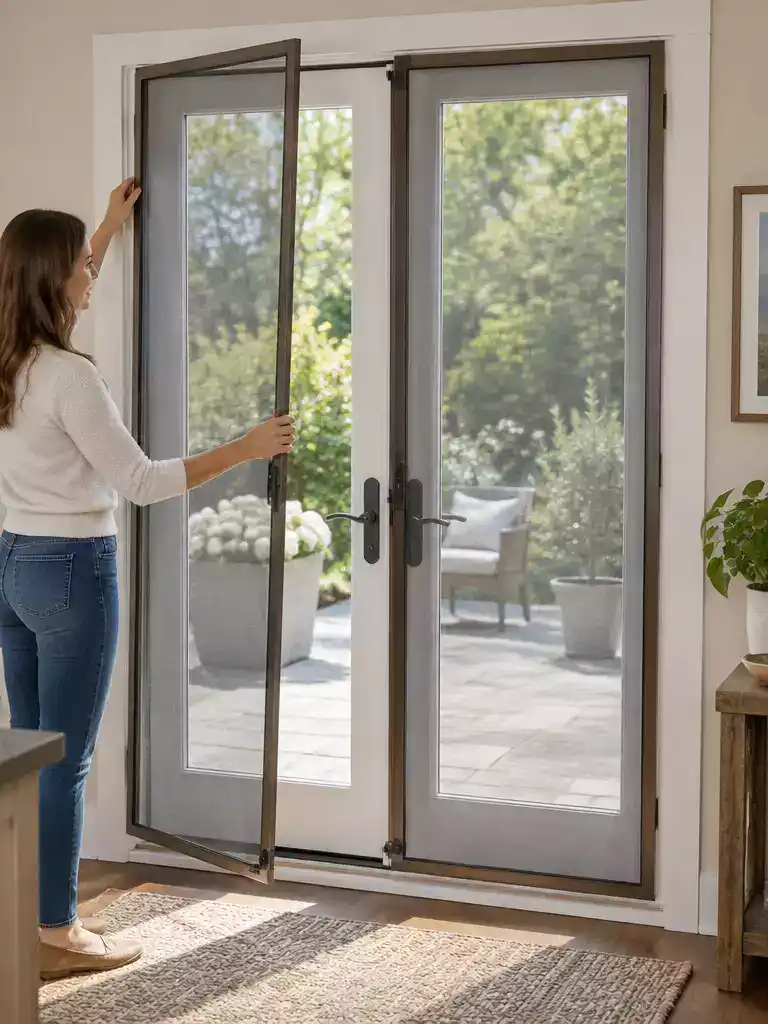
Screens that lift away in minutes, leaving your French doors completely clear.
A lift-off screen pair is two framed mesh panels that sit in a mounting frame across your French doors and come out completely when you want the doorway clear. No roller cassette, no folding stack, no swing clearance to plan around – removal is the entire mechanism.
That simplicity cuts both ways. You get a plain insect barrier for the months you want it, and you become the person carrying both panels to a closet when you don’t.
Before you commit, run these four checks:
- Storage first: decide where both panels will live when they come down – a garage wall or closet slot that won’t put leaning weight on the frames.
- One-person handling: you should be able to lift each panel down and back up without snagging the mesh; if it takes two people, removal day gets tedious.
- Seating security: each panel needs to seat firmly enough to shrug off a wind gust or a pawing pet, not just rest in place by gravity.
- Removal frequency: if you’d want the doorway fully open every week, taking panels down by hand will wear thin fast.
Easy mix-up to avoid: some hinged screen pairs use lift-out hinges, so a swinging leaf comes off its hardware. A lift-off pair is defined by the screen panels themselves lifting out of the frame – ask the seller exactly which system you’re buying.
Manufacturer and installer guidance generally groups lift-off screens with hinged ones: simpler, but more intrusive in daily use than retractable or pleated systems. There’s also no verified French-door pricing or performance data for lift-off pairs, so treat every quote as product-specific and check the panel seating in detail before buying.
If the carry-and-store routine sounds like too much hands-on work, the next system folds its sections into a compact stack during everyday use. No lifting required – the bi-fold screen pair collapses itself.
⭐ Replaceable Screen Mesh to Consider
✨ Editor’s Pick
Replaceable Fiberglass Screen Mesh Kit
🔢 A Seasonal Routine That Prevents Rework:
A little planning before each changeover helps keep the panels organized and makes reinstalling them less of a scramble.
- Choose when screening matters, then plan removal for a time the doorway can stay open.
- As you remove the panels, note their orientation and set them down without pressing on the mesh.
- Before reinstalling, inspect the frames and mesh, then seat each panel and confirm it stays secure.
10. Bi-Fold Screen Pair
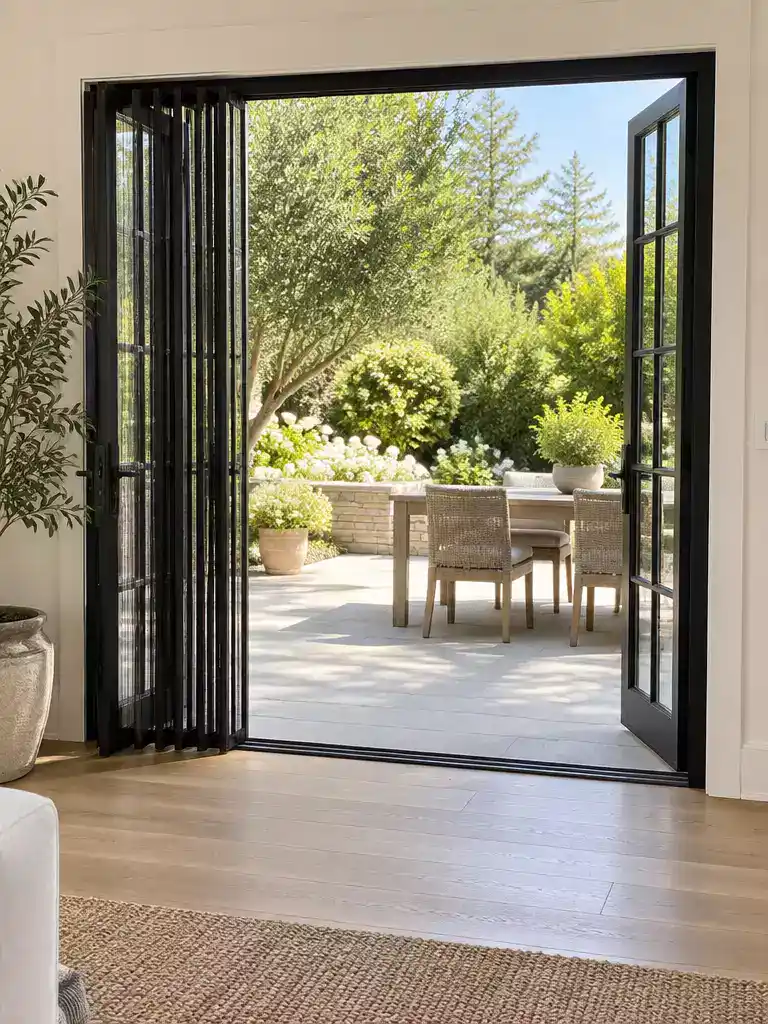
Fold the screen into a slim stack and let both French doors open wide.
Two framed screen halves that meet at the center and fold back like an accordion – that’s the core of a bi-fold screen pair. Open the doors and the sections stack into a compact bundle at one side, or split and gather toward both edges, leaving the doorway clear with nothing swinging into the room.
That folding movement is exactly what separates this from the pleated pair earlier in the list. Both store flat, but they store in very different ways.
The paired-door catch is where that folded stack lands. It needs parking space at one or both sides, and the bundled sections can’t collide with either French-door leaf or choke the opening you actually walk through.
Before you commit to one, run this five-point fit check:
- Stacking space – measure where the folded bundle will sit and confirm it stays clear of both door swings.
- Mounting depth – check that the surrounding wall or frame reveal can accept the track and stacked panels.
- Header and jamb capacity – confirm both can carry the system’s weight and fixings.
- Track clearance – check the bottom rail height for a trip point at the threshold.
- Door swing interaction – open both French doors fully and confirm the folded sections never conflict.
Read the big numbers like a brochure, not a spec sheet. One manufacturer describes an accordion system for bi-fold and French swing doors covering openings up to 32 feet wide and 10.5 feet tall, and a separate supplier says its retractable fly screens suit bi-fold doors and other wide openings.
Both are product-specific claims, not industry limits – and no independent pricing or standardized sizing exists for French-door bi-fold screen pairs. Get quotes for your exact opening before assuming either figure applies to you.
Warranty check: one manufacturer claims a six-year warranty on its retractable/accordion screens. Confirm the specific system’s coverage includes the folding hinges, mesh, and labor – those moving joints take more daily wear than a static frame ever will.
A bi-fold pair earns its spot on a wide opening where a swinging screen leaf or a parked panel would crowd the room – think indoor-outdoor entertaining zones. If there’s nowhere for the stack to sit, or the header, jambs, track, or door swings won’t let the sections fold clear, skip it.
That’s the last system – and the deciding rule never changed. The best screen is the one that covers the full paired opening and still moves clear the way your household actually uses both doors.
⭐ Folding Screens That Save Space
✨ Editor’s Pick
Folding Accordion Screen Door Divider
✓ Make the Folding System Easy to Live With:
- Frequent route: Ask whether the screen can open from the side your household uses most, so everyday passage feels natural.
- Try the motion: Have everyone who regularly uses the doorway test folding and unfolding the sections before you choose a system.
- Screen routine: Decide when you’ll keep the screen extended for airflow and insect protection, and when you’ll fold it away for an open doorway.
With all ten Screen Door Ideas for French Doors in view, the main choice is how the screen should move and what the paired opening needs to do. Compact-storing systems, swinging or sliding panels, easy-pass curtains, and removable or folding options each make different demands on space; weather, security, and pet access also call for checking the specific setup. You don’t need to combine every approach: one or two mechanisms that match how you use both door leaves can shape the whole result.
Start by measuring the clear opening and noting both door swings and where the screen edges must meet. Then shortlist the options that suit your priority – whether that’s open access, insect protection, or pet passage – and verify fit and product claims for the exact opening. With those checks in place, choosing the right screen for your French doors becomes a practical decision, not a guess.
Related posts:
 Storm and Screen Doors: The Ultimate Guide to Home Protection and Comfort
 Dog Door Ideas for French Doors
 Ideas for Keeping French Doors Open
 15 Dining Room Ideas With French Doors
 16 Ideas for Using Antique French Doors as Room Dividers
 11 Sliding French Doors Patio Ideas
 16 French Doors for Bedroom Ideas
 17 Window Covering Ideas for French Doors