
Clear or Reeded Glass for Interior French Doors? The decision is whether to preserve open sightlines or soften views, without ending up with exposed rooms, unexpected darkness, or a quote that misses the mark. This guide narrows the choice to 7 practical ideas covering privacy, light, style, room fit, upkeep, and cost. Start with sightlines.
1. PRIVACY AND SIGHTLINES

Choose the glazing that protects private rooms without sacrificing the connection your home needs.
As an Amazon Associate I earn from qualifying purchases. Affiliate links may earn me a commission at no extra cost to you.
Stand at the hallway approach where someone would actually see the doors, then check what the glass reveals: a bed, toilet, desk, laundry pile, kitchen counter, or simply the movement of a person. This sightline test is the most important difference between clear and reeded glass.
Clear glass is not a privacy solution. Its view is direct and unobstructed, so people, furniture, objects, and room activity remain readable at normal viewing distances; bedrooms, bathrooms, offices, and everyday clutter stay visually exposed.
Reeded glass uses ridges to scatter light and distort forms. You can usually tell that someone or something is behind the door, but facial features and fine details become soft rather than fully readable.
That is partial privacy, not opacity. Reeded glass can blur a bathroom or office during the day and still show a person’s outline when the room lights are on and the adjoining hall is dark.
Nighttime silhouette test: view the sample in daylight, then turn on the room lights after dark. Backlighting can reveal silhouettes through reeded glass, even when the ridges hide most detail.
Privacy changes with groove spacing, depth, orientation, thickness, viewing distance, viewing angle, and the exact manufacturing pattern. Narrower, closely spaced ridges generally obscure more than wider, shallower ones, but no pattern name or thickness guarantees a specific result.
Viewing straight on may conceal more than viewing from an angle, so a catalog photograph is not enough. Request the exact sample and check it from the hallway, from the room side, and at the angle people will use most often.
- Ask whether the supplier describes the pane as clear, diffused/distorted, obscure, or opaque.
- Check the manufacturer’s privacy or opacity scale rather than comparing numbers across brands.
- Confirm the exact pattern, groove spacing and depth, vertical or horizontal orientation, thickness, and textured-side location.
- Verify whether the glass is smooth on one side and reeded on the other, since that affects both the appearance and cleaning.
For reference, one Thermatru scale rates clear glass at 1 and its privacy or textured options at levels 8–10. Those ratings are manufacturer-specific, so they should not be treated as a universal privacy measurement.
Once you know how much the glass conceals, the next decision is how that texture changes the light entering the room.
⭐ Best Frosted Glass Doors for Privacy
✨ Editor’s Pick
Frosted Glass Pantry Door
Five Lite Frosted Interior Door
Single Lite Frosted Glass Door
💡 Designer Note: Let the Sightline Guide the Layout
Privacy depends on more than the pane itself. Check the view toward the most revealing feature – such as a bed, desk, or toilet – and consider whether furniture placement can soften that sightline. This helps you judge the glass in the finished room, rather than choosing from a close-up sample alone.
2. LIGHT TRANSMISSION

Borrow daylight gracefully while choosing between crisp visibility and softer, scattered illumination.
Use the doors to borrow daylight into a darker hall, office, pantry, or interior room, then decide whether you want that light to arrive sharply or softly. Clear and reeded glass are both light-admitting choices; the tradeoff is maximum transmission versus diffusion.
Clear glass typically passes about 85–90% of visible light, while reeded or fluted glass transmits roughly 75–80%. Exact performance varies with the product, thickness, pattern, and construction, so those ranges are planning figures rather than a guarantee for every textured pane.
With clear glass, daylight stays more direct and directional. Illumination is sharper, the adjoining room feels more visually connected, and shadows and furniture outlines remain clearly defined.
Reeded glass breaks up those direct rays as they pass across the ridges. The room may receive slightly less light, but the glow is softer, outlines are less sharp, and glare and harsh shadows can be reduced – useful if the doors face a work screen or a busy room you do not want fully exposed.
Reeded glass changes light quality; it does not simply remove light. Its ribs can turn a sharp beam and defined shadows into a softer, more scattered glow while still admitting daylight.
Reeded glass also differs from uniformly frosted glass. Its diffusion can vary across the ribbed pattern, and it may retain more directional light instead of producing an evenly white surface.
Do not judge brightness from the transmission percentage alone. Door size, wall color, adjoining-room brightness, orientation, artificial lighting, and rib spacing all affect how the opening feels once installed.
Before ordering, request the exact visible-light-transmission value and confirm what type of pane you are comparing. Clear reeded, frosted reeded, laminated, and other hybrid constructions can create noticeably different light experiences.
- View a physical sample in lighting similar to the installation site.
- Check it during daytime and again with the adjoining room lights on at night.
- Confirm the pattern orientation, rib spacing, thickness, and construction.
Clear is the better fit when a narrow hallway needs the strongest visual connection to a bright room. Reeded makes more sense when borrowed light matters but direct glare, hard shadows, or a visually exposed work area would be irritating.
⭐ Clear Glass Doors That Brighten Rooms
Custom Cut Clear Glass Panel
✨ Editor’s Pick
Double Clear Glass French Doors
💡 Why Diffusion Makes a Difference:
Reeded glass can make borrowed daylight feel easier to live with when a clear beam lands across a desk, floor, or glossy surface. By softening outlines and shadows, it reduces the visual drama of direct light without turning the adjoining room into a uniformly frosted panel.
Best practical fit: Choose diffusion when softer illumination matters more than the clearest possible view between rooms.
The decision becomes much smaller once privacy and brightness are tested in the actual opening. Style matters, but it should follow what the glass needs to conceal and how much light the room can give up.
🎯 What Moves the Needle:
- Test privacy at night with private French-door ideas.
- Compare daylight quality, not simply whether the room looks bright.
- Settle the real sightline first; style can follow confidently.
3. LOOK AND STYLE FIT

Choose glass that makes the doorway feel intentional, balanced, and connected to the rooms around it.
The door is a visible architectural element, not merely a transparent panel. Decide whether the opening should disappear into the room or contribute a repeated vertical texture that people notice as they pass.
Clear glass keeps the architecture in charge. The frame, muntins, hardware, and adjoining room remain fully legible, creating visual continuity that suits clean, minimal, contemporary, high-end, or gallery-like interiors.
That restraint works especially well with thin profiles, balanced muntins, and quiet hardware finishes. Clear panes can look stark, though, when paired with an ornate, heavily segmented frame whose surrounding architecture already calls for more texture.
Reeded glass makes a different decision: the pane becomes part of the design. Parallel ridges create depth, shifting shadows, movement, and a vertical rhythm that can support modern, mid-century, transitional, art-deco, vintage, industrial, eclectic, and modern farmhouse rooms.
Vertical reeds are the usual choice for French doors because they reinforce the height of a tall, narrow opening. Horizontal or diagonal grooves exist, but they change the visual direction enough that they should be specified intentionally rather than selected casually from a pattern list.
Frame-and-pattern balance rule: use reeded glass when the glass should contribute texture, but check that the frame and hardware are not already carrying a competing pattern.
A thin, minimal frame can make reeded glass the focal point, while a substantial or period-leaning frame may feel more intentional beside the added texture. A busy frame paired with strongly patterned glass can look overworked; clear glass may be the calmer choice in that situation.
- Place a glass sample beside the intended frame and hardware finish, not against a plain catalog background.
- Check whether the supplier offers a clear-substrate version if you want texture without a cloudy base.
- Assess reed spacing visually; one catalog example references 1/2-inch spacing, but the word reeded does not describe one universal pattern.
- Expect some textured products to show natural manufacturing variations such as seeds or bubbles, which some suppliers do not classify as defects.
Make the style choice only after checking the real frame, hardware, door proportions, and surrounding finishes. A glass sample that looks delicate online can become the main pattern in the room once it fills both French-door leaves.
⭐ Standout Glass Door Styles
Two Lite Opaque Glass Door
Two Panel Primed Interior Door
✨ Editor’s Pick
Five Lite Frosted Pantry Door
💡 The Detail That Pulls It Together:
Treat both French-door leaves as one composition, especially when the doors sit between two differently styled rooms. Let the glass provide either calm continuity or deliberate texture, then use the frame and hardware to bridge the spaces. This keeps reeded glass intentional rather than making it feel like an isolated decorative insert.
4. ROOM-BY-ROOM SUITABILITY

Match each pane to the view, light, privacy, and activity the doorway reveals.
The best glazing depends less on the room’s label than on what the door reveals from the approach. Stand in the hallway or adjoining room and check whether the glass frames a screen, bed, toilet, sink, counters, pantry shelving, or everyday clutter.
Room test: Reeded glass is usually the safer direction once a door exposes a private activity, a work screen, or a clutter-prone zone. It still provides partial privacy, so check silhouettes at night rather than assuming the grooves fully block the view.
Reeded glass can be specified as toughened or laminated where the door application requires safety construction. The glass type alone does not provide sound isolation, fire protection, or complete visual blocking.
Before ordering, confirm the exact dimensions, thickness, safety type, frame, seal, glazing method, and compatibility with the door. A pattern that suits the room can still fail if the panel or glazing system does not match the existing French-door package.
⭐ Room-Specific Door Hardware Picks
✨ Editor’s Pick
Privacy Knobs for Bedrooms Bathrooms
Crystal Privacy Knob for Interior Doors
Dummy Knobs for Pantry French Doors
🏡 How This Works in a Real Home:
- Open-door routine: If the French doors usually stay open, let the surrounding rooms – not privacy alone – set the visual priority.
- Changing contents: Reeded glass stays adaptable when desks, storage, or work surfaces may shift over time.
- Everyday comfort: Choose the pane that keeps ordinary activity feeling connected without making the doorway demand constant tidying.
5. CLEANING AND UPKEEP

Choose the surface that matches your tolerance for visible marks and detailed cleaning.
Clear glass makes every fingerprint obvious, while reeded glass hides small marks but gives grime more places to settle. The choice is really about visible dirt versus removal effort, not about finding a surface that never needs attention.
On clear glass, fingerprints, dust, water marks, and streaks show quickly across the smooth pane, especially around frequently touched handles and at eye level. The flat surface is simpler to wipe and buff, so clear may need more frequent spot cleaning but less precision work.
Reeded glass is more forgiving between cleanings because its ridges break up the appearance of minor smudges. Those same channels can collect dust, soap film, hard-water residue, and kitchen grime, particularly on a bathroom or kitchen door where moisture and residue are part of daily use.
Upkeep rule: clear glass needs more visible spot cleaning; reeded glass needs more detailed groove cleaning. Reeded is less revealing between cleanings, not easier to clean.
For either surface, dust first, then use a soft microfiber or lint-free cloth with mild soap and water or a suitable glass cleaner. A squeegee works well on smooth clear glass and flat areas, but it cannot reach textured channels as effectively as a soft brush or detail brush.
- Use a soft brush in reeded grooves, then wipe the pane dry with microfiber.
- Diluted white vinegar and water is commonly used for ordinary glass and some mineral deposits; follow the manufacturer’s care guidance for coated or specialty panes.
- Spray cleaner onto the cloth rather than directly onto the door, and limit moisture near glazing edges, frames, seals, hinges, handles, and locks.
- Dry hardware after wiping so residue and excess moisture do not linger on the finish.
Skip abrasive pads, steel wool, razor blades, harsh solvents, bleach, caustic cleaners, wax-based products on textured or frosted surfaces, and paper towels that leave lint. Low-E-coated glass needs extra caution around abrasive cleaners and blades.
Inspect the pane periodically for chips, cracks, scratches, loose glazing, hard-water spots, groove buildup, or cleaner-related clouding. There is no universal lifespan or maintenance-cost figure for either glass type, so the practical decision rests on whether frequent visible fingerprints or occasional detail cleaning bothers you more.
⭐ Cleaning and Upkeep Essentials
✨ Editor’s Pick
Door Hinge Grease With Cleaning Cloth
🔢 Clean It in This Order:
A consistent sequence helps prevent grit, residue, and moisture from spreading across the glass or into the door assembly.
- Test the chosen cleaner on an inconspicuous area and confirm it suits the glass finish.
- Work from the least soiled pane toward handles, edges, and residue-prone areas.
- Finish by drying grooves, glazing edges, frames, and hardware separately before closing the doors.
6. Cost Difference

Compare the complete door package so specialty glass never becomes a surprise renovation expense.
The glass pattern is only one line in the quote. A reeded premium may reflect custom sizing, safety construction, special-order availability, or retrofit labor rather than the pattern alone, so comparing two vague totals can send your budget in the wrong direction.
Clear glass is generally the stocked, lower-cost baseline. Reeded glass is a specialty patterned product and usually costs more, particularly when it is custom-cut, tempered, enlarged, or matched for a replacement panel.
There is no dependable universal dollar premium for choosing reeded over clear glass. The broad U.S. planning figures below describe the overall interior French-door project, not glass-specific averages, and the stock-versus-custom ranges are report-based inferences rather than guaranteed quotes.
Professional installation may run about $300–$800+ per door set, or roughly $70–$120 per hour, with 2–6 hours depending on complexity. Removing an existing door, disposal, delivery, finishing, framing changes, and retrofit work can add substantially, especially when the new panel must fit an existing slab or frame.
Cost note: Larger openings, double leaves, thicker glass, tempered or laminated construction, nonstandard dimensions, custom pattern matching, glazing beads, and special-order availability can move the quote more than the clear-versus-reeded label suggests.
Clear replacement panes are usually easier to source later because clear glass is standard. A reeded replacement may cost more if the pattern is discontinued, special-ordered, or custom-cut to match the original, and replacement access depends on whether the glass is independently replaceable or integrated into the door slab.
Quote-comparison worksheet
- Glass type, exact pattern, orientation, dimensions, and thickness
- Tempered or laminated safety construction
- Door slab or replacement panel, frame, hardware, seal, and glazing method
- Labor, removal, disposal, delivery, finishing, and framing changes
- Future pattern-match availability
- Materials-only total and installed total shown separately
Ask for every line before ordering. A specialty-glass surcharge may be smaller than the cost of custom fabrication, retrofit labor, or finding a matching pane years later.
⭐ Door Options Across Price Points
✨ Editor’s Pick
Five Lite Frosted French Doors
📈 Long-Term Cost Perspective:
Reeded glass can be worth the extra spend when privacy prevents a costly replacement later, but the research does not establish a reliable resale premium or lifespan advantage. Clear is the safer long-term sourcing choice; reeded rewards careful record-keeping if its pattern ever needs matching.
Best protection: Keep the exact pattern, thickness, orientation, and supplier details with your home records.
7. FINAL VERDICT

Match the glass to the privacy, daylight, and visual connection your room actually needs.
Choose clear when maximum openness and sightline clarity matter more than privacy. Choose reeded when privacy matters but the room still needs borrowed light.
Clear glass fits living rooms, dining connections, hall transitions, and intentionally open offices where uninterrupted visibility, maximum daylight, a minimal look, and the transparent lower-cost baseline carry more weight than privacy. It is the wrong choice for a door that directly frames a bed, toilet, shower entry, busy desk, or exposed work zone.
Reeded glass is usually the safer default when privacy matters at all, provided partial concealment is enough. It suits bathrooms, bedrooms, offices opening onto busy areas, kitchens that expose counters or preparation zones, laundry rooms, pantries, dressing rooms, and other spaces that need light without a fully readable view.
Before ordering
- View the exact sample from the hallway approach in similar daylight and with the adjoining room lit at night.
- Confirm the privacy description or rating, visible-light transmission, orientation, spacing, groove depth, textured-side location, thickness, safety construction, panel dimensions, glazing method, and door compatibility.
- Compare materials-only and installed quotes, including the frame, hardware, removal, delivery, finishing, and installation.
Warnings that prevent expensive regret
- Clear glass is not a privacy solution.
- Reeded glass is not opaque; backlighting can reveal silhouettes.
- Reeded is a pattern description, not a universal privacy rating.
- There is no universal reeded premium or reliable lifespan figure for either glass type.
Use a clear-versus-reeded quote checklist before committing, or ask the supplier for a quote that spells out the exact pattern, privacy level, transmission, thickness, safety type, dimensions, and installation inclusions. If privacy matters, start with reeded and verify that its partial concealment works at night; if maximum openness matters more, choose clear.
⭐ Final Glass Door Choices
Clear Low E Door Glass Insert
Four Lite Clear Glass Dutch Door
With the full comparison in front of you, Clear or Reeded Glass for Interior French Doors? comes down to a few practical priorities. Clear glass keeps sightlines direct, transmits roughly 85–90% of visible light, suits an open and minimal look, and is usually the simpler, lower-cost surface to maintain. Reeded glass softens forms, provides partial privacy, diffuses light at roughly 75–80% depending on the product, and adds texture while requiring more detailed groove cleaning. The right answer depends on what the door reveals and how the room needs to function.
You do not need to resolve every possible variable before making a sound choice. Start with the one or two calls that carry the most weight: privacy at the actual approach, and the amount and quality of borrowed light you want. View the exact sample in daytime and at night, then request a quote that spells out the pattern, privacy rating, transmission, dimensions, safety construction, glazing, and installation. Make those decisions carefully, and the rest becomes refinement rather than guesswork.
Related posts
 What Is Safer Sliding Glass Door or French Doors
 Do French Doors Use Tempered Glass
 How Long Do Wood French Doors Last With Glass
 Can the Glass in a French Door Be Replaced?
 Standard French Door Glass Size: A Complete Guide
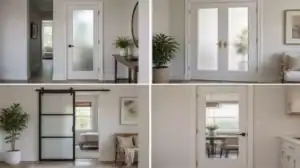 12 Frosted Glass Interior Doors That Add Light Without Losing Privacy
 19 Interior French Doors That Quietly Add $10K in Home Value
 A Less Formal Way to Use French Doors in a Casual Interior