A bookcase with glass doors protects collectible books from one threat very well and from two others hardly at all. Dust is the easy one, because a closed door stops the air from carrying it onto the shelves. Humidity and light still need your attention, and our double door designs show the same glass idea at room size.
Some product links below are Amazon affiliate links. As an Amazon Associate we earn from qualifying purchases.

What the glass really does
Glass doors keep dust off books by closing the shelf face, so the cabinet only protects as well as the doors fit. They do not control humidity, and ordinary glass does not stop the light that fades spines. Place the cabinet away from windows, keep the doors shut and add a cheap hygrometer to watch the damp.
How Glass Doors Keep Dust Off the Shelves
Dust is more than untidy. The Northeast Document Conservation Center says that “particulates, which include dust, soot, and mold, can abrade, soil, and disfigure materials.” It also notes that “silica in dirt can be very abrasive,” which is why gritty dust is harder on paper and cloth than the soft gray fluff it looks like.
Open shelves let room air flow straight across the spines. A glass door breaks that flow, so only a little dust gets in when you open it for a book. The doors do the job only when they sit snug, because a gap at the center seam or the edges lets air, and dust, drift back in.
The diagram marks five spots. The top of the cabinet (1) collects dust that falls into the shelves each time you open the doors, and the seam between the doors (2) is the usual leak. Packed shelves (3) leave no air gap, while warm light (4) and a window path (5) matter for the next two sections.
Fixing the seam is cheap. Self-adhesive clear bumpers on the door edges close a small gap and stop the doors from rattling.
Shop this fix
Close the gaps and dust the top
- DOOR BUMPERSClear self-adhesive cabinet door bumpersShop on Amazon
- EXTENDABLE DUSTERExtendable microfiber duster kitShop on Amazon
As an Amazon Associate we earn from qualifying purchases.
Dust the top of the cabinet first and the glass last, so you do not carry dust down onto clean surfaces. A microfiber head traps dust instead of pushing it around, and it can be washed.
Where the Glass Stops Helping: Humidity
A glass door does not make a cabinet airtight. The preservation guidance from NEDCC lists 30% to 60% relative humidity for books in rooms people use, at about 68°F, and warns that mold “will become active when the environment becomes warm and damp.” Your living room is the climate your books live in, doors or no doors.
That is why a cheap hygrometer is worth more than any cabinet feature. Put it on the shelf for a week, and you will know if the room swings above that range in summer or drops in winter. If it does, fix the room first with ventilation or a dehumidifier, not the cabinet.
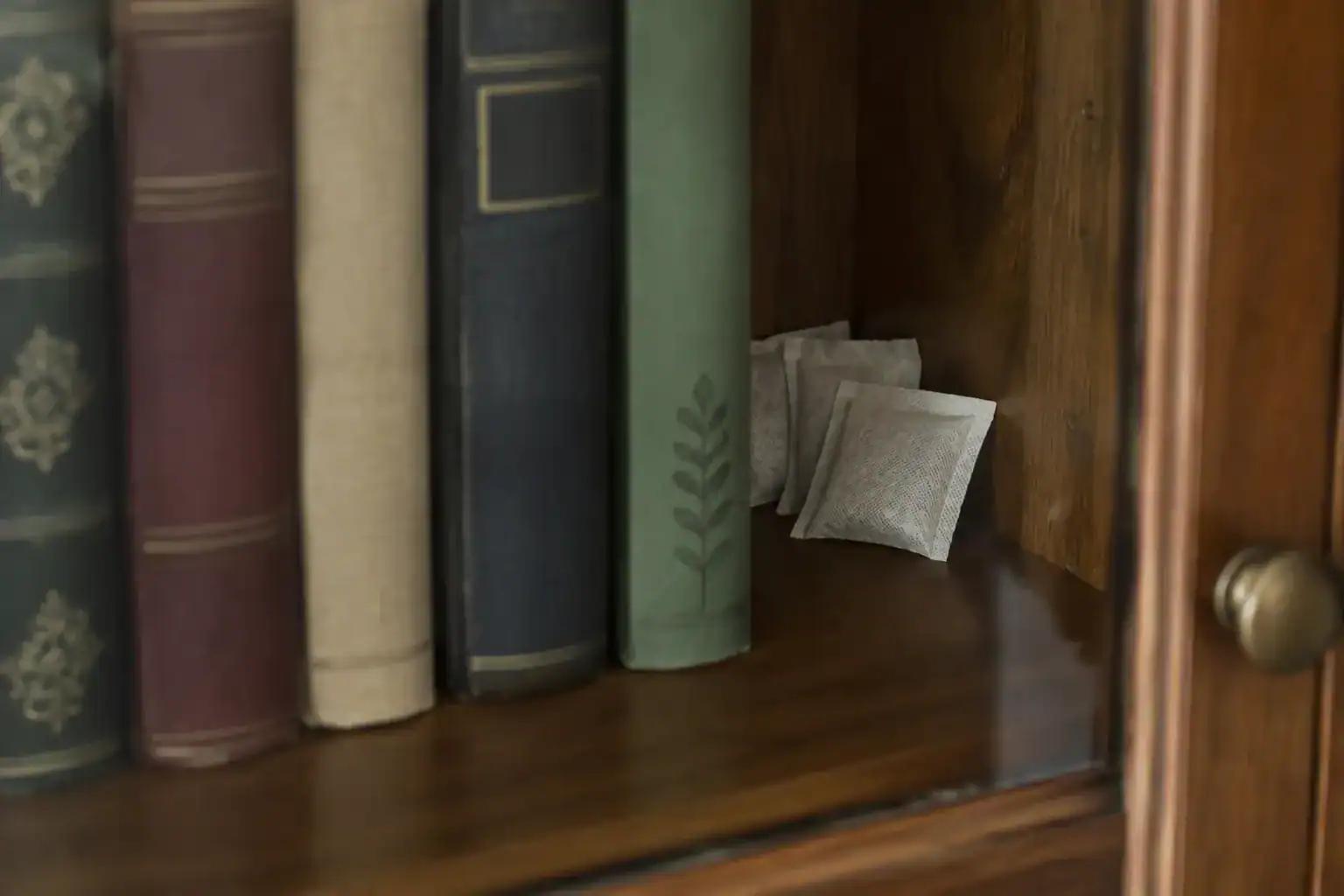
Silica gel is the popular fix, but it helps most in a very tight case. The Canadian Conservation Institute says a well-designed glass and metal display case “can easily reach an air exchange rate as low as 0.3 per day.” A household bookcase is not built to that standard, so a few packets will soften small swings and not much more.
If you add packets, buy the color-indicating kind, keep them away from children and pets, and dry or replace them when they change color.
Shop this idea
Measure the damp, then buffer it
- HYGROMETERDigital hygrometer and room thermometerShop on Amazon
- SILICA GELColor-indicating rechargeable silica gel packetsShop on Amazon
As an Amazon Associate we earn from qualifying purchases.
Light Is the Quiet Threat Behind Glass
Light is the slow threat that glass does not stop. NEDCC says “ultraviolet radiation will lead to weakening, bleaching, and yellowing of paper.” Its light leaflet adds that “standard office lighting is around 400 lux and direct sunlight measures 30,000 lux,” about 75 times as much light on a sunny shelf as under office lamps.
The same leaflet gives a way to count the damage. Harm grows with light level multiplied by hours, a measure called lux hours, and “ideally, light-sensitive materials would have an annual exposure of only 50,000 lx h.” Try your own shelf below.
A shelf beside a window can land far above that yardstick. That matters little for a paperback, but a signed first edition or an old dust jacket deserves the placement rules below.
Glass alone is not the answer. The leaflet lists UV-filtering films for "windows, exhibit cases, glass fronted cabinets," so a clear film on the cabinet glass or the nearby window is a direct fix. The cheapest fix is distance, since NEDCC advises keeping collections "off of top shelves and away from direct sunlight from windows and skylights."
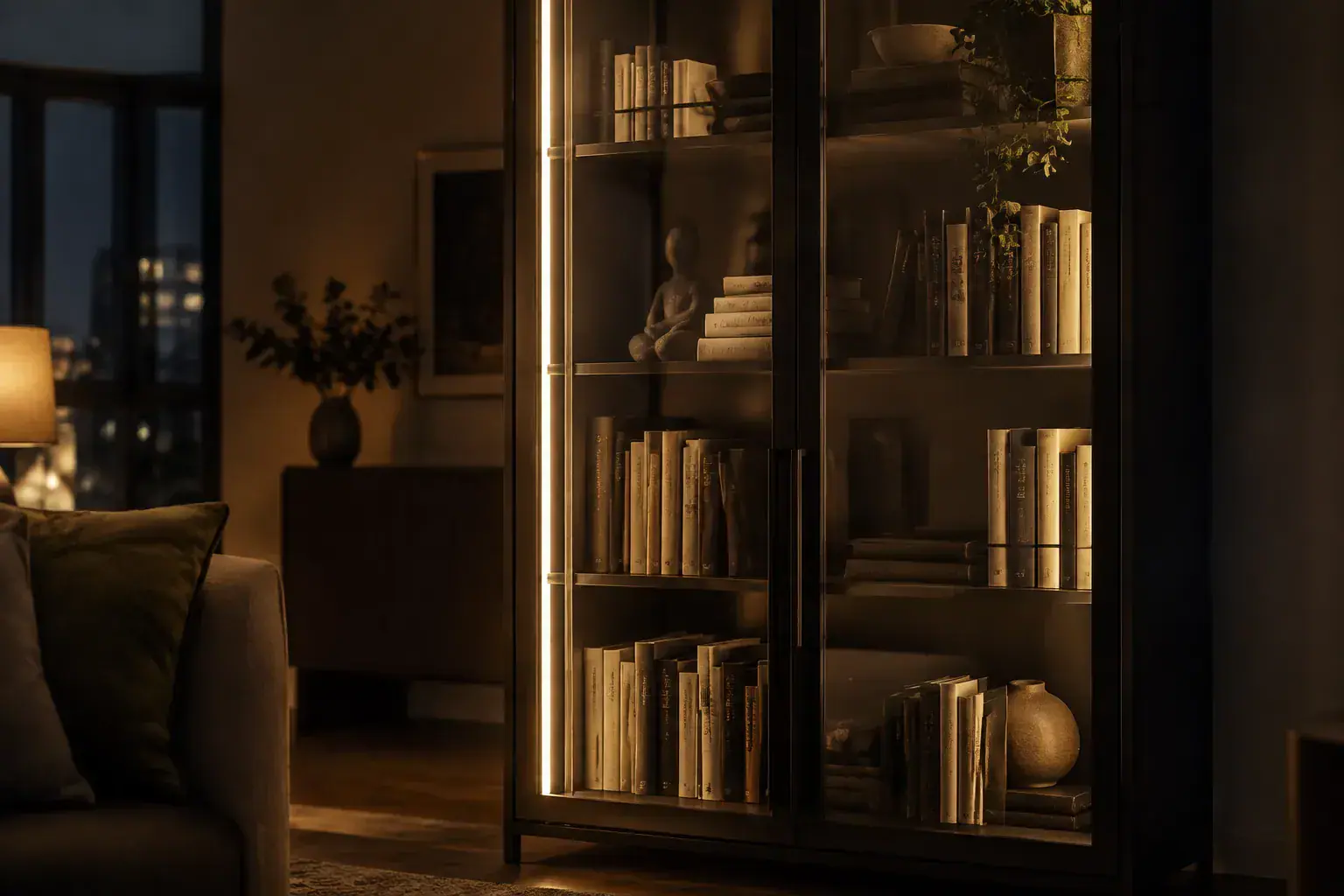
Light the display with LEDs rather than bulbs. NEDCC states that "LEDs do not emit UV or IR radiation and the light does not generate heat," and adds that LEDs used inside a case should be rated for an enclosed space. Pick a warm white so covers keep their color, and switch the strip off when nobody is looking at the shelves.
Shop this idea
Block UV and light the shelves safely
- CLEAR UV FILMClear UV blocking window film for glassShop on Amazon
- LED STRIP KITDimmable under cabinet LED light kit with remoteShop on Amazon
- PUCK LIGHTSBattery puck lights with remoteShop on Amazon
As an Amazon Associate we earn from qualifying purchases.
Choosing a Cabinet That Closes Tight
The cabinet matters because the doors are the whole defense. Look at three things before you buy: how the doors meet, how deep the shelves are and whether the doors lock.

A tall metal display cabinet suits a narrow wall and holds books at eye level, and its adjustable shelves fit art books on one tier and paperbacks on another. A bookcase with glass above and solid doors below shows your best books and hides papers and supplies, so it suits a home office. A locking curio cabinet is the quietest choice for a shared room with children.
Test the doors before you load the shelves. Close them on a strip of paper at the seam and at each corner, and if the paper slides out freely, the gap is wide enough for dust.
Shop this idea
Glass door cabinets for books and collectibles
- METAL DISPLAY CABINETTall display cabinet with glass doors and adjustable shelvesShop on Amazon
- CURIO CABINETLocking curio display cabinet with glass doorShop on Amazon
- WOOD BOOKCASETall wood bookcase with glass doors, whiteShop on Amazon
As an Amazon Associate we earn from qualifying purchases.
Anchor tall cabinets to the wall
A tall cabinet full of books and glass can tip if a child climbs it or a shelf is overloaded. Use the anti-tip hardware that comes with the cabinet and screw it into a wall stud, then keep the heaviest books on the lowest shelves.
Shelf Habits That Protect the Books
Pack the shelves firmly enough that books stand upright and no tighter. A book squeezed in with no air around it rubs its neighbors each time you pull it out, and a half-empty shelf leans unless something holds the row.
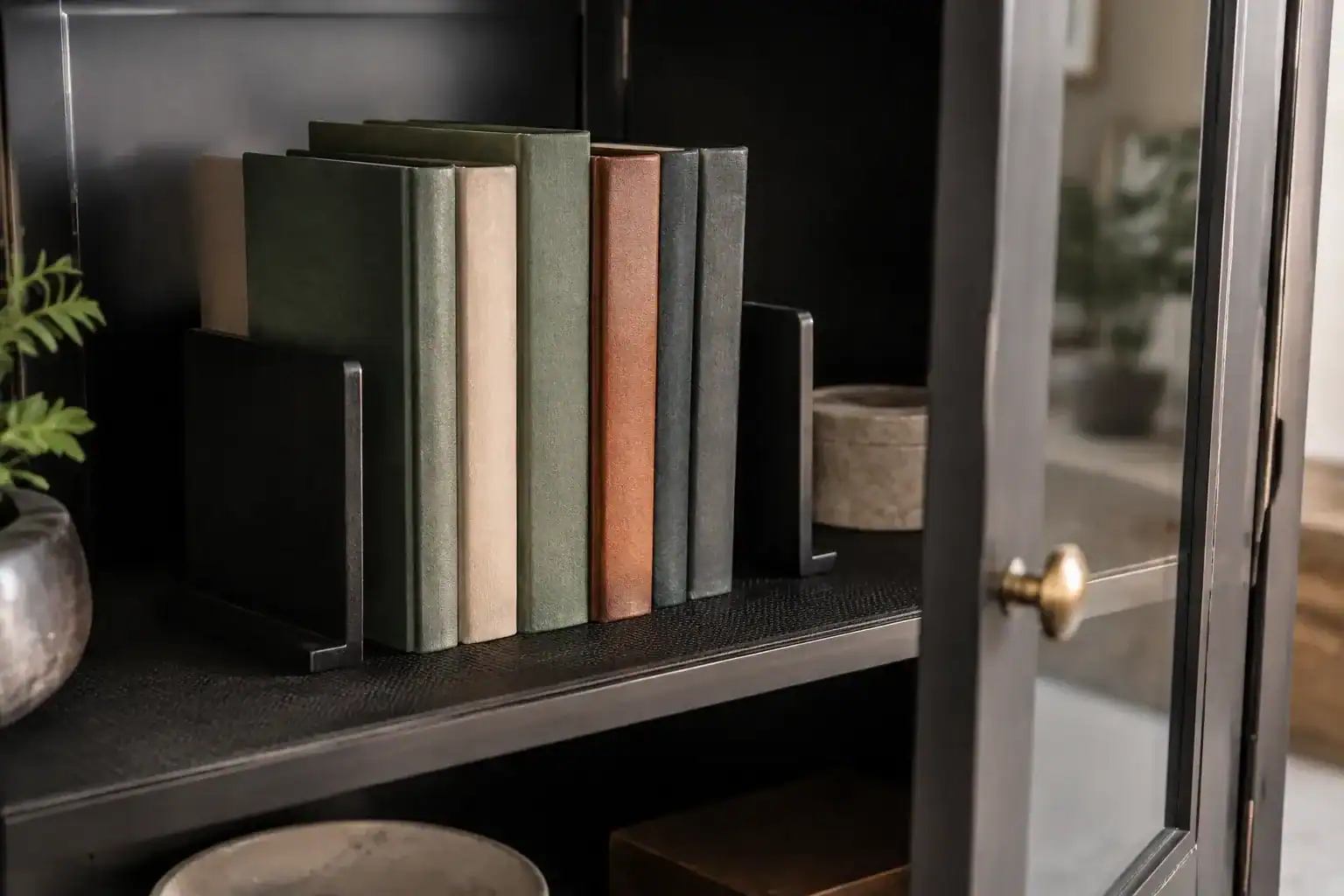
A non slip liner stops books from sliding when you open the door, and a pair of heavy bookends keeps a short row from leaning. Cut the liner to fit and leave a small gap at the back for air.
Loose papers, maps and prints do not stand up on a shelf. NEDCC advises storing sensitive material "in custom protective enclosures or boxes of acid-free, lignin-free, buffered paper or board," so give those items a lidded archival box and shelve the box like a book.
Shop this idea
Liners, bookends and a box for loose papers
- SHELF LINERNon slip shelf and drawer liner, blackShop on Amazon
- BOOKENDSHeavy duty metal bookends, blackShop on Amazon
- ARCHIVAL BOXAcid-free archival storage box with metal edgeShop on Amazon
As an Amazon Associate we earn from qualifying purchases.
Three Myths About Glass Door Bookcases
Myth one says glass makes a cabinet airtight. It does not, so humidity belongs to the room and not the cabinet. Myth two says silica gel will rescue a damp room, but a leaky cabinet cannot hold the air that the gel has dried.
Myth three says LED lighting harms old paper. The reverse is closer to the truth, since NEDCC notes that LEDs emit no UV or IR and do not generate heat.
Before you load a new cabinet, run through this list.
- Measure the wall space and the ceiling height
- Close the doors on a paper strip to test the seam
- Keep the cabinet out of the path of direct sun
- Put a hygrometer on the shelf for a week
- Choose warm white LEDs for any inside lighting
These checks take a few minutes and protect the books for years.
Our take · James Davis
If you only buy one thing, buy the cabinet with the tightest doors. Every other fix in this list helps, but nothing beats a closed door for keeping paper clean.
The cabinet is a small display case, so give it the same care you give the books inside it.
Quick Answers on Bookcases With Glass Doors
Do glass doors protect books from fading?
Not by themselves. NEDCC lists UV-filtering film as the fix for glass fronted cabinets, so keep the cabinet out of direct sun and consider a clear film on the glass.
Can I keep a bookcase with glass doors in a kitchen?
You can, but kitchen air carries grease and steam, which settle on the glass and swing humidity. Place it as far from the stove and sink as the room allows and wipe the glass often.
How often should I dust inside a glass door bookcase?
Dust the top and the glass whenever you see a film, and wipe the shelf edges a few times a year. Closed doors keep the inside much cleaner, so inside dusting is rarely needed.
Do I need a hygrometer for a glass door bookcase?
It is the cheapest way to learn whether your room is too damp or too dry for paper. Check it for a week in each season, and act only if readings stay outside the range NEDCC lists.
Related posts
 Why Your Door Lock Keeps Clicking or Beeping and How to Fix It
 Why Are My French Doors Leaking? Causes and Fixes
 Why Do French Doors Have the Knob in the Middle?
 Why Choose French Doors
 Why Deep Green and Navy Front Doors Are Easier to Live With Than Black
 Why Sliding Doors That Open in the Middle Beat a Standard Slider
 Why Black Front Doors Fade Faster in Full Sun
 Why Sliding Patio Doors Get Harder to Open Over Time