A pivot front door does not hang from hinges on its side. It turns on a pin in the floor and another at the top, set a little in from the edge, so the whole slab swings around that point. That is why it looks so striking. It is also why the questions that matter differ from an ordinary door: how much it weighs, how rain gets past it and how much room you have to swing it. This guide explains how a pivot front door works, what to check before you buy one and what it costs, using manufacturer guides and trade sources.
Best for most entries
Offset pivot
Best for wide, balanced openings
Center pivot
Best for slim frames and big glass
Top pivot (TP-R)
Best for heavy doors that must latch
Hydraulic self-closing pivot
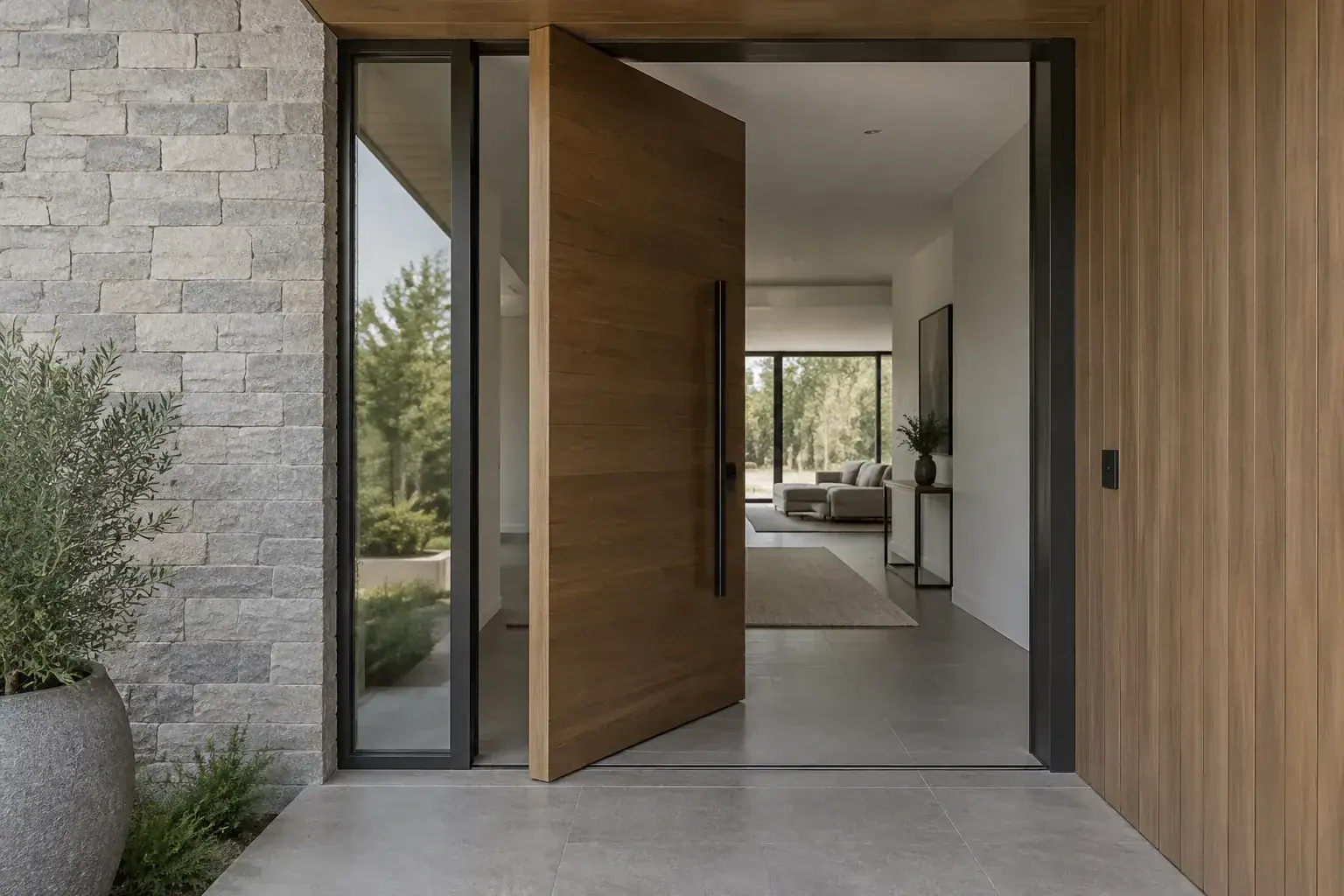
How it works
What is a pivot front door and how does it work?
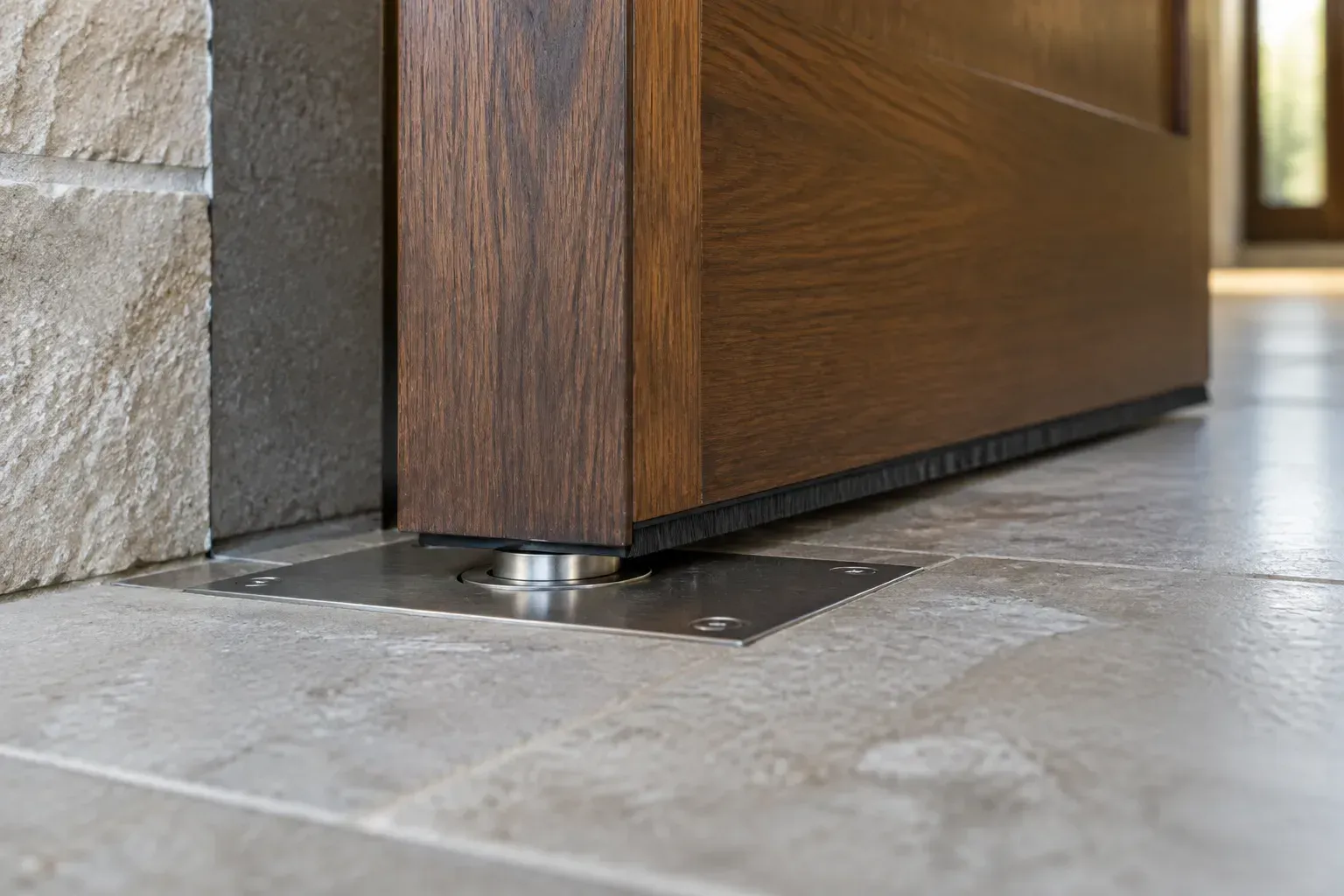
A pivot door rotates on a vertical axis between two points, one in the floor and one in the head of the frame or the ceiling, instead of swinging on side hinges. The weight of the door goes down through the floor pivot instead of hanging from the side frame. A single hinge system can be rated anywhere from 20 kg up to 500 kg (1,100 pounds), depending on the model, which is why very large slabs are possible.
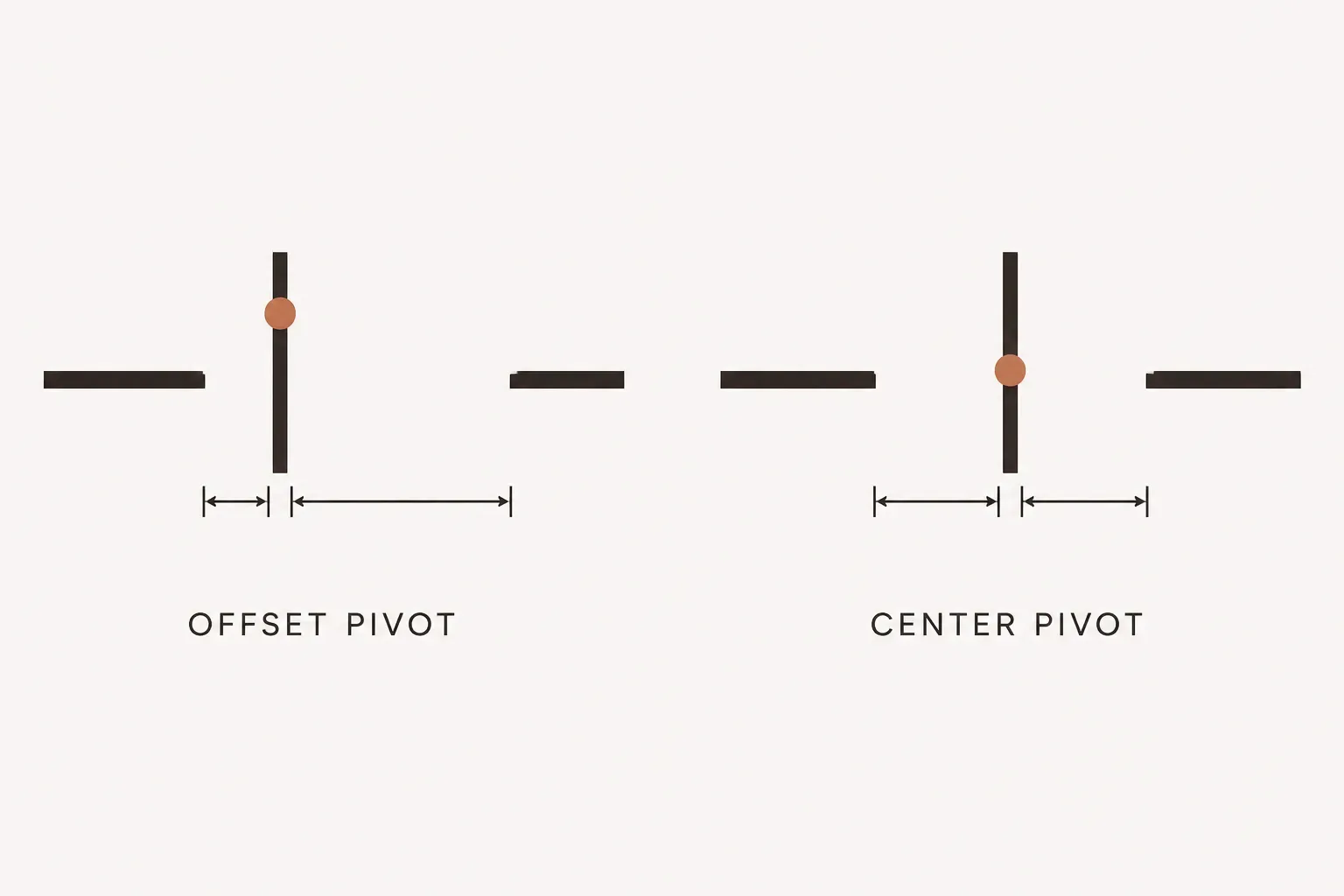
Because the pivot sits in from the edge, opening the door splits the doorway into a wide side and a narrow side. The pivots are usually offset by about one third of the leaf width, which leaves an opening of about two thirds of the width on the wide side. Where exactly the pivot goes varies by maker. On select Andersen models it sits 4 inches from the panel center on an outswing door and 12 inches on an inswing door (Andersen spec sheet).
A quick calculation
With the pivot one third in from the edge, a 36-inch slab leaves a wide side of about 24 inches (36 × 2/3). The maker Urban Front’s own published figures show a similar effect. On a 1,200 mm (about 47-inch) doorset the walkthrough is 930 mm (about 37 inches), against 1,113 mm (about 44 inches) for a hinged door of the same width. These are my conversions and ratios. They suggest the wide side is roughly two thirds to three quarters of the door width, depending on where the pivot sits.
What matters
What should you check before choosing a pivot front door?
Most of the trouble with pivot doors comes from things a hinged door never asks you to think about. These are the ones worth settling before you fall in love with a photo.
- Door weight. The hinge system is chosen from the door’s weight, dimensions, function and finish. Don’t order until the weight, function and size are confirmed.
- Minimum width. One UK maker says its pivot doors need to be at least 1,000 mm (about 39 inches) wide to work well, and another page quotes 1,200 mm (about 47 inches). A standard 36-inch US slab is narrower than both, so ask each maker for its minimum.
- Structure above and below. Large openings usually need a steel or concrete lintel at the head, and a retrofit means checking that the existing structure can carry the new door. The floor plate also needs a recess: FritsJurgens lists 8 to 11 mm (about 5/16 to 7/16 inch) of depth.
- Weather and the threshold. Urban Front says the area of about 2 mm around the top and bottom pivots is not covered by its drop-down seals, so driving rain can get in. It recommends a sheltered position such as a porch, a set-back doorway or an overhang at least half the size of the doorway. A flush threshold also needs drainage planned before installation, such as a slot drain.
- Tested performance. Ask for numbers for the complete door. As an example of what exists, Andersen’s sheet lists air infiltration of 0.17 CFM per square foot and a water test pressure of 12.11 PSF. It also lists design pressure of +60/-60 with a multi-point lock against +30/-30 with a single-point lock. The sheet gives these as design pressure ratings, not wind ratings.
- Swing space and safety. The slab needs a clear arc, large openings may need a stay-open catch in wind and the gap at the pivot side can catch fingers. Some suppliers offer finger grooves for this.
- Upkeep. Timber weathers unless it is treated and maintained, and painted timber needs regular care. Aluminum costs more up front and needs much less maintenance.
Pivot vs hinged
How does a pivot door compare with a regular hinged door?
| Question | Pivot door | Hinged door |
|---|---|---|
| Where the weight goes | Down through the floor pivot, not the side frame | Hangs from the side hinges |
| Clear opening | Split into a wide and a narrow side; the wide side is roughly two thirds to three quarters of the width (my calculation above) | The slab swings out of the way; 1,113 mm against 930 mm on a 1,200 mm doorset (Urban Front) |
| Size | Larger-than-standard sizes are readily available; Andersen lists panels up to 5 feet wide or 10 feet tall | Most front doors are standard-size slabs |
| Weather sealing | Brush and drop seals, no overlapping frame stop; makers advise a sheltered entry | The frame stop overlaps the slab, which is the usual weather barrier |
| Space and wind | Needs a clear swing area; may need a stay-open catch | Needs a swing area too, with no pivot-side gap |
| Cost | Usually higher than a side-hung door; one UK maker prices them the same above about 1,200 mm wide | Lower for standard sizes |
Our take · George Anderson
If your front door takes weather head on, I would fix the shelter first and the door second. A pivot door is a design choice, and the makers’ own guides say it suits a protected entry. On an exposed wall I would stay with a hinged door and put the money into a good threshold and seals.
If sealing is what worries you about any door, our guide on how to weatherstrip a door explains the checks that apply to hinged doors too.
Pick a setup
Which pivot setup should you choose?
Offset pivot
This is the layout most guides describe as the default, with the pivot about one third in. It gives you a wide side to walk through and a narrow side to ignore. Measure the wide side against the biggest thing you will carry through the door, such as a sofa, a stroller or a wheelchair.
Center pivot
With the pivot at the middle of the slab, both sides of the open door are equal. That suits a very wide entry where each side is still a comfortable gap. By geometry, the slab then swings into both the hall and the porch at the same time, so you need clear space on both sides.
Top pivot (TP-R)
In a top-pivot-reversed system the pivot moves to the head jamb or ceiling and only a small receiver is cut into the top edge of the door. This allows thinner frames and larger glass openings. It is a good match for a minimal, glass-heavy entry, but the weight still has to go somewhere, so the floor detail matters as much as the head.
Hydraulic self-closing pivot
Not every pivot system closes the door for you. Some free-swing systems have no hold positions and no self-closing. Others are fully hydraulic with damping, hold positions and a latch control that speeds up the last degrees so the latch engages reliably. For a front door that has to close and lock behind a family, the closing function is worth paying for.
Cost
Are pivot front doors worth the money?
I could not find a current US price survey for pivot front doors, so treat every figure here as a rough guide and get several quotes. The most useful US figures I found are from a door dealer’s 2018 cost breakdown. It puts the overall range at $3,000 to $20,000. A standard-size wood style, about 3 feet wide by 6 feet 8 inches tall, comes to roughly $13,000 fully installed, and a 9-foot by 11-foot door to a little over $20,000. For a wood door with glass the same breakdown gives $5,000 for the door alone and $12,000 fully installed. By my arithmetic that makes installation the larger part of the bill in that example.
For a second reference point, the UK guide from Homebuilding gives pound prices that do not convert neatly to US costs. It lists pivot front doors from about £3,250 plus VAT and installation in a painted finish, aluminum pivot doors from around £1,200 per square meter and steel-framed ones from £3,000 and up per square meter. The two sources agree on one thing: a pivot door usually costs more than a side-hung one.
Our take · George Anderson
I would ask for the tested air, water and structural data in writing before paying a deposit. If a maker cannot show it for the exact door, lock and threshold you are buying, I would look at another maker. A bold hinged door in a strong color gets you much of the look for less. Our ideas on refined front door looks and Scandinavian front door designs show how far color and hardware alone can go.
A pivot door is worth it when three things are true. The entry is sheltered, the wide side of the opening is big enough for daily life and the budget covers the structure and a skilled installer, not just the slab. If one of those fails, a hinged door is the better buy. If the appeal is mostly drama, our roundup of door designs that make a room look more expensive has options that cost far less, and the front door ideas guide covers the rest.
Before you buy
What should you ask before buying a pivot front door?
- What does the door weigh, and which hinge class and capacity does the maker specify for it?
- What are the minimum and maximum width and height for this model?
- Where is the pivot set, and how wide is the clear opening on the wide side?
- Is there tested air, water and structural data for the complete door, with the same lock and threshold I am buying?
- How does the threshold drain, and what sits under the floor plate?
- What carries the weight at the floor and at the head in my house, and does the installer need an engineer to check it?
- Does it self-close and latch, or is it free swing?
- What does the warranty cover, and who services the hardware?
Watch for
Poor installation and cheap hardware cause most pivot door problems, and weatherstripping on a door that swings both ways can leak water and air. Do not order hardware before the door’s weight is confirmed, and do not accept a double-acting exterior door without asking how it is sealed.
Can a pivot front door swing both ways?
Yes, on some systems. Pivot hinges come in single-acting and double-acting versions, and pivot doors can be made inswing, outswing or both. Ask how the maker seals a double-acting exterior door, because the swing direction affects the seals.
Do pivot front doors leak in rain?
They can if they are exposed. Urban Front says a small area around the pivots is not covered by the drop-down seals and recommends a protected position. Doors with tested air and water ratings do exist, so ask for the numbers for the exact model.
Can I install a pivot door myself?
It is a heavy-duty job. The tool list is simple, but the door needs heavy-duty hardware, and in a retrofit someone has to confirm the structure can carry the new weight. Have a professional check the floor plate recess and the head support at least.
Is a pivot door good for people with limited mobility?
A level threshold helps wheelchair users and people with mobility issues. The clear opening is narrower than the slab, though, so measure the wide side and check any local accessibility rules that apply to your house.
The verdict
Choose a pivot front door if your entry is sheltered, the wide side of the opening is generous and the budget covers structure and installation. Pick an offset pivot for most houses, ask for tested weather data and a closing function, and stay with a hinged door if the entry takes the weather head on.
Related posts
 12 Natural Wood Door Picks That Work With Grey Floors—Not Against Them
 How to Maintain a Wood Front Door (And When It’s Not Worth It Anymore)
 Sliding French Doors: How They Work and What to Know
 Do Roller Blinds Work On French Doors
 Are 8 Foot Doors Worth the Money? A Comprehensive Guide
 12 Climate-Proof Main Door Design Ideas That Always Work
 10 Door Colors That Work With Painted Kitchen Cabinets
 The Real Cost of Woodworking: Is This Rewarding Hobby Worth the Investment?