
Salt air does three things to a front door. It dulls the finish, it eats the metal parts, and it works its way into every gap where a little water can sit. None of it looks dramatic in the first year. That is why a door that was perfect at move-in can have a chalky finish, a stiff lock and rust streaks under the hinges by year three. The fix is not a special product. It is a short routine of rinsing, inspecting, lubricating and touching up, done on a schedule that matches how close you are to the water.
Before you start
Plan on a short session every three months and a longer one once a year. Skill level: any confident DIYer. The tools that matter are a hose with a soft nozzle, a soft cloth and the right lubricant. What decides success is frequency: salt that is rinsed off regularly does far less harm than salt left to bake on. Rust-through at the hinges, a soft or rotting frame, or a door that no longer closes square is a job for a pro.
5 miles
From salt water, inside which Therma-Tru excludes multi-point locks and hinge mechanisms from its warranty
3 months
How often Loewen says to wash windows and doors in a coastal environment
6 months
How often Loewen says to lubricate door hinges and locksets and to check perimeter seals
Those figures come from the door makers themselves (Therma-Tru, Loewen). They are one maker’s rules each, so check the guide for your own door, but they are a good yardstick for how often coastal care really is.

Check / Your exposure
Does your front door need coastal care?
If you can taste or smell the sea at the door, yes. Distance matters, but it is a sliding scale rather than a line. On an oceanfront house, rinse seaward-facing surfaces monthly. At 1 to 3 miles inland, rinse quarterly and after storms, and in high-salt zones do it twice as often. Therma-Tru draws its own warranty line at 5 miles, which tells you how far the effect is taken seriously.
Our take · George Anderson
I would treat the hardware, not the door slab, as the part to protect first. A fiberglass door can look fine for years while the hinges and the lock behind it quietly corrode. If the house is within sight of the water, plan the routine from day one rather than waiting for the first rust streak.
If you are also choosing a new color for a coastal entry, see beach house front door ideas and coastal front door colors.
Gather / Tools
What do you need for coastal door care?
- A garden hose with a soft spray nozzle, so you can rinse at low pressure
- A soft cloth or sponge, a soft-bristled brush and mild detergent
- Compressed air in a can, or a small hand blower, for sand and salt in moving parts
- A marine-grade or waterproof lubricant that your lock and hinge maker accepts
- Touch-up paint or stain from the door maker, in the exact finish of your door
- Stainless steel screws if any fasteners are rusty, and a notebook for a care log
Step 1 of 4 / Rinse and clean
How do you rinse and clean a front door in salt air?
Start with fresh water. Rinse exterior frames and surfaces at low to medium pressure with a mild detergent, and avoid high-pressure nozzles. In coastal areas, clean the hardware more often with a mild detergent and a soft cloth, and skip harsh chemicals and abrasives (Andersen hardware care). Caustic cleansers strip the protective coating on multi-point handlesets, and a damp cloth cleans them safely.
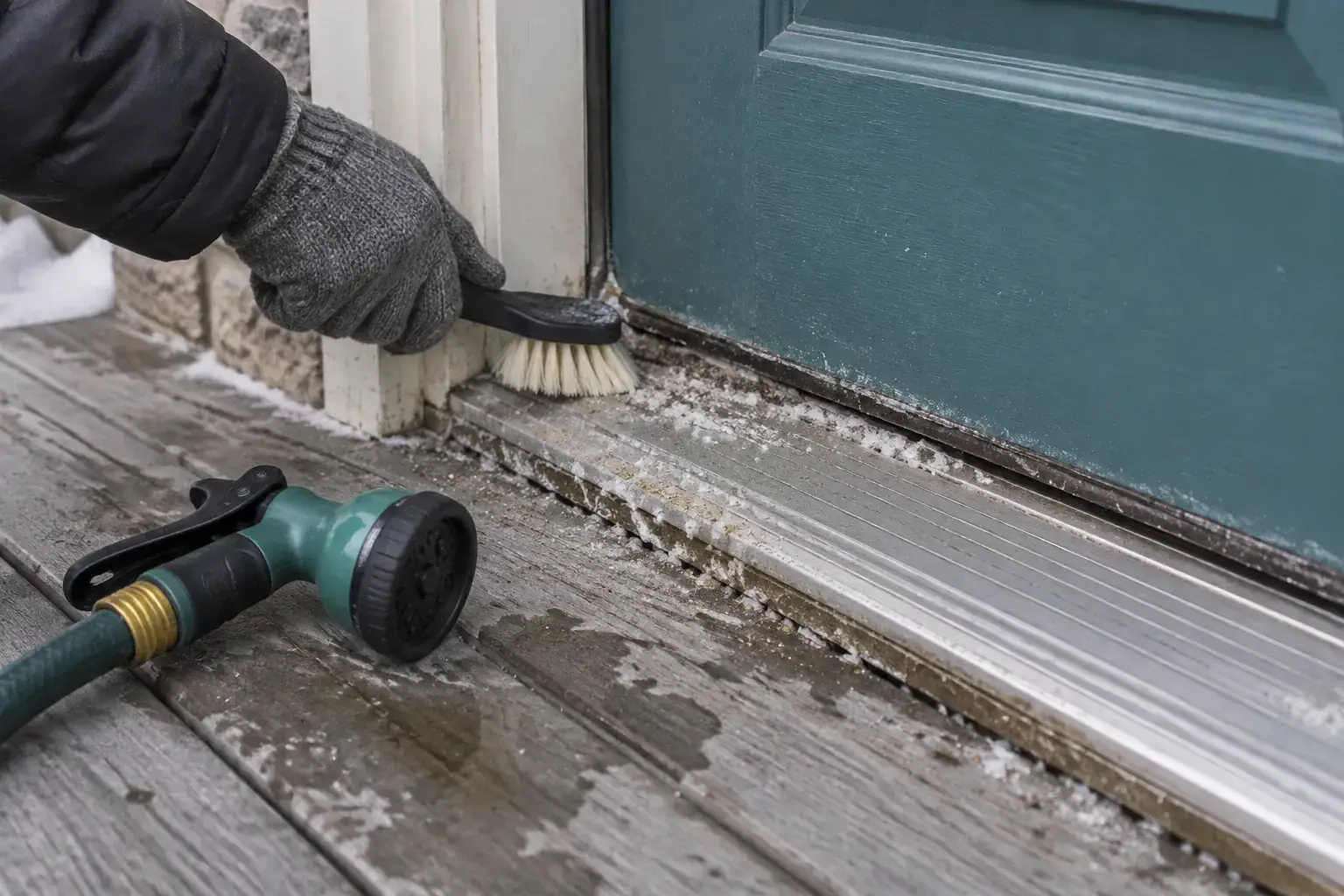
- Rinse the whole door, frame and threshold with fresh water. Keep the pressure low and work from the top down.
- Brush sand and salt crust out of the threshold and sill with a soft brush before it turns into paste.
- Wash the slab and frame with mild detergent and a soft cloth. Skip harsh chemicals, abrasive pads and caustic cleaners.
- Rinse again, then wipe the hardware dry so salty water does not dry on the metal.
Step 2 of 4 / Inspect
What should you inspect on a coastal door?
Therma-Tru’s annual inspection list covers fading of the finish, weatherstrip seals that no longer seal well, wear on the door bottom or sill gasket, and splitting or cracking in a vinyl threshold or oak riser. Loewen adds perimeter seals and sill weep holes every 6 months, and says to repair or replace caulk that is cracked, divoted or pulling away.
- Look at the finish for fading, chips, bubbling or chalky patches, and note where they are.
- Check the weatherstrip, door bottom and sill gasket for wear or cracks. If the seal no longer seals, our guide on how to weatherstrip a door covers the replacement.
- Clear the sill. If your threshold has weep holes, vacuum the debris and clear the holes with a small soft brush.
- Check the caulk or sealant around the frame and replace any that is cracked or pulling away.
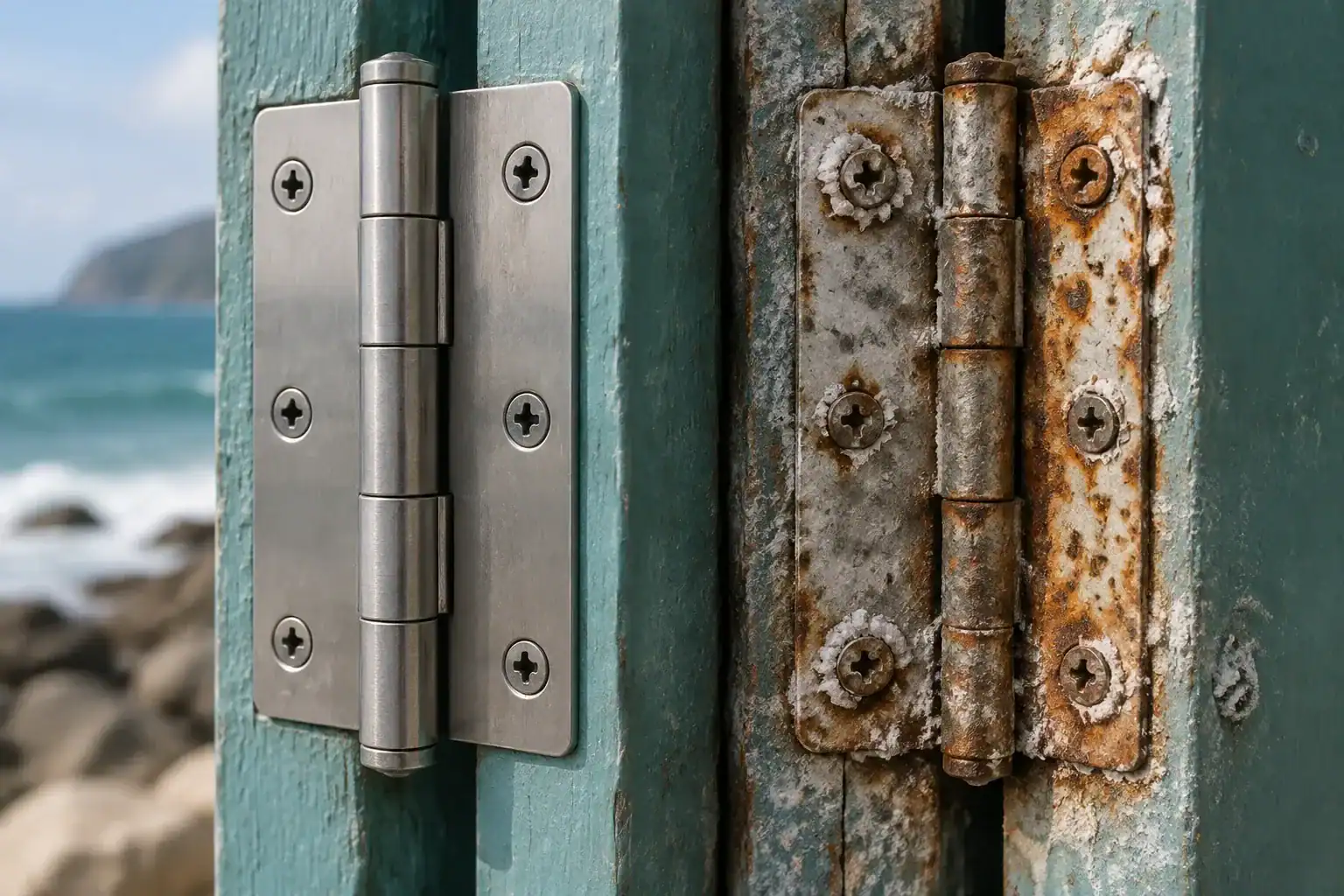
- Look at the hinges, screws and lock for rust, pitting, or white or green crust, and write down anything that needs replacing.
Step 3 of 4 / Protect the metal
How do you protect the lock and hinges from salt?
Lubricate door hinges, locksets and multi-point mechanisms every 6 months with a marine-grade or waterproof lubricant, and use compressed air to clear sand and salt from moving parts. Loewen warns that silicone sprays can make some plastic parts brittle, although other coastal guides suggest silicone, so use whatever your lock and hinge maker approves. For the hardware itself, 316 stainless steel is the best choice, because its corrosion resistance comes from the base metal rather than a plating. Avoid plated chrome, brass and oil-rubbed bronze near salt water. Our guide to door hardware finishes for coastal homes compares the options.
- Blow sand and salt out of the lock, latch and hinge knuckles with compressed air.
- Lubricate the hinges and lock with a marine-grade or waterproof lubricant that your maker accepts, work the door a few times and wipe off the excess.
- Replace rusted screws with stainless steel ones. Near the water, choose 316 grade.
- Plan to replace pitting hardware rather than polishing it. If you have brass, note that Andersen advises against re-applying a clear coat in corrosive environments, because tarnish can form underneath it.
Warranty check
Therma-Tru says installations within 5 miles of salt water are excluded from its multi-point lock and hinge mechanism coverage, and that hinge finishes are not warranted at all, so rust is not covered. Loewen asks owners to keep cleaning records through the warranty period as evidence for any claim. Read your own warranty, and keep a short log with dates.
Step 4 of 4 / Fix the finish
How do you fix and renew the finish?
Therma-Tru says nicks and scratches can be spot-repaired with stain and then a thin topcoat. It says fiberglass doors should be finished within 6 months of installation, and bare wood such as frames should be primed and topcoated within 2 weeks of installation or before weather exposure. The beach-home guide mentioned earlier suggests reapplying salt-resistant paint every 3 to 5 years and re-sealing joints around doors and windows each year.
- Touch up chips the day you see them. Clean the spot, let it dry, repair it with the door maker’s stain or paint, then add a thin topcoat.
- Never leave bare door or bare wood frame exposed. Follow the maker’s finishing instructions for any worn or bare area.
- Plan a full refinish when the finish turns chalky across the whole door. Treat 3 to 5 years as a rough guide for painted surfaces in salt-heavy settings, and check your maker’s rules first.
- Re-seal the exterior joints around the frame once a year.
Our take · George Anderson
A chip is a quick touch-up the week you see it and a stripping job a season later. If I could change one habit for coastal owners, it would be the touch-up kit. Keep the exact stain or paint from the door maker in the garage, labeled, so there is never an excuse to wait.
Choose / Door material
Which door material holds up best in salt air?
Most coastal guides point to fiberglass first. The beach-home guide linked above lists fiberglass frames or aluminum-clad wood for doors and windows, and advises avoiding uncoated carbon steel and standard wood in extreme exposure.
- Fiberglass. It contains no iron, so the slab does not rust. It still needs its finish maintained, and its hinges and lock are still metal, which is where salt does the damage.
- Steel. It relies on a zinc coating that salt air gradually wears away, so a scratch that reaches bare metal should be touched up right away. A deep porch overhang helps by keeping spray and rain off the door.
- Wood. It needs a finish made for harsh exposure, renewed before it fails. I found no reliable recoat interval for wood in salt air, so follow the finish maker’s directions.
Common mistakes
What mistakes shorten a coastal door’s life?
- Pressure washing the door. Loewen says to avoid high-pressure nozzles. Use a soft nozzle at low pressure instead.
- Using harsh or abrasive cleaners. They strip protective coatings. Use mild detergent and a soft cloth.
- Spraying any product on any lock. Some lubricants can damage plastic parts. Use one your lock and hinge maker approves.
- Clear-coating tarnished brass. Tarnish can form underneath the coating. Replace the hardware instead, or follow the maker’s directions.
- Waiting to touch up chips. Bare metal rusts, and a coating that is breached stays breached. Repair chips as soon as you see them.
Schedule
How often should you do each job?
Use this as a starting point and shorten the intervals the closer the door is to the water.
| When | Job | Basis |
|---|---|---|
| After storms or heavy spray | Rinse the door, frame and hardware, then inspect | Beach-home guide |
| Every 3 months in a coastal setting | Wash the door, frame and threshold and clear grit from the sill | Loewen |
| Every 6 months | Lubricate hinges and lock, clear weep holes, check perimeter seals | Loewen |
| Once a year | Full inspection, touch-ups and re-sealing of exterior joints | Therma-Tru, beach-home guide |
| Every 3 to 5 years | Refinish painted surfaces in salt-heavy settings (rough guide) | Beach-home guide |
How close to the ocean counts as coastal?
There is no single line. Therma-Tru limits its lock and hinge coverage within 5 miles of salt water. One beach-home guide suggests monthly rinsing on the oceanfront and quarterly at 1 to 3 miles inland, and Loewen’s 3-month washing interval is for coastal settings generally. The closer you are and the more spray the door sees, the shorter your intervals should be.
Which lubricant should I use on a salt-exposed lock?
Guides disagree. Loewen recommends a marine-grade or waterproof lubricant and warns that silicone sprays can make some plastic parts brittle, while other coastal guides suggest silicone. Follow the instructions from your lock and hinge maker.
Will a porch roof or a storm door help?
A deep overhang keeps spray and rain off the door and can extend the life of a steel one. Therma-Tru says a properly installed and vented storm door does not void its door warranty, but it is not responsible for damage the storm door causes, so check the vent and fit.
How can I tell the finish is wearing out?
Look for fading, chalky patches and chips. On a steel door, bubbling or flaking paint can mean rust has started underneath, so treat it quickly.
The short version
Rinse the door and hardware on a regular schedule, lubricate hinges and locks every six months with a product the maker approves, and replace pitting hardware with 316 stainless steel. Touch up chips right away and read your warranty. The closer you are to the water, the shorter the intervals.
Related posts
 Bifold Door Makeover From Builder-Basic to Built-In Looking
 Transform Interior Doors From Builder Basic to Designer Looking
 Curtains for Closet Doors That Hide Clutter Without Looking Makeshift
 How to Keep a French Door Closed
 How to Keep Your Shed Door Open: A Comprehensive Guide
 12 Interior French Door Ideas Designers Keep to Themselves
 14 Door Mat for Front Door That Won’t Fade in Full Sun
 10 Pet Door Ideas for Homes Where You Don’t Want to Ruin the Front Door