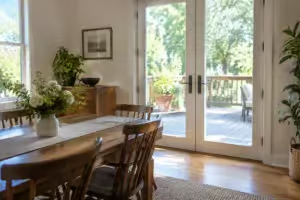
You can change inswing French doors to outswing, but on an exterior pair it is rarely a simple flip. The frame, hinges, threshold and seals all have to change, and many people end up replacing the whole unit with a true outswing door.
An interior door with a square-edged slab is much easier. For an exterior pair, price both routes before you start cutting.
Why people want outswing doors
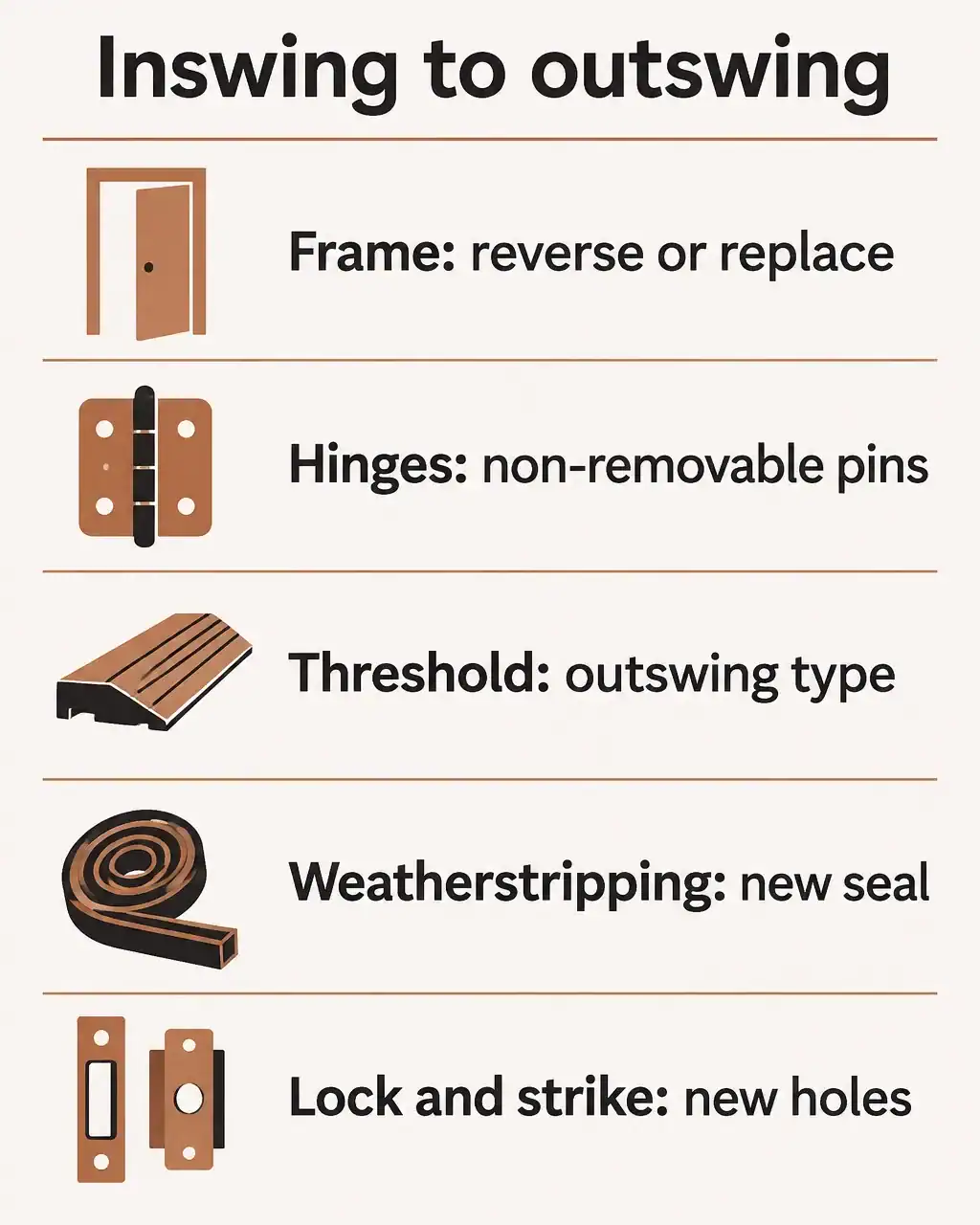
Milgard’s guide to outswing French doors says a standard 72 by 80 inch unit uses about 15 square feet of swing space inside. An outswing door moves that space outdoors. Furniture can sit closer to the doors.
The hinges sit outside and the interior frame can look slimmer. Milgard also says outswing doors use compression gaskets, and wind pushes the door into its seals rather than forcing it open.
What to check first
Heavy snow can block an outswing door, according to Milgard, and a covered patio or deck helps. Outswing doors also cost more, because they need weatherproof hinges and specialized weatherstripping.
Codes matter too. Milgard says outswing doors generally don’t violate residential codes, but many local codes want front entry doors to swing inward for emergency access. Check with your local building department, and with your homeowners association if you have one.
Why exterior doors are harder
Engineer Fix says that reversing the swing leaves the jamb and threshold facing the wrong way for weather sealing, which can let water in.
For an exterior door, its answer is to remove the whole prehung unit and reinstall it facing the other way, or replace it with a proper outswing unit. The jamb also has to be strong enough to take new hinge mortises.
What has to change
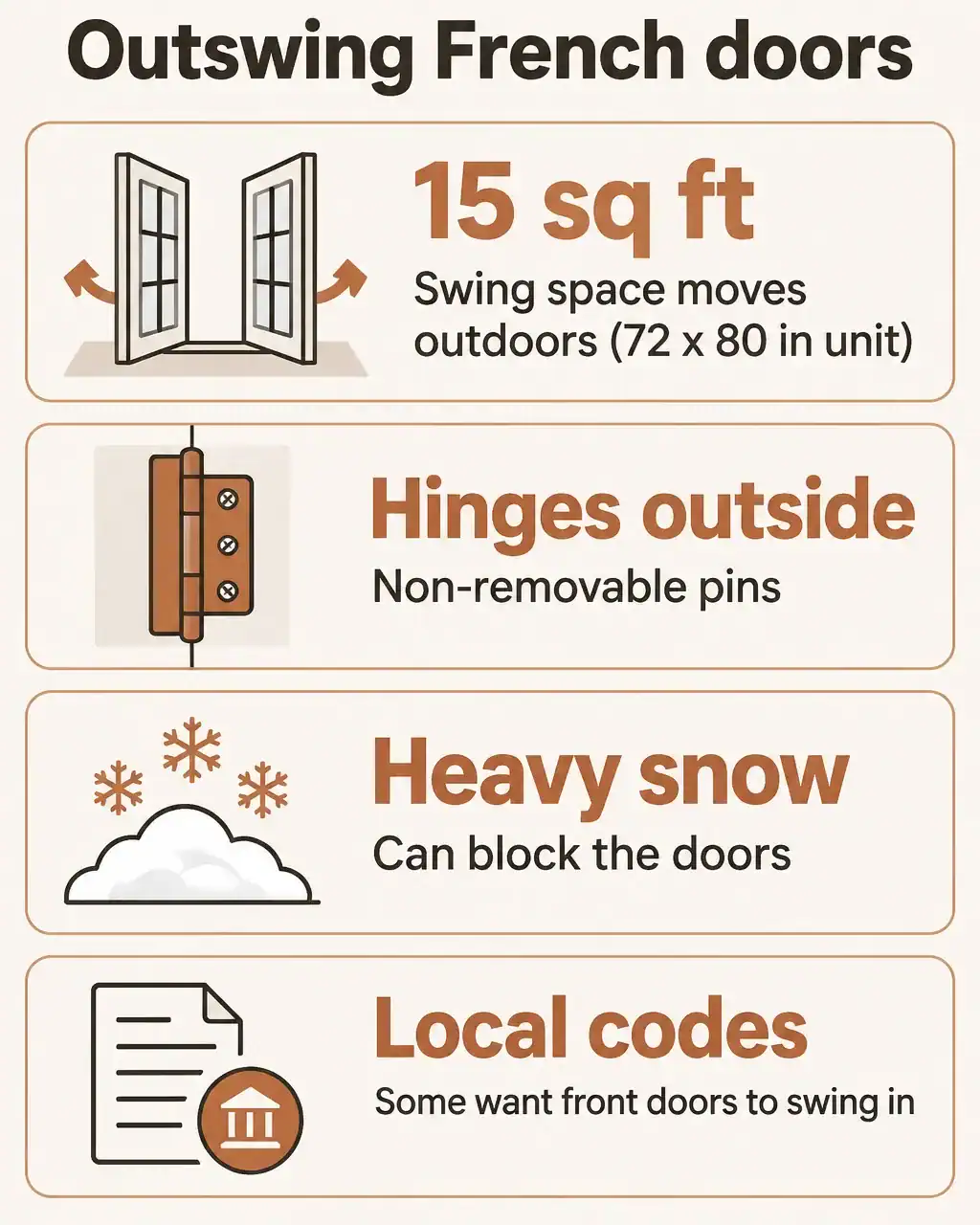
- The frame, which is reversed or replaced and must hold new hinge mortises.
- The hinges, which move outside and should be non-removable pin or security-pin types.
- The threshold, which needs an outswing design that slopes to shed water.
- The weatherstripping, which needs a new compressible seal around the whole perimeter.
- The lockset and strike, which need new holes at the right height, with the old ones patched.
On the hinges, Milgard notes that makers use non-removable pin hinges to deal with tampering, since the hinge side faces the outdoors.
The simple case: a square interior slab
For a simple interior door, Engineer Fix describes pulling the hinge pins, filling the old mortises with plugs and glue and sanding them flush. You then flip a symmetrical slab, bore new lock and strike holes and cut new hinge mortises.
Leave about a 1/8 inch gap around the edge so the door closes flush against the stop. For a pair, the astragal on the meeting edge also has to move, as covered in how to change which French door is the opening leaf.
Check the outside clearance
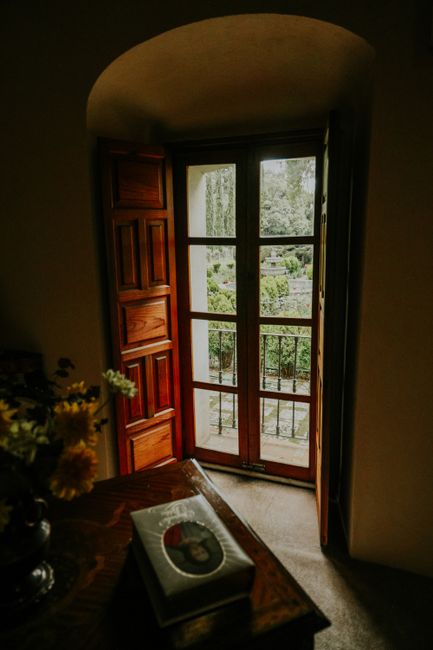
Engineer Fix also says to check that the door opens fully without hitting landscaping, steps or railings. A railing or a planter that is fine today can stop the doors tomorrow.
Convert or replace · George Anderson
If the pair is exterior, I would get a quote for a real outswing unit before I touch the old one. The threshold and the seals are the parts that cause leaks later, and a unit built to swing out comes with them done.
Before you start
- Measure the outside space the doors will swing into.
- Ask your building department whether local code limits outswing doors.
- Get one quote to convert and one to replace with an outswing unit.
- Check that the jamb can take new hinge mortises.
- Plan the security hardware: non-removable pin hinges and a multipoint lock.
If you are still deciding which swing to choose, an insider’s guide to inswing French doors makes the case for the other direction.
Related posts
 Can You Change the Opening Door on French Doors?
 When New Window Frames Change What Color Your Front Door Should Be
 An Insider’s Guide to Inswing French Doors
 How Long Does It Take To Install Exterior French Doors?
 Are French Doors Better Than Sliding Patio Doors?
 Can You Get Screens for French Doors?
 Why Do French Doors Have the Knob in the Middle?
 French Doors with Built-in Blinds: Types, Materials, Cost, and Common Issues