Most concealed hinges just hide. This one also closes the door: an invisible closer hinge is a full-mortise concealed hinge with a spring inside, so a flush, handle-less door shuts itself with no visible hardware and no separate door closer. It is the most specialised hinge in our coverage — and, honestly, the least proven.
Start with the evidence problem. The Amazon listing for this hinge is thin — barely any detail — and it holds a 5.0 average from only 8 ratings. Eight ratings prove nothing either way. What can be checked is the design’s published specification: this is the SOSS-pattern invisible closer, and the manufacturer’s spec for it is set out below so you can judge the part on its engineering rather than its reviews.
Disclosure
As an Amazon Associate we earn from qualifying purchases.
The short answer
Buy this hinge only if you specifically need a concealed door that closes itself, your door is 1-3/8 to 1-3/4 inches thick, and you can rout deep, precise mortises: per the manufacturer’s spec it is a full-mortise invisible hinge with an adjustable closure rate and a 20-minute UL fire rating. Everyone else should take the proven concealed hinge below — it has 182 ratings behind it instead of 8.

What you’re getting
A single-action invisible hinge with a built-in spring closer. Mortised into the door edge and frame, it disappears completely when the door is closed — no knuckle, no leaf, no closer arm on the surface — and the spring returns the door to the frame when you let go. The closure rate is adjustable, which is what separates a closer hinge from a door that slams.
The manufacturer’s published specification for this closer hinge: zinc hinge bodies with steel and nylon links, a chrome vanadium spring, an opening angle of 180 degrees, and wood and machine screws included. It is listed with a 20-minute UL fire rating for wood or metal doors.
Specs
| Type | Invisible (concealed) hinge with built-in spring closer |
| Mounting | Full mortise — door edge and frame |
| Door thickness | 1-3/8 in. to 1-3/4 in. |
| Opening | 180 degrees |
| Construction | Zinc bodies, steel and nylon links, chrome vanadium spring (manufacturer spec) |
| Closure | Adjustable rate |
| Fire rating | UL 20-minute, wood or metal doors (manufacturer spec) |
| Finish | Silver |
| In the box | Hinge with wood and machine screws |
| Amazon track record | 5.0 average from just 8 ratings — treat as unproven |
The good and the not-so-good
- Two jobs in one invisible part: concealed hinge and self-closer, nothing visible from either side.
- Adjustable closure rate, so the door can be tuned to a soft close.
- A published fire rating and a proper engineering spec behind the design.
- Full 180-degree opening.
Worth knowing before you buy
- Only 8 Amazon ratings — there is effectively no buyer track record to lean on.
- The most demanding install in this coverage: deep, precise mortises in door and frame, ideally with a routing template.
- A fixed door-thickness window (1-3/8 to 1-3/4 in.) — outside it, the hinge simply does not fit.
- Specialist money for a specialist part, with a thin listing to buy from.
Who it’s for — and who should skip it
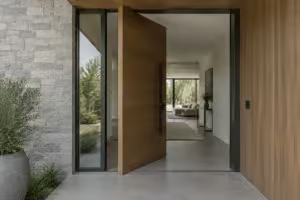
Flush-door projects where the door must close itself and no hardware may show: handle-less modern interiors, concealed doors on latch-less openings, and doors where a surface closer would ruin the design.
Skip it if this is your first concealed-hinge install, if your door is outside the thickness range, or if you just need a hidden door that closes with a normal latch — the proven concealed hinge below does that job with far less risk.
Fitting it
- Confirm the door thickness is inside 1-3/8 to 1-3/4 inches before anything else.
- Rout the deep mortises in door edge and frame with a template — make practice cuts on scrap first; concealed closer hinges punish approximate mortises.
- Dry-fit the hinge and check the closed door sits flush before driving the screws home.
- Hang the door, then set the closure rate per the instructions: firm enough to latch, never a slam.
Worth comparing
TamBee 6 inch concealed hinges — the proven invisible hinge
The mortised concealed hinge with the track record: 3-way adjustable, 180-degree opening, rated 4.4 out of 5 across 182 ratings. It does not close the door itself — pair it with a latch — but it is the safer buy for most hidden doors. Full detail in our concealed hinge review.

HBL’ pivot — the other way to hide a door
A concealed stainless pivot with full 360-degree rotation, rated 4.4 out of 5 across 225 ratings, for hidden doors that should swing both ways. See our pivot review.

Questions people ask
What makes it a ‘closer’ hinge?
A spring built into the hinge body pulls the door shut, and the closing rate is adjustable — so the door closes itself with no visible closer hardware.
Why so cautious about the 5.0 rating?
Because it rests on 8 ratings. A perfect score from eight buyers is a coin toss, not a track record; the alternatives above have hundreds.
How thick must my door be?
Between 1-3/8 and 1-3/4 inches, per the manufacturer’s specification.
Is it hard to fit?
It is the hardest install on this page’s family: deep, accurate mortises in both door and frame. A template and practice cuts are strongly advised.
The bottom line
A genuinely clever part — invisible and self-closing in one — sold on a thin listing with almost no buyer evidence. If your project truly needs it and your routing is precise, the engineering spec is real. If not, buy the proven concealed hinge and a latch, and sleep fine.
Related posts
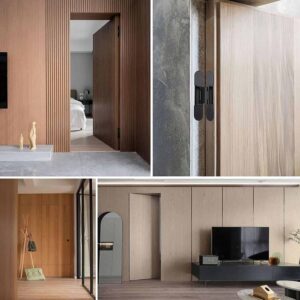 Invisible Hinges Concealed Door Hinge Review
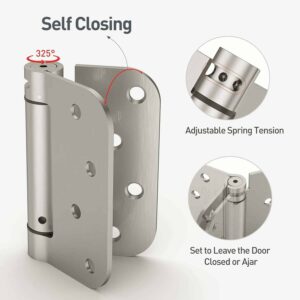 HOSOM Self Closing Door Hinges Review
 Haidms Self Closing Door Hinges Review
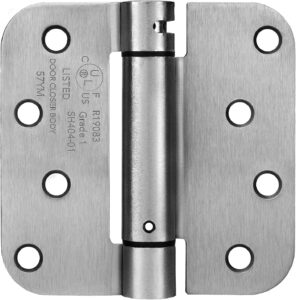 Comparing 3 Automatic Self-Closing Door Hinges
 Adjusting Self Closing Hinges
 Design House 181412 Door Hinge Review
 Milescraft 1229 HingeJigPLUS Door Hinge Jig Review
 10 Pack 4 Inch T-Strap Shed Hinge Review