Cutting a hinge mortise by hand with a chisel is a skill. Cutting ten of them, identically, on a Saturday, is a jig’s job. The Milescraft 1229 HingeJigPLUS is a clamping template that guides a router to cut door hinge mortises — and the strike and latch plates too — at the standard sizes.
A note on names first: this page originally pointed at an older Milescraft kit. The current tool is the 1229 HingeJigPLUS, a dual-clamping jig that routs mortises for hinges from 2.5 inches to 4.5 inches, with the strike and latch plate templates included for standard doors. It carries a 4.2 average across several hundred Amazon ratings — good, with the complaints you would expect about any jig: setup care matters.
Disclosure
As an Amazon Associate we earn from qualifying purchases.
The short answer
Buy the HingeJigPLUS if you are hanging several doors: it clamps to the door edge, guides your router to identical mortises for hinges from 2.5 to 4.5 inches, and cuts strike and latch plates with the included templates. One door with existing mortises? You need a screwdriver, not a jig.

What it does
The jig clamps onto the edge of the door — the dual clamping is the upgrade over single-clamp templates, holding the jig square while the router runs. You set it to the hinge size, and the template guides the router bit to cut a mortise of the right length, width and depth, with the corner radius done by the bit.
The same kit handles the door frame side of the job: strike plate and latch plate templates are included, which is what turns it from a hinge gadget into a door-hanging kit.
Specs
| Type | Router template jig for hinge mortises |
| Hinge sizes | 2.5 in. to 4.5 in. |
| Also cuts | Strike plates and latch plates (templates included) |
| Clamping | Dual clamping to the door edge |
| You supply | A router and template bit |
The good and the not-so-good
- Dual clamping holds the jig square while the router runs — the weak point of cheaper templates.
- Covers the full standard range: hinges from 2.5 to 4.5 inches.
- Strike and latch plate templates included — a door-hanging kit, not just a hinge gadget.
- Repeatable depth, so every mortise matches and every door hangs the same way.
Worth knowing before you buy
- You supply the router and template bit — the jig alone cuts nothing.
- A 4.2 average says setup care matters; a rushed first cut is the common complaint.
- Overkill for replacing hinges in mortises that already exist.
Who it’s for — and who should skip it
Anyone hanging several new slabs, building out a renovation, or replacing doors where the hinge positions are not pre-cut. The jig pays for itself in consistency: every mortise the same depth means every door hangs the same way.
Skip it for a single hinge replacement — if the mortise already exists, you need a screwdriver, not a jig. And if you would rather mark and chisel with a simple template instead of routing, the Ryobi kit below takes that lighter approach.
Using it
- Do a practice cut on scrap timber first — every jig has a personality, and its first mortise should not be in a finished door.
- Mark your hinge positions on the door edge and clamp the jig square at the first mark.
- Set the router depth to the hinge leaf thickness.
- Rout the mortise in shallow passes, then test-fit the hinge leaf before unclamping — it should sit flush with the door edge, neither proud nor buried.
Worth comparing
Ryobi A99HT3 — the chisel-template approach
Ryobi’s door hinge installation kit (4.5 out of 5 on Amazon) takes the lighter route: a marking template plus chisel work instead of a router jig. Slower per mortise, cheaper to buy, and no router needed. See the Ryobi A99HT3 on Amazon, or read our Ryobi kit review first.
Questions people ask
What hinge sizes does it cover?
Mortises for hinges from 2.5 inches to 4.5 inches, which spans the standard interior and entry door sizes.
Does it cut latch and strike plates too?
Yes — templates for standard strike and latch plates are included.
Do I need a router?
Yes. The jig is a guide; the cutting is done by your router with a template guide and bit.
The bottom line
For one door, a chisel is fine. For a houseful of doors, this is the tool that makes the tenth mortise as clean as the first — and clean mortises are what make doors hang straight and latch without a fight.
Related posts
 Design House 181412 Door Hinge Review
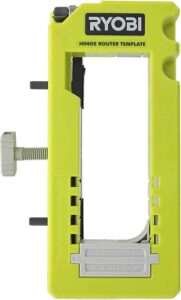 Ryobi A99HT3 Door Hinge Installation Kit/Mortiser Template Review
 10 Pcs Stainless Steel Home Furniture Hardware Door Hinge Long 2.15 x 1.3 inch Review
 Heavy Duty Pivot Hinge for Wood Door Review
 Invisible Hinges Concealed Door Hinge Review
 10 Pack 4 Inch T-Strap Shed Hinge Review
 Three Leaf Non-Mortised Hinge Review
 18 Pack Matte Black Door Hinges 3.5 Inch Review