A sliding baby gate solves the one thing a swinging gate gets wrong: it never swings into the room, into you, or into the toddler chasing you.
The panel glides sideways on a track, rolls up into a slim housing, or folds flat to the wall. The doorway stays open for grown-ups and shut for small climbers. These 12 sliding baby gate ideas cover stairs, doorways, wide openings, and the deck, with the safety numbers that matter and the look notes to match your trim.
Pick by where the gate goes first, then by how it slides. Each one borrows its track and hardware from sliding doors, so the same rules about level tracks and solid mounts apply.

1. Retractable Mesh Sliding Baby Gate That Disappears When You Open It
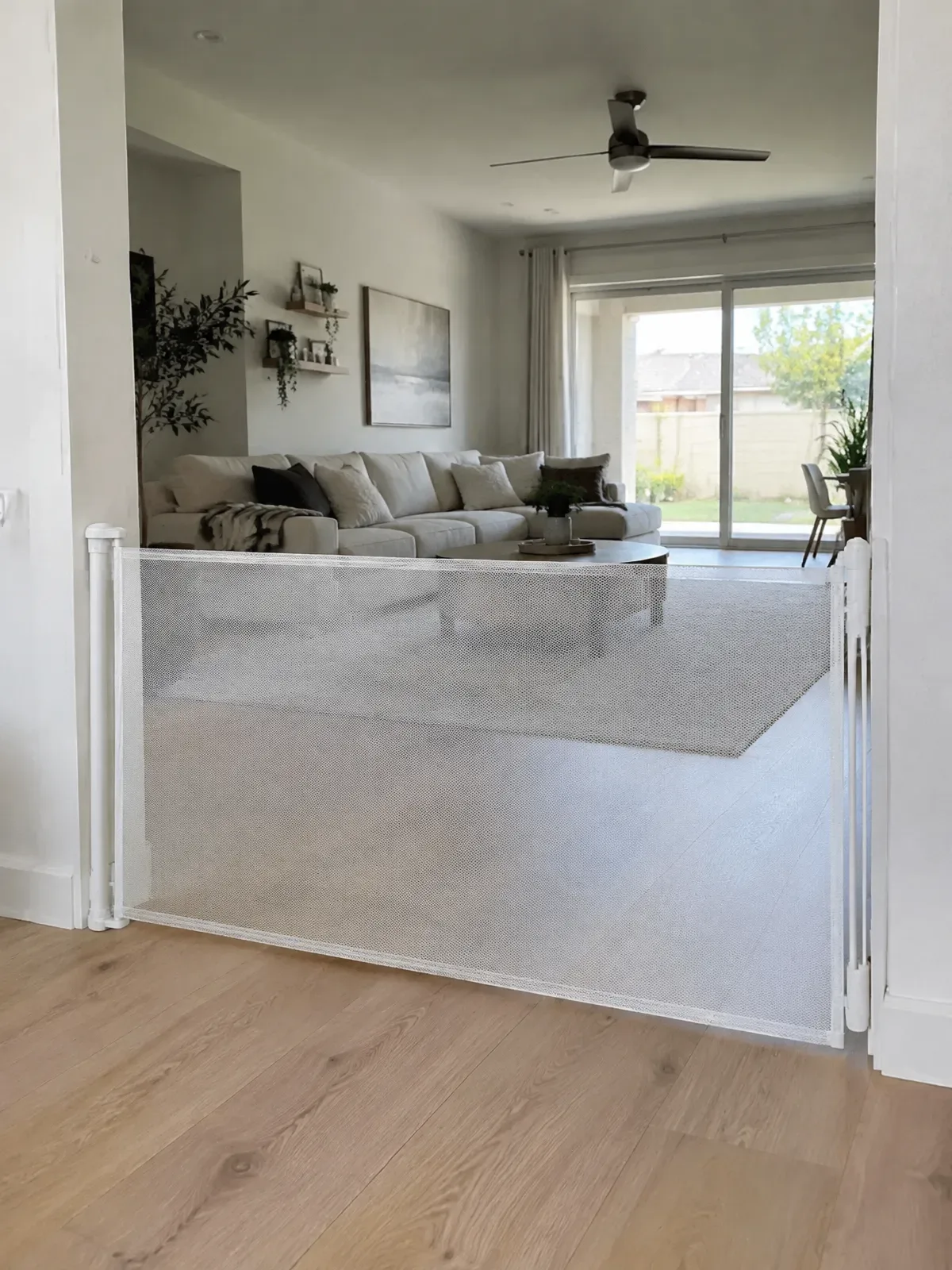
Pull the mesh across the opening, hook it, and lock it with a push-and-turn latch. When you want the room back, you unhook it and the spring winds the mesh into a slim roll on the wall. Nothing swings, nothing folds, and nothing sits on the floor to trip over.
At the top of the stairs
The numbers are what sell it. Smart Retract makes two Retract-A-Gate models that cover openings up to 52 or 72 inches, and the mesh stands 34 inches tall.
Shop this idea
Products that fit this idea
- RETRACTABLE GATERetract-A-Gate 52 Inch White Retractable GateShop on Amazon
- WIDE RETRACTABLE GATEReinforced 80 Inch Retractable Baby GateShop on Amazon
- OUTDOOR RETRACTABLE GATERetractable Mesh Baby Gate for Doorways and StairsShop on Amazon
As an Amazon Associate we earn from qualifying purchases.
The gate holds up to 200 pounds of push-out force. It carries JPMA certification for babies and toddlers aged 6 to 24 months.
It works indoors and out, and the maker tests it for use at the top and the bottom of the stairs. To get the look, mount the slim housing on flat trim or a wall, keep the mesh taut, and lock it every time.
At the top of a staircase, set the mesh at least 6 inches back from the edge of the top step. That way no gap opens where a small child could slip through. White mesh all but vanishes against white trim, which is the point: the gate is there when you need it and gone when you do not.
One more thing to check before you buy: measure the flat surface where the brackets will sit. The brackets need a flat run of wall or trim, and a thick baseboard can push the housing out of line. Wall spacers fix that, and they cost less than a second trip to the store.
2. Barn Door Panel That Slides on a Wall Track

Look at it from the hallway and you would think it was a small barn door, not baby gear. A half-height wood panel with an X brace hangs from a black metal track above the doorway and slides sideways, just like a full barn door.
When it is open, it parks flat against the wall. When it is shut, it reads as a small barn door. The track does the work, so the track gets the attention.
Fix it level into studs, not just drywall, and use barn door hardware rated for the panel weight. A floor guide keeps the bottom of the panel from swinging out when a toddler leans on it; see barn door floor guides for the kinds that suit a half-height panel.
Put the latch high, out of reach, and easy for an adult to work with one hand. To get the look, match the panel to the room: natural pine with a clear finish for a light hallway, or the same paint as the trim for a quieter read.
The black track and rollers are the contrast, so keep them matte and plain. This gate suits a doorway or a hallway best, where the wall beside the opening gives the panel somewhere to park.
Shop this idea
Products that fit this idea
- BARN DOOR TRACK KIT6.8 Ft Sliding Barn Door Hardware KitShop on Amazon
- BARN DOOR LATCHBarn Door Jamb Latch With Hook, 2 PackShop on Amazon
As an Amazon Associate we earn from qualifying purchases.
Watch the gap at the sides. A barn door panel hangs in front of the opening, not inside it, so a determined toddler can find the edges. A snug fit and a latch that holds the panel shut matter more here than on a gate that sits inside the frame.
3. Two-Panel Wood Slider You Can Build in a Weekend

Two matching wood panels, one fixed and one sliding, make a gate that fits a doorway nothing off the shelf quite covers. The fixed panel screws to one side of the opening. The sliding panel rides on drawer slides at the top and bottom and glides behind it.
It is the oldest trick in this list, and it still works because you cut it to your exact opening. Twig and Thistle puts the build at 4 to 6 hours for an intermediate woodworker. The materials run $30 to $50 for wood and $40 to $70 for the hardware kit.
Pine boards, wood glue, screws, a latch, and a sliding barn door hardware kit are the whole list. Sand every edge smooth: rough edges and splinters are the first thing a small hand finds.
- Measure twice. Measure the width at the top and the bottom of the opening, and cut the sliding panel 2 inches wider than the opening so it overlaps the frame when shut.
- Build two frames. Cut grooves in the top and bottom rails, glue the slats in with even gaps, and let the glue dry before you sand.
- Hang the track. Fix the fixed panel to the wall, fit the drawer slides top and bottom, and hang the sliding panel so it glides without binding.
- Latch and test. Fit the latch high, then open and close the gate a dozen times and check that it stays shut when pushed.
Before you build the gate
Do This
- Mount the track level and into studs, and follow the hardware kit instructions.
- Measure the opening width and add a few inches for overlap.
Skip This
- Use a floor track where little feet can trip on it.
- Leave rough edges or splinters where small hands will grab.
To get the look, stain the panels to match the floor or paint them the trim color. If you are new to this kind of build, read how many hinges a wooden gate needs before you pick fasteners: a gate that sags on weak hinges is a gate that stops latching.
4. Walk-Through Slider That Expands to Fit Your Opening
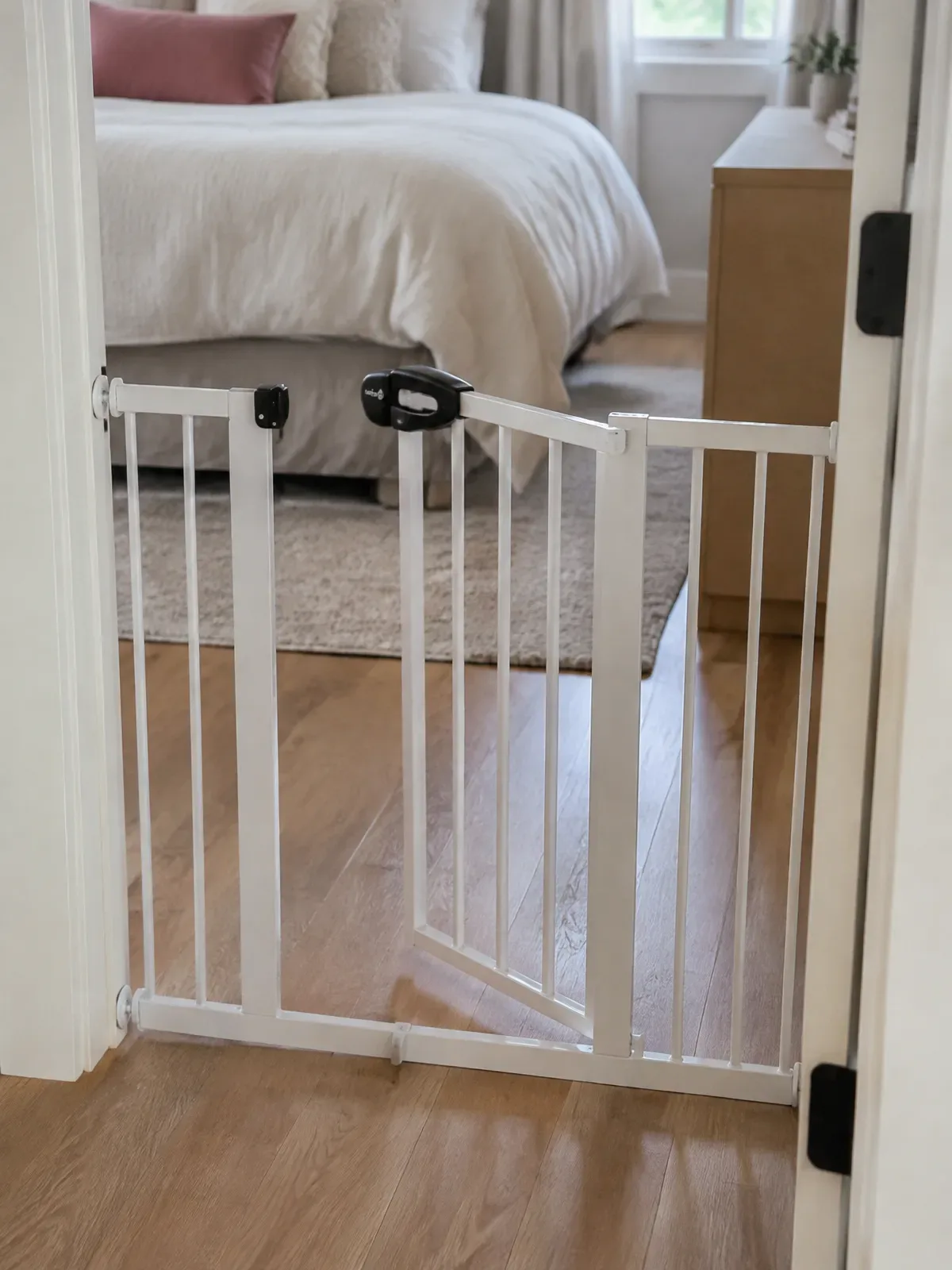
Most walk-through gates slide to expand. Two panels telescope inside each other, so one gate fits a range of openings instead of a single width. You set the width once, lock it, and the small door in the middle opens with one hand while the frame stays put.
It is the gate for a doorway or the bottom of the stairs that gets used twenty times a day. Measure first, because width ranges have gaps. The Consumers Guide notes one popular gate that adjusts from 32 to 48 inches, which covers most stair landings and doorways without extra panels.
Openings wider than that need a different gate or an extension kit, and openings between two sizes on the same gate can fall in a dead zone. Measure at the narrowest point of your opening, top and bottom, before you order.

To get the look, pick white metal for a hallway that already has white trim, and keep the latch on the adult side of the door. Auto-close is worth having here: a gate that shuts itself is a gate that is shut when you walk away with a laundry basket.
Check that the door swings the way you need it to, and that it stops where you want it, before you call the job done.
Shop this idea
Products that fit this idea
- WALK-THROUGH GATEAuto Close Walk-Through Baby Gate, 29-40 InchShop on Amazon
- EXTRA WIDE GATERegalo Extra Wide Baby Gate, 30.5-58 InchShop on Amazon
- TOP OF STAIRS GATERegalo Extra Wide Top of Stairs Baby Gate, 24-40.5 InchShop on Amazon
As an Amazon Associate we earn from qualifying purchases.
One habit makes or breaks this gate: use the wall cups. Pressure pads on bare drywall slip over time, and a gate that has slipped is a gate that is not holding. The cups give the pads something to bite into, and they cost nothing next to the gate.
5. Accordion Gate That Folds Flat Against the Wall

Fold it up and it packs flat against the wall in a strip a few inches deep. Open, it spans a hallway. It suits a hallway or a room divider that opens and closes all day.
A swinging gate would always be in the way there, and a fixed panel would always be in sight. The fold is the whole point, so test it before you commit. The hinges should run smooth with one hand, and the folded stack should sit flat without bowing out into the walkway.
A latch that holds the folded stack shut keeps it from drifting open when someone brushes past. A pocket door at the top of the stairs solves the same problem in a different way, if your wall can take one, but the accordion gate needs no work inside the wall at all.
To get the look, paint the panels the wall color so the folded stack reads as trim, or stain them to match the floor. Keep the hardware plain and the same finish on every hinge.
This gate is at its best in a wide, plain opening; a narrow doorway with heavy trim fights the fold and wastes the idea.
6. Wide-Opening Slider Made of Configurable Panels

Some openings are too wide for one gate. An open plan living room, a wide stair bottom, or a fireplace front needs panels, not a single frame. Configurable panel gates join in a run and angle around corners, so you set the shape to the room instead of forcing the room to fit the gate.
The walk-through door sits inside the run, so adults step through instead of stepping over. Width is the spec to read. The Consumers Guide describes a hardware-mounted gate that spans 38.3 to 72 inches out of the box, which covers open landings a standard gate cannot touch.
Panel systems go wider still by adding panels, and they angle where a straight gate cannot. Measure the full run, not just the doorway, and count the panels before you buy: a run that ends a panel short is a run that does not close.
To get the look, keep the panels in one finish and one height so the run reads as a single piece. White metal suits a light room; a wood-toned frame suits a room with wood floors. See sliding door ideas for more ways a sliding panel can close off a room without closing it in.
Put the walk-through door where the traffic already goes, not where it looks tidy on paper.
Shop this idea
Products that fit this idea
- GATE PANELSBonnlo 134 Inch Wide Configurable Baby Gate, 5 PanelShop on Amazon
- SUPER WIDE GATERegalo 28-76 Inch Super Wide Metal Baby Gate, 3 PanelShop on Amazon
As an Amazon Associate we earn from qualifying purchases.
Wall mounts are part of the system, not an extra. A long run of panels leans on its mounts. Fix them into studs or solid trim, and test the whole run with a firm push before you trust it with a toddler leaning on the middle.
7. Hardware-Mounted Slider for the Top of the Stairs

At the top of the stairs, the mount is not a choice. A pressure-mounted gate can be knocked loose, so it belongs at the bottom of the stairs or in a doorway, never at the top.
At the top, the gate screws into the wall or the banister, and it stays there when a toddler leans on it. The CPSC and JPMA are both plain about this, and the standard behind it is ASTM F1004, the federal safety standard for expansion gates, made mandatory under 16 CFR 1239.
Two numbers decide whether the gate does its job. ASTM F1004 caps slat openings at 2 3/8 inches so a small head cannot pass through, and ASTM F1004 sets the minimum gate height at 22 inches, measured from the floor.
A gate that clears those two numbers and mounts into solid wood is doing what it was built to do. A tall gate helps too: one well-known stair gate stands 33 inches tall, a few inches clear of the standard 30-inch gates, and those extra inches buy time with a climber.

- Mount into a stud. Find solid wood on both sides before you drill, and use a banister kit where there is no wall.
- Check the gaps. Bar spacing no wider than 2 3/8 inches, and no gap between the gate and the wall a small head could find.
- Set the swing. At the top of the stairs, the door should swing away from the steps only, never out over them.
- Test the latch. It should need two deliberate steps to open and still work one-handed while you carry a child.
22 in
Minimum gate height under ASTM F1004.
2 3/8 in
Maximum slat and bar opening under ASTM F1004.
Sources: The Consumers Guide.
To get the look, paint the gate the trim color and keep the hardware plain. A white metal gate against white trim is the least visible safe option, and it is the one to pick when the stairs sit in the front hallway.
If your landing has no stud where you need one, ask a licensed pro to fit the mounts. A few patched holes beat a fall, and this is the gate where a pro earns the fee.
Shop this idea
Products that fit this idea
- HARDWARE GATECumbor No Bottom Bar Hardware Mounted Baby Gate, 29.2-43 InchShop on Amazon
- MOUNTING KITVmaisi Baby Gate Threaded Spindle Rods, 4 PackShop on Amazon
As an Amazon Associate we earn from qualifying purchases.
Renters face a hard trade here: there is no renter-friendly way to secure the top of the stairs, because the safe gate needs screws. If you rent, talk to your landlord about the mounts before your baby crawls, not after.
8. Pressure-Mounted Slider for a Doorway or Hallway

You put it up with no drilling at all. Four pads press against the door frame, you turn the spindles by hand, and the gate holds.
It moves between rooms in minutes, which is why it suits a doorway, a hallway, or the bottom of the stairs. It is also the gate to move when your child starts a new room, because it leaves no holes behind.
The limit is the mount, not the gate. Pressure pads can be pushed loose, so this gate never goes at the top of the stairs. Keep it where a fall is not behind it, and use the wall cups every time.
The cups give the pads something to bite into, and skipping them is how a pressure gate ends up flat on the floor. The Consumers Guide notes one popular pressure gate that fits openings from 29 to 38.5 inches and stands 30 inches tall, which covers most interior doorways.
To get the look, match the gate to the door frame and keep it white or black to match the hardware already in the room. A pressure gate is the right pick for a rental, a doorway you use ten times a day, or a room you want to close off for a season and open up again later.
9. No-Threshold-Bar Slider That Keeps the Step Clear
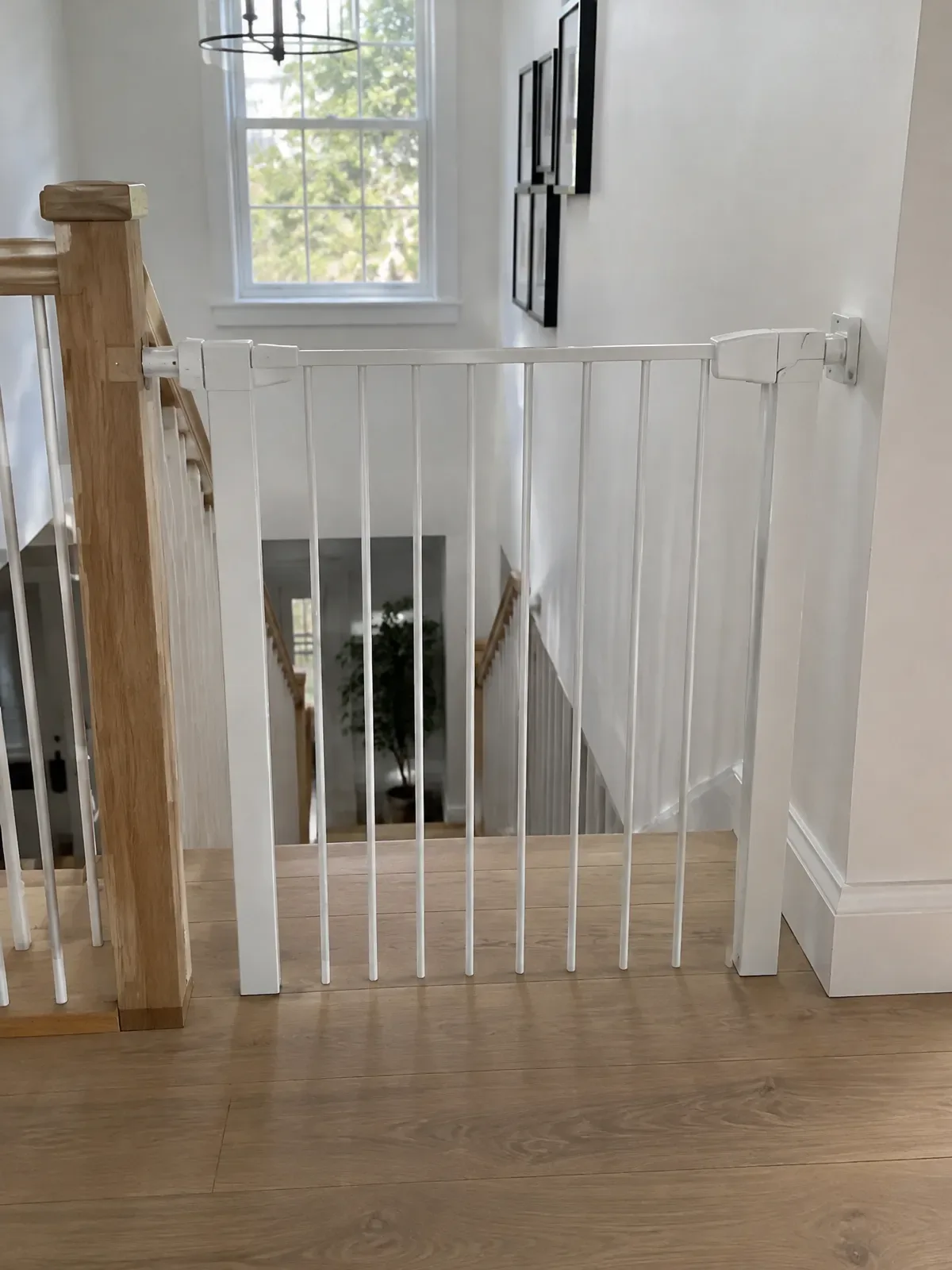
Most gates have a bar across the bottom of the opening. You step over it every time, usually in the dark, usually carrying something.
A no-threshold-bar gate has no bar at all: the frame ends at the floor and the step stays clear. At the top of a staircase, that clear step is not a nice extra. It is the difference between a safe step and a trip where a trip is most dangerous.
This design only works when the gate is hardware-mounted, because the frame needs the wall and the banister to hold it rigid without a bottom rail tying the sides together. Look for a gate that says plainly it has no bottom bar, and check the latch still works one-handed when the door is carrying its own weight.
The door should swing away from the steps and stop where you set it, not drift back over the stair edge. To get the look, keep the frame slim and the same color as the trim, so the eye reads the banister and the stair, not the gate.
This is the gate to pick when the stairs are the daily route: nursery runs at night, laundry up and down, and a toddler who follows you everywhere.
10. Outdoor Deck Slider in Weatherproof Wood
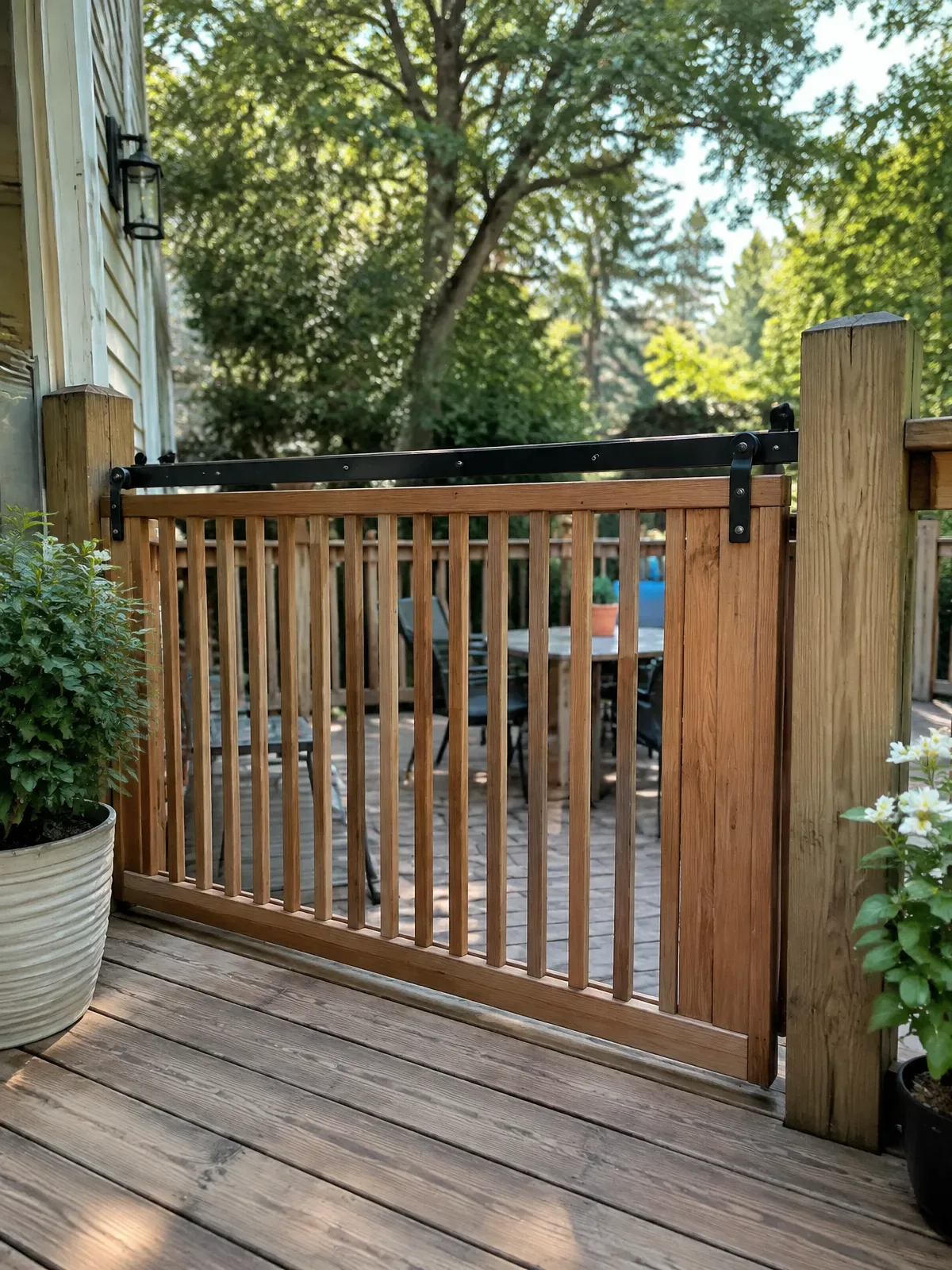
Outside, the gate keeps a toddler on the deck and off the stairs down to the yard. It also has to survive rain and sun while it does it.
A wood slider on an overhead track is the right shape for it. The panel hangs from a rail above, so there is no floor track to fill with leaves and no bar to trip over in bare feet.
The overhead track is the part to get right. A floor track is cheaper, but it is dangerous for babies: debris and small toes find it, and it trips adults too. An overhead track needs a tough header to carry it, and the wheels should roll on a top rail that stays clear of dirt.
Cedar or pressure-treated wood stands up to weather; plain pine will not last a season outside, and metal gets hot in the sun unless it is powder-coated. Height matters more outside, where the drop is real.
A deck gate guide puts the minimum height at 34 inches, and 36 inches or more to hinder climbing. Mount the latch at 38 inches or higher so a small child cannot reach it, and make sure an adult can work it from both sides.
Seal the wood after the build and again each year, and check the track and screws every month. Weather loosens what indoor gates never face.
11. Extra-Tall Slider for a Toddler Who Climbs
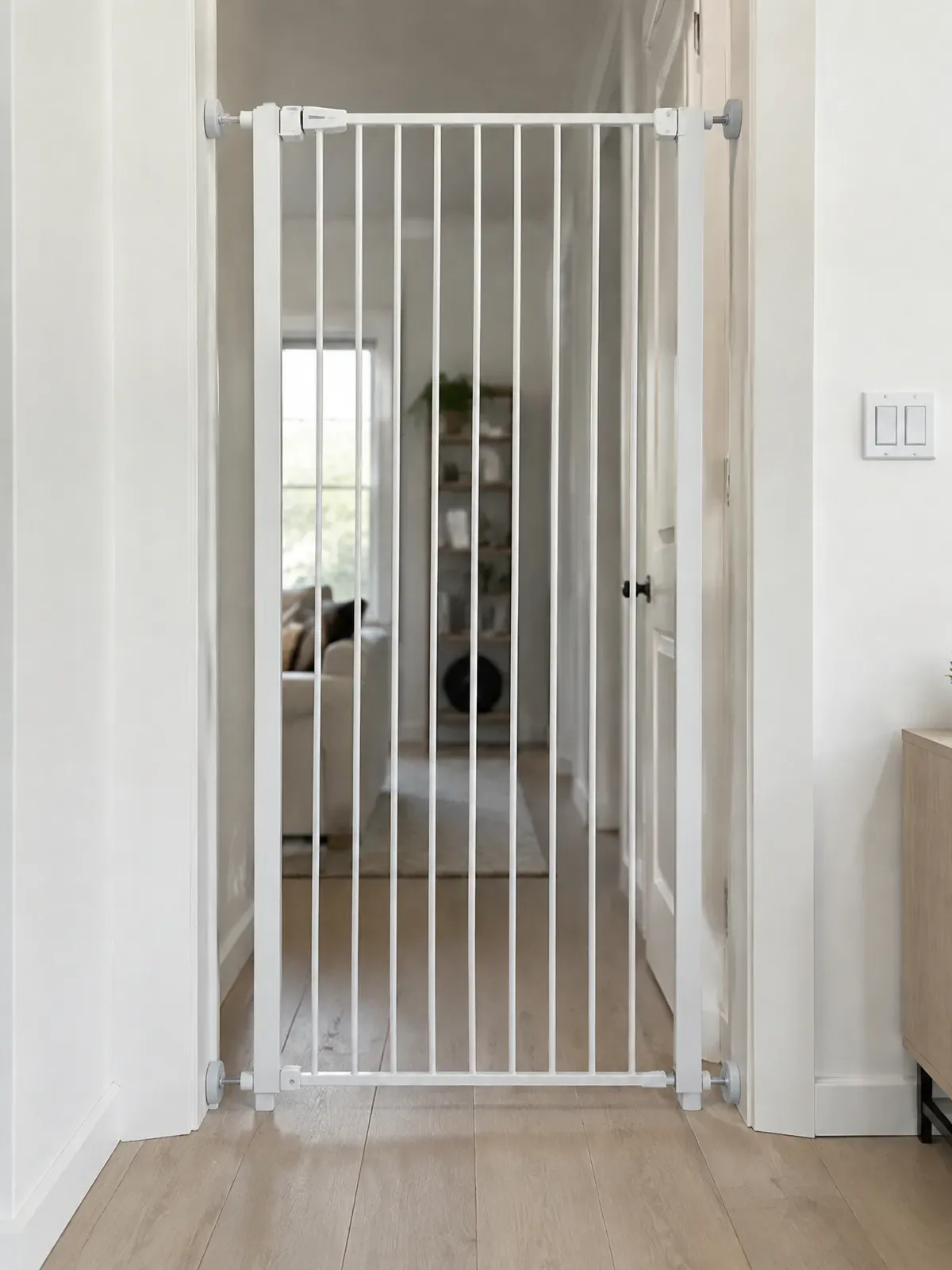
Some toddlers climb. A standard gate stands about 30 inches tall, and a determined climber treats that as a first step.
An extra-tall gate adds the inches that change the climb from easy to not worth trying. The Consumers Guide describes one tall gate at 36 inches that adjusts from 30 to 46 inches wide, about half a foot above a standard gate, and calls height the one spec you cannot add later.
Height alone is not the whole answer. The bars still need to sit no wider than 2 3/8 inches apart, and the gate still needs the right mount for where it goes: hardware at the top of the stairs, pressure anywhere else.
A tall pressure-mounted gate puts more force on its pads, so a big dog leaning on the top rail can work it loose over months. If the gate is holding back a climber and a dog, use the hardware option even at the bottom of the stairs.
To get the look, accept that a tall gate is visible. White reads as construction fencing in a narrow hallway, so put the tall gate where it earns its height and use a standard gate where it does not.
Shop this idea
Products that fit this idea
- TALL WIDE GATEExtra Wide Baby Gate, 29.4-78 InchShop on Amazon
- TALL PRESSURE GATERegalo 36 Inch Extra Tall Baby Gate, 29-36.5 InchShop on Amazon
As an Amazon Associate we earn from qualifying purchases.
Watch the weight too. Tall gates are heavier and more awkward, and when one is latched open it eats more hallway than a short gate. Measure the swing before you buy, and leave room for it.
12. Painted Slider That Matches Your Trim and Walls

Paint the gate the trim color. That is the simplest idea on this list, and the cheapest.
A white gate against white trim stops reading as baby gear and starts reading as part of the room. The eye passes over it, the hallway looks finished, and the gate still does its job.
It is the cheapest look on this list, and it is the one most people skip. Paint it before you hang it, and use a low-VOC paint or stain made for interior wood.
Two thin coats beat one thick one: thick paint gums up the track and the latch, and it chips where the panel slides. Sand between coats, let it dry fully, and test the slide before the gate goes back on the wall.
A rustic barn door ideas page shows how far a painted panel can go when the finish matches the room around it. To get the look, match the sheen as well as the color. Trim paint is usually satin or semi-gloss, and a flat gate next to satin trim still shows.
Take a piece of trim to the paint store and match it there, not from memory. The gate should be the same white as the door beside it, down to the sheen.
Our take · James Davis
If the stairs are the problem, spend on the hardware-mounted gate and skip the rest. A sliding gate that looks good but mounts wrong at the top of the stairs is the wrong gate, whatever color you paint it.
Start with the opening, not the catalog. Measure the width at the top, the middle, and the bottom, check the height against the 22-inch floor, and pick the mount for the spot before you pick the style.
A sliding baby gate that fits the opening, mounts the right way, and matches the trim is a gate you will actually latch every time, and that is the whole job.
Related posts
 10 Toddler Christmas Door Ideas
 Maximizing Space with Style: The Pros and Cons of Installing a Pocket Door at the Top of the Stairs
 Purr-fect Screen Doors: Keeping Cats Safe and Happy
 Front Steps and Landings: The Sizes That Make an Entry Safe and Look Right
 12 Interior French Door Ideas Designers Keep to Themselves
 How to Keep a Front Door Looking Good in Salt Air
 Christmas Wreath Crafts for Kids That Keep Little Hands Busy on Snow Days
 12 Small Portico Over a Door Looks That Keep Rain Off Your Step