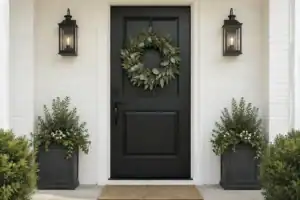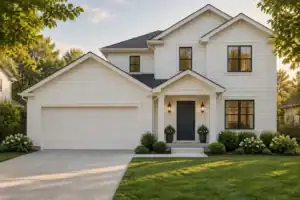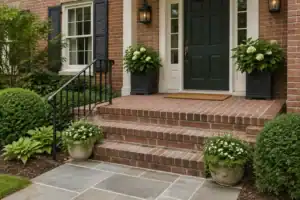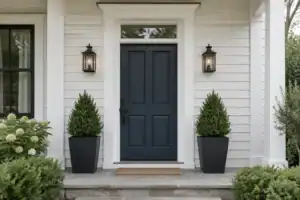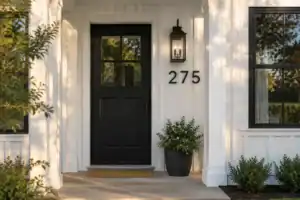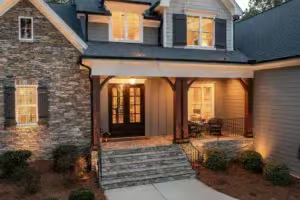

17 Wreaths for Front Door Ideas That Make a Beautiful Impression helps you choose a wreath that fits your home’s entry. This guide rounds up 17 door ideas worth saving, so you can find the right style for your exterior and start with Eucalyptus Greenery.
Eucalyptus Greenery

Airy gray-green foliage adds texture and calm contrast without crowding a narrow entry.
As an Amazon Associate I earn from qualifying purchases. Affiliate links may earn me a commission at no extra cost to you.
On a covered entry, eucalyptus brings gray-green leaves in an open ring, with enough space between the stems for the door color to show through. It is the right pick for modern farmhouse, coastal, and transitional homes that need greenery without a dense, formal, or strongly seasonal look.
The muted foliage works especially well against white siding, pale blue doors, black hardware, and natural wood. Its airy silhouette also creates movement and negative space, so it feels lighter on a narrow door than broad magnolia leaves or tightly packed boxwood.
Best placement: Use eucalyptus where muted foliage can contrast with a darker door. A thin preserved wreath is a poor match for a fully exposed, windy entry.
Most versions are faux or preserved, so check the listing for outdoor-rated or suitable for covered exterior use before buying. Afternoon sun, occasional rain, and moisture can shorten the life of cheaper materials.
- For a standard 36-inch door, start around 20–24 inches.
- Judge fullness, not diameter alone; sparse stems can look undersized.
- Keep the wreath clear of the handle, peephole, trim, and door sweep.
High-quality eucalyptus can stay up from spring through summer and often work year-round, especially when the foliage remains full and evenly gray-green. For broader leaves and a fuller profile, the next idea turns to magnolia.
⭐ Top Eucalyptus Wreaths to Buy
✨ Editor’s Pick
12-Inch Eucalyptus Berry Door Wreath
24-Inch Mixed Eucalyptus Greenery Wreath
Large Eucalyptus Berry Front Door Wreath
Magnolia Leaf

Broad glossy leaves give a traditional entry the visual weight it needs.
Broad, glossy magnolia leaves hold their own on a substantial front door, especially when wide trim, brick, lantern lighting, or a traditional porch makes a delicate wreath look undersized. The fuller ring suits southern, traditional, and refined farmhouse exteriors, pairing naturally with painted wood doors and brass or bronze hardware.
Look for designs that let a few leaves curl outward. Their brown or copper-toned undersides add depth, so the wreath reads as layered rather than like one flat circle from the sidewalk.
Best fit: Choose magnolia when your entry needs presence; choose a lighter style when the door is narrow or already crowded by glass and trim. Whatever you choose, check the size first with our what size wreath for a front door guide.
Magnolia is heavier and broader than airy eucalyptus, so use sturdy hanging hardware and confirm that the leaves will not press against nearby trim or glass. For a standard 36-inch door, a 20–24-inch wreath is a useful starting point, but measure the outermost leaves because the profile can make that diameter feel larger.
- Check whether the wreath is faux, preserved, or specifically outdoor-rated.
- Protect natural or preserved leaves from rain, humidity, and prolonged direct sun.
- Leave clearance for the handle, peephole, glass, and door opening arc.
Magnolia delivers classic foliage with stronger visual impact than eucalyptus, but it can overwhelm a small entry. Measure first, then move into boxwood for a more tightly tailored green ring.
⭐ Magnolia Wreaths Worth Buying
✨ Editor’s Pick
24-Inch Magnolia Farmhouse Door Wreath
💡 Designer Note: Let the Leaves Lead
Magnolia already supplies a strong focal point, so keep nearby porch styling quieter. Simple lanterns, restrained planters, or one finish repeated in the hardware will let the glossy leaves and copper-toned undersides provide depth without making the entry feel visually heavy.
Boxwood

A compact green circle keeps the front door polished through every season.
Small, closely packed leaves give a boxwood wreath its neat, tailored outline. It is the right pick for classic, colonial, cottage, and transitional homes – especially when you want one front-door accent to stay in place from spring through winter.
On a standard 36-inch door, start with a 24-inch wreath, then compare that measurement with the trim, sidelights, door windows, and handle clearance. A larger size can add presence, but a dense boxwood ring already reads fuller than an airy eucalyptus design.
Best year-round bet: Choose faux boxwood for hot or wet climates, but look for UV-resistant foliage and wording such as outdoor-rated or suitable for covered exterior use.
Natural boxwood can dry out or deteriorate, while a quality faux version needs little seasonal attention. The tradeoff is straightforward: you get dependable green restraint, not the changing color or pronounced texture of berries, florals, wheat, or pampas.
- Check the foliage from several feet away; sparse leaves can expose the base against a light door.
- Inspect UV protection before placing it on a west-facing entry.
- Confirm the hanging method will keep the wreath flat and clear of the handle, peephole, and door sweep.
⭐ Standout Boxwood Wreaths
26-Inch Gradient Boxwood Greenery Wreath
Eucalyptus Boxwood Berry Wreath
✨ Editor’s Pick
28-Inch Large Boxwood Door Wreath
💡 Why This Works:
Boxwood acts like a quiet visual frame for the entry. Its repeated small leaves create enough pattern to define the door without competing with seasonal planters, lanterns, painted trim, or changing porch accents. That restraint is what makes it easier to keep styled as the rest of the entry evolves.
Best advantage: Choose boxwood when you want the wreath to support the entry rather than become its only focal point.
Grapevine

A textured open base creates an adaptable welcome for rustic front doors.
The exposed, twisting branches are the point of a grapevine wreath – not something to hide under a solid layer of greenery. Its open weave gives a rustic, farmhouse-ready texture while leaving room for a small bow, dried flowers, berries, or another seasonal accent.
This is the right pick for cottage, rustic, and autumn-forward entries, especially when you want one base that can change with the season. The dry, open structure is usually lightweight and easy to hang, making it one of the better DIY starting points for a simple front-door project.
Keep the vine visible. Glue marks, loose stems, uneven clusters, and too many embellishments stand out immediately against the open framework.
Before buying, check the base diameter rather than relying on the finished product photo. On a standard 36-inch door, roughly 20–24 inches is a useful starting range, but attached accents may expand the outer profile.
- Confirm every flower, berry, or bow is wired or firmly tucked into the branches.
- Watch for one heavy cluster pulling the wreath off-center or making it tilt.
- Choose materials marked outdoor-rated or suitable for covered exterior use.
Photograph the finished wreath from the sidewalk before adding more decoration; the vine should remain visible enough to anchor the design.
⭐ Natural Grapevine Wreaths to Consider
✨ Editor’s Pick
Natural Grapevine Garland Craft Set
💡 The Detail That Pulls It Together:
Choose accents that echo one existing porch detail, such as a door finish, planter, or textile, rather than matching everything. Concentrate color in one restrained cluster and let the remaining branches breathe. This gives the wreath a clear focal point while keeping its rustic texture from competing with brick, siding, or busy hardware.
A wreath can look right in a photo and still miss the door in practice. A few practical checks – scale, exposure, and secure hardware – do more to protect the entry than trying to make every style work.
🎯 The Calls Worth Getting Right:
- Measure first, then compare proportions with these front door ideas.
- Weather exposure matters: covered entries protect delicate wreath materials longer.
- Hardware and clearance keep the wreath stable, usable, and damage-free.
Dried Hydrangea

Soft hydrangea clusters bring muted color and inviting texture to a sheltered front entry.
Dusty cream, faded blue, mauve, and muted green hydrangea heads give this wreath its softly aged character. The papery blooms build volume through irregular clusters, making it a natural fit for romantic, vintage, cottage, and soft traditional homes.
On a weathered wood door or pale painted entry, dried hydrangea feels more organic than a crisp evergreen ring. It also works especially well with aged metal hardware, muted siding, and a porch that already leans toward gentle, timeworn textures.
Best placement: Use dried hydrangea on a protected porch, not a fully exposed door receiving regular rain, direct sun, or strong wind.
Check the listing carefully before buying. Dried, preserved, and faux hydrangea are not interchangeable: preserved does not automatically mean weatherproof, while a faux version may better reproduce the clustered shape in a more exposed location.
- Inspect customer photos for brittle, flattened, or shedding flower heads.
- Look for blooms that are firmly attached rather than loosely glued to the base.
- Confirm the product is suitable for covered exterior use.
- For a standard 36-inch door, begin around 20–24 inches and check the full outer profile.
Choose this style when organic texture matters more than weather resistance. If your entry is completely exposed, select an outdoor-rated faux design instead; otherwise, rain and humidity can shorten its outdoor life quickly.
⭐ Hydrangea Wreaths We Love
22-Inch Rose Hydrangea Summer Wreath
✨ Editor’s Pick
Lighted Blue Hydrangea Floral Wreath
Harvest Hydrangea Pumpkin Floral Wreath
Lavender

Add calm purple-gray texture to a pale door without creating a crowded floral display.
On a white or cream door, narrow lavender sprays add small points of purple-gray color instead of a dense mass of flowers. That makes this wreath a natural fit for cottage, Provence-inspired, rustic, and light farmhouse exteriors.
Lavender is a spring-to-summer style with fine vertical detail, so it looks especially clear against pale green, natural wood, or a quiet, minimally paneled door. It will disappear more easily on a busy facade with dark brick, ornate hardware, or several competing porch accents.
Check the fullness, not just the diameter. A listed size can still look skimpy when the sprays are thin or widely spaced, so compare customer photos with the product image before buying.
- Faux lavender: Usually holds its color better outdoors and is the safer pick for a brighter, longer-lasting purple accent.
- Dried lavender: Offers more natural texture but is delicate and better suited to a covered entry.
- Wind exposure: Look for sprays that are firmly wired or fixed to the base so they do not loosen, rotate, or leave the wreath uneven.
For a standard 36-inch door, begin around 20–24 inches, then judge whether the actual sprays fill that circle without blocking the handle or peephole. Choose lavender for a simple, light-colored entry; fully exposed, windy doors should use an outdoor-rated faux version or another sturdier material.
⭐ Lavender Wreaths for Every Season
✨ Editor’s Pick
18-Inch Lavender Berry Butterfly Wreath
Lavender Eucalyptus Front Door Wreath
💡 The Detail That Pulls It Together:
Lavender looks most intentional when its purple-gray tone has a quiet echo nearby, such as a muted planter, natural fiber doormat, or weathered wood accent. Keep those supporting details understated; repeating the color once is enough to connect the wreath to the entry without turning the doorway into a themed display.
Cotton Stem

White cotton bolls add quiet texture and crisp contrast to a dark front door.
White cotton bolls projecting from a dark door create an immediate light-and-shadow pattern, especially against charcoal, black, navy, or deep green paint. This wreath suits farmhouse, rustic, and transitional homes, but its neutral texture can also stay in place year-round when your entry favors natural wood and quiet colors.
Choose cotton stem when you want seasonal character without adding red, orange, or purple. The rounded bolls bring more tactile interest than a plain greenery ring, while the tan stems keep the overall look grounded rather than overly winter-specific.
Best placement: Use dried cotton on a covered porch, away from rain and heavy humidity. Fully exposed doors should use synthetic cotton or a wreath specifically marked outdoor-rated.
Before hanging, inspect how firmly each stem is wired or fixed into the base. Loose branches can catch wind, shift the wreath off-center, or pull its weight toward one side.
- Check whether the cotton is dried, preserved, or faux.
- Look for secure stems and a balanced radial arrangement.
- Use finish-safe hardware that will not scratch a painted or glass-paneled door.
- Confirm the cotton bolls do not project far enough to scrape the surface or catch clothing.
Skip a natural cotton wreath if your entry receives direct rain or frequent strong wind. For a standard 36-inch door, roughly 20–24 inches usually gives the cotton enough presence without crowding the handle or trim.
⭐ Cotton Stem Decor to Consider
✨ Editor’s Pick
Natural Dried Cotton Stem Bundle
💡 Why This Contrast Works:
The repeated white forms act like visual punctuation, giving a quiet entry a clear focal point without requiring several competing colors. That makes cotton especially useful when the door already has attractive hardware or strong panels you want to leave visible.
Best visual payoff: Let the door provide the drama, then keep nearby porch accents simple and naturally toned.
Berry

Add welcoming seasonal color without covering the door in a full floral arrangement.
Clusters of red, burgundy, orange, or soft spring berries can punctuate a greenery wreath with small, repeated color points. That makes a berry wreath a strong fit for traditional, cottage, and holiday-leaning exteriors when you want seasonal energy without a full floral look.
Color does most of the decorating work here: burgundy supports fall, red can lean winter or holly-like, and softer berry shades feel more at home in spring. Match the berries to one existing detail, such as a planter or shutter, instead of echoing every accent on the porch.
Best visual balance: Choose enough berries to create a clear color rhythm, but leave portions of the greenery visible so the wreath does not become one oversized color ball.
Direct sun is the biggest enemy of faux berries, especially on a west-facing door. Lower-cost stems may fade, shed individual berries, or lose their coating after repeated exposure to sun and weather.
- Check attachment: Tug gently at several clusters to make sure berries are fixed to their stems.
- Check density: Sparse berries can look accidental, while tightly packed clusters may hide the greenery entirely.
- Check exposure: Look for UV or weather resistance, plus outdoor-rated or suitable-for-covered-exterior-use wording.
- Check scale: A wreath around 20–24 inches usually suits a standard 36-inch door, provided the berries do not interfere with the handle, peephole, or trim.
Choose berry wreaths when color is the entry’s missing ingredient; skip them when you want a quiet, year-round door that will not need seasonal attention. A well-attached, weather-suitable design can shift its mood simply by changing the berry shade.
⭐ Berry Wreaths That Welcome Fall
Harvest Red Berry Wreath With Bow
✨ Editor’s Pick
Red Berry Eucalyptus Christmas Wreath
Apple Berry Hello Fall Wreath
💡 Let the Door Set the Contrast:
Use brighter berries when the door or facade is deep and matte, so each cluster stays visible from the walkway. Against a pale door, burgundy or muted orange usually creates clearer definition without needing excessive berry density. On brick, keep the foliage generous so the color feels intentional rather than visually tangled.
Ribbon

Refresh one wreath base with color, movement, and a polished seasonal welcome.
A wired bow can make a plain boxwood, magnolia, eucalyptus, or grapevine wreath feel newly styled without replacing its base. Ribbon is the right pick for homeowners who like to refresh colors throughout the year or want a manageable DIY project.
Use a short bow when the door is narrow, one long tail for a relaxed farmhouse look, or a patterned ribbon that echoes the door color without matching it exactly. Keep the treatment intentional; a single strong pattern usually looks more finished than several competing prints.
Secure it before it reaches the door. Wire the bow to the frame or tuck it firmly into the wreath so wind cannot twist the tails, loosen the knot, or pull the design off-center.
- Choose ribbon intended for outdoor or covered use when possible; direct sun can fade saturated red, navy, and printed patterns.
- Measure the bow and tails as part of the wreath’s outer profile, not as an afterthought.
- Check that the tails clear the handle, peephole, door sweep, and nearby trim when the door opens.
Simple ribbon refreshes suit DIYers using a lightweight base, with material-only projects often around $15–$40; larger statement designs can reach $50–$150 or more. A fully exposed, windy entry should use shorter, tightly secured tails – or skip the loose-ribbon look altogether.
⭐ Ribbon Wreath Accents to Shop
Large Autumn Burlap Wreath Bow
Four-Piece Fall Wreath Bow Set
✨ Editor’s Pick
Three-Roll Deco Mesh Ribbon Set
💸 Save Without Losing the Look:
- Reuse the base: Keep one simple wreath and change its ribbon treatment for different seasons.
- Buy less yardage: A compact wired bow creates visible impact without covering the entire wreath.
- Spend wisely: Prioritize outdoor-suitable ribbon and secure wire before paying more for elaborate embellishments.
Deco Mesh

Create a large, festive-looking entry statement without hanging an equally heavy wreath.
Layered deco mesh loops can extend far beyond a compact wire ring, making the wreath look oversized while remaining surprisingly light in your hands. Choose it when your front door needs a bold, festive focal point rather than a quiet greenery accent.
Saturated mesh, curled loops, and inserted accents give this style its graphic shape. It suits homeowners who enjoy strong color and noticeable volume, but it is not the right pick for a restrained entry or a narrow door crowded by sidelights and hardware.
The sizing trap: The advertised diameter may include the outer loops and decorative inserts, not just the wire base.
Before buying, measure the complete outer profile against the door – not only the inner ring. A deco mesh wreath can occupy more space than a foliage wreath with the same listed measurement, so leave clearance around the handle, peephole, trim, and door sweep.
- Inspect the mesh edges for fraying, flattening, or loose loops.
- Confirm that inserts are firmly secured to the wire form.
- Look for outdoor-rated construction, especially on doors exposed to rain or direct sun.
Mesh can deteriorate, fade, or lose its shape faster than higher-grade faux foliage when weather reaches it regularly. In windy locations, use secure mounting because the large, lightweight surface can shift, bump the door, or hang crooked.
⭐ Deco Mesh Wreaths Worth Buying
✨ Editor’s Pick
Handmade Fall Mesh Bow Wreath
Weatherproof Red Mesh Ribbon Roll
💡 Designer Note: Let the Color Breathe
Because deco mesh already supplies plenty of movement, choose one dominant color and let the inserts play a supporting role. Repeat that main shade in one nearby porch detail, such as a planter or welcome mat, while keeping the door and trim quieter. This keeps the oversized loops festive without making the entry feel visually scattered.
Floral

A focused bloom palette gives your entry a welcoming seasonal color story from the curb.
Coral blooms against a neutral door make a floral wreath an instant seasonal signal, while rust and cream flowers can warm up a fall entry. This style suits homeowners who want color to lead the design rather than sit quietly behind greenery.
Floral wreaths are defined by bloom type, color, and density. Small scattered blossoms feel light and cottage-like, while oversized roses, sunflowers, or mixed meadow flowers create a fuller statement that can overwhelm a narrow door.
Choose the palette before the flower count. One dominant flower with one supporting filler keeps the wreath intentional, especially against busy brick or patterned siding.
Check the actual construction before buying: fabric, foam, silk-like synthetic, and preserved natural flowers handle sun and moisture differently. Direct sunlight can fade petals, while rain and humidity can damage less protected materials, so an outdoor-rated wreath or one marked suitable for covered exterior use is the safer pick.
- For spring: choose a bright, limited palette such as coral and cream.
- For fall: look for rust, cream, and warm foliage with fewer competing bloom types.
- For a standard 36-inch door: begin around 20–24 inches, then check the full outer diameter and flower projection.
- Before hanging: inspect petal realism, flower density, attachment points, and clearance from the handle and peephole.
Skip delicate preserved florals for a fully exposed door with daily rain or strong afternoon sun unless the listing specifically supports that exposure. Many well-made wreaths fall around $50–$100, while premium or large pieces can reach $75–$300.
⭐ Floral Wreaths for Front Doors
Artificial Multicolor Peony Wreath
✨ Editor’s Pick
24-Inch Daisy Lavender Spring Wreath
26-Inch White Forsythia Spring Wreath
Faux Succulent

Sculptural rosettes give a modern entry lasting texture without seasonal upkeep.
Layered rosettes and pointed leaves give a faux succulent wreath a sculptural look that leafy or flower-filled designs cannot match. It is a strong fit for modern, desert, minimalist, and contemporary farmhouse homes, especially against warm white stucco, concrete, black doors, or pale wood.
The best versions vary the rosette sizes, green tones, and surface finishes so the wreath reads as textured rather than molded from one repeated shape. Cheap leaves can look shiny and plastic up close, which is difficult to hide when the wreath hangs at eye level.
Best fit: Choose faux succulents when you want architectural texture with minimal seasonal maintenance. Skip a low-quality version if the entry is viewed up close or the leaves have a noticeably glossy finish.
Before buying, check the wreath’s construction: a foam base is often light, while wire or grapevine can change the weight, profile, and hanging requirements. On a standard 36-inch door, begin around 20–24 inches, then confirm the outermost leaves leave room for the handle, peephole, trim, and door swing.
- For direct sun: Look for UV resistance and an outdoor rating; synthetic greens can fade when those protections are missing.
- For a covered porch: A broader range of faux constructions can work, but inspect leaf attachment and the wreath’s total projection.
- For realism: View product photos at eye level and several feet away, checking for varied shapes, matte surfaces, and natural-looking spacing.
💡 Why This Works:
Succulent rosettes give a flat door a layered focal point: overlapping forms create shadow, while pointed leaves add direction around the circular frame. That architectural rhythm feels especially intentional beside simple modern hardware, plain siding, or a streamlined porch with few decorative elements.
Best visual payoff: Prioritize varied rosette shapes and finishes over sheer fullness for a wreath that feels designed, not repetitive.
Wheat

Warm wheat texture gives a neutral entry a welcoming harvest-season focal point.
Golden wheat heads rising at different angles give a neutral front door fine vertical movement instead of rounded blooms or broad leaves. This wreath suits farmhouse, rustic, and harvest-inspired entries, especially alongside natural wood, cream siding, black lanterns, and muted clay accents.
Wheat is a protected-porch material. Most wreaths use dried or preserved stems, so rain, humidity, and strong wind can flatten, crumble, or loosen the grain faster than outdoor-rated faux greenery.
- Choose a covered porch or deeply recessed entry for the longest-lasting display.
- Confirm whether the listing says dried, preserved, or specifically suitable for covered exterior use.
- Check that tall stems are firmly fixed; projecting wheat can catch gusts, rotate the wreath, or brush the door.
- For a standard 36-inch door, begin with roughly 20–24 inches, then check the full outer tips rather than the base alone.
Look closely at the stem pattern before buying. A balanced radial arrangement will look intentional from the sidewalk, while uneven sprays can make a level wreath appear visually tilted.
Best fit: Choose wheat when you want warm harvest color without orange pumpkins or a crowded seasonal display. A fully exposed, windy door should use a synthetic alternative instead.
⭐ Wheat Wreaths With Rustic Texture
✨ Editor’s Pick
Lambs Ear Berry Wheat Wreath
Harvest Wheat Sunflower Welcome Wreath
🔢 Style It in This Order:
Wheat is delicate, so arranging and testing the wreath before final attachment helps prevent crushed stems and awkward adjustments.
- Lay the wreath flat and rotate it until the grain heads create even visual movement.
- Secure loose stems and reinforce any areas that feel heavier or more exposed.
- Hang it temporarily, open the door, then make final adjustments before committing to placement.
Pampas Grass

Soft pampas plumes give a neutral entry a layered, welcoming halo of texture.
Feathery pampas plumes are made for a neutral or natural wood door, where their soft edges catch the light instead of disappearing into colorful surroundings. The look suits boho, coastal, modern organic, and minimalist homes especially well.
Unlike boxwood’s compact leaf ring or hydrangea’s rounded blooms, pampas creates a cloudlike outline with loose movement. That airy shape is the appeal – and the sizing trap.
- Check fullness, not just diameter: a small, sparsely covered wreath can look unfinished once mounted on a standard entry.
- Inspect the stalks: every plume should be firmly attached, especially when it projects beyond the base and catches gusts.
- Choose shelter: an overhang protects the grass from moisture, flattening, fraying, and shape loss.
- Protect the door: use secure mounting and confirm the plumes cannot scrape paint or swing into nearby glass.
Best fit: a protected entry where texture matters more than low maintenance. A fully exposed, windy door should use an outdoor-rated synthetic version – or choose a sturdier wreath material instead.
⭐ Pampas Grass Wreaths We Love
26-Inch Brown Pampas Grass Wreath
✨ Editor’s Pick
25-Inch Ivory Taupe Pampas Wreath
Lighted Neutral Pampas Harvest Wreath
📈 The Long-Term Payoff:
Pampas adds personality and texture, but it is primarily a removable styling choice rather than a lasting home-value upgrade. Spend thoughtfully on secure construction and a fuller design, especially if replacing a shedding wreath would cost more over time.
Best investment: Prioritize plume quality and sturdy attachment over oversized decoration that may need frequent replacement.
Monogram

Turn a simple wreath into a welcoming front-door signature made for your household.
A large initial centered inside greenery or grapevine makes the wreath read as a family marker before the surrounding foliage. It suits homeowners who want personalized curb appeal that does not depend on a particular season.
Common versions pair a painted wood or metal letter with a grapevine ring, greenery wreath, or floral base. Choose the finish with intention: black relates neatly to black hardware, while natural wood works especially well with a wood door.
Proportion check: The letter should be readable inside the wreath, not fill the entire opening. An oversized initial can crowd the foliage, cover the peephole, or make the door look visually lopsided.
Measure the wreath and initial together, including any bow or attached accents. On a standard 36-inch door, the usual 20–24-inch wreath range can work, but the letter and its projection determine whether the finished piece feels cramped.
- Secure the initial firmly so its weight does not pull the wreath forward or to one side.
- Keep the letter clear of the peephole, handle, trim, and door-opening path.
- For a simple lightweight DIY version, materials may run roughly $15–$40; larger handmade statements can cost $50–$150 or more.
This is right for a family-centered, traditional entry; skip it if you prefer an anonymous, foliage-only look. A simple base and standard initial also make customization approachable without commissioning a fully custom piece.
⭐ Personalized Monogram Wreaths
✨ Editor’s Pick
Metal Monogram Door Wreath Letter
Personalized Last Name Wreath Sign
📈 The Long-Term Payoff:
A monogram is mainly a personal curb-appeal choice, not a guaranteed resale upgrade. Its lasting advantage is flexibility: a well-made initial with a restrained base can stay welcoming across seasons, while a coordinated finish feels intentional rather than trend-bound. Spend on secure construction and a finish that complements the home, not excessive seasonal embellishments.
Best lasting choice: Keep the letter finish simple enough to suit future paint, hardware, and seasonal styling changes.
Farmhouse Bell

Add a welcoming farmhouse note with texture, movement, and a gentle bit of sound.
Galvanized bells hanging at the lower center of a grapevine or greenery wreath give a rustic front door more than visual texture – they move when the door opens and may make a soft sound in the breeze. This style belongs on country, farmhouse, and rustic exteriors, especially alongside wood siding, a natural wood door, aged black hardware, bronze, or muted brass.
Choose a bell wreath when you want the entry to feel informal and welcoming. It is less suitable for a windy doorway, a glass-paneled door, or anyone who prefers completely quiet, motionless decor.
Before hanging: Check the combined weight of the wreath and bells, not just the wreath base.
- Look for firmly stitched, wired, or knotted bell attachments so the metal cannot swing loose.
- Leave enough space between the bells and the door to prevent scratches, especially on painted or glass surfaces.
- Keep the lower bells clear of the handle and door sweep, and confirm the wreath hangs level rather than rotating to one side.
- Use stronger hardware when the bells are substantial or the entry receives regular wind.
A short, secure hanger works better than long dangling cords in exposed locations. The bells still create movement, but they are less likely to strike the door, bump nearby glass, or become noisy whenever the weather picks up.
💡 Why This Works:
The contrast between organic greenery and cool metal gives a simple wreath a clear farmhouse signature. Matching the bell finish to one existing porch detail – such as aged black hardware or muted brass lighting – helps the arrangement feel connected without making every entry accent identical.
Best visual balance: Let the bell remain the single metal focal point while the wreath supplies the softer surrounding texture.
Layered Double

Layered wreath depth gives a broad entry the scale and presence it needs.
A pair of nested rings can rescue a wide entry where one thin wreath looks lost against the door. Layered Double designs may use stacked bases, two matching rings, or one wreath finished with an oversized bow for extra depth and symmetry.
This is the right pick for large doors, double doors, and broad porch openings with substantial trim. On a small standard door, the added material can crowd the handle, peephole, and surrounding casing, so choose a simpler wreath instead.
Measure the finished footprint, not the inner wreath. Include the outer ring, bow, stems, and embellishments before deciding whether the door can handle the design.
- Scale: Larger entries may suit a combined profile around 28–36 inches, but that range is not a requirement for every door.
- Mounting: More layers mean more weight and more places for wind to catch, so use hardware rated for the combined load.
- Testing: Assemble the design on the floor, measure its full footprint, then open the door through its complete arc before hanging it permanently.
Expect to spend more than you would on a lightweight single wreath: many well-made pieces fall around $50–$100, while premium or large designs can reach $75–$300. Larger DIY statement materials may run $50–$150 or more, and a high, fragile, or wind-exposed installation is a sensible place to hire professional help.
⭐ Layered Double Door Decor
✨ Editor’s Pick
Double-Sided Fall Pumpkin Door Swag
📈 The Long-Term Payoff:
A layered wreath is mainly a curb-appeal purchase, not a guaranteed resale upgrade. Its lasting value comes from choosing durable materials, balanced proportions, and a design that can be refreshed rather than replaced when seasons change. That makes quality and adaptable construction more worthwhile than excessive embellishment.
Best investment: Prioritize a sturdy base and adaptable layers before spending more on fragile decorative details.
After exploring all seventeen wreath directions in 17 Wreaths for Front Door Ideas That Make a Beautiful Impression, you can sort the choices by what your entry needs: greenery-led simplicity, natural texture, seasonal color, or a more personal and substantial statement. You do not need to combine every material and accent; one or two well-chosen elements can establish the whole look.
Match the style to your home, the scale to your door, and the material to its exposure. For a standard 36-inch door, around 20–24 inches is a useful starting point, while larger designs need added clearance and stronger mounting. Check the outdoor rating, attachment points, handle and peephole access, and the door’s full opening arc before deciding. Then choose the one idea that best solves your entry’s biggest gap – color, texture, scale, or personalization – and let that choice carry the front door with confidence.
Related posts
 10 Front Door Entryway Ideas for a Stunning First Impression
 17 Christmas Wreaths for Front Door Ideas Too Pretty Not to Save
 15 Fall Wreaths for Front Door With the Cozy Look Everyone Loves
 15 DIY Wreaths for Front Door That Look Surprisingly Expensive
 15 Winter Wreaths for Front Door With a Rich Layered Look
 12 Patriotic Wreaths for Front Door Beyond the Usual Stars and Stripes
 15 Easter Wreaths for Front Door From Soft Pastels to Playful
 15 Fall Wreaths for Front Door Beyond Leaves and Burlap