
This page contains Amazon affiliate links, and I may earn a commission if you purchase through them at no additional cost to you.
A no-nonsense guide to the locks that actually work – and the ones to avoid despite the hype.
The smart lock market in 2026 has a credibility problem. Owners explain in what homeowners wish about smart locks. Premium-priced locks with impressive feature lists fail chronically in the field. Facial recognition and biometric sensors sound sophisticated, but don’t make your door harder to break down. And some of the most Instagram-worthy options have become cautionary tales of dead batteries and lockouts.
This guide cuts through the noise. After reviewing 80+ sources – including real-world reliability data, security research, and field reports from property managers with 1,000+ installations – a clear picture emerges: a handful of locks consistently deliver, and several popular options should be avoided entirely.
Key Takeaways
- Mechanical grade matters more than any electronic feature. ANSI Grade 1 or 2 locks withstand forced entry; Grade 3 locks with $500 price tags and facial recognition offer no more physical protection than an $80 deadbolt.
- Battery life is the real reliability issue. Wi-Fi locks drain in 4–6 months. Matter/Thread extends battery life by roughly 30%, reaching 12–18 months in testing.
- Two locks dominate for reliability: Schlage Encode Plus (99%+ Home Key success rate) and Yale Assure 2 Plus (best balance of features and dependability).
- Level Lock+ should be avoided despite its premium positioning – documented field failures include battery drain requiring replacement every 2–8 weeks and a 10% Home Key failure rate.
- Matter/Thread support future-proofs your purchase. Aliro (launching Q1 2026) will bring Android tap-to-unlock, but existing locks built before 2024 cannot be upgraded to support it.
What Actually Matters in a Smart Lock (Beyond Features)
Smart lock marketing conflates convenience features – facial recognition, app notifications, voice control – with security and reliability. These are separate things, and the distinction matters when you’re standing outside your house with dead batteries.
Mechanical Grade Is Your Baseline
ANSI/BHMA certification provides the only independent, reproducible standard for residential locks. The grading system measures how well the physical deadbolt resists forced entry – drilling, prying, bumping. The electronic layer can’t compensate for weak mechanical design; it can only fail in addition to it.
| Grade | Security Level | Durability | Residential Use |
|---|---|---|---|
| Grade 1 | Highest (commercial-grade) | 1M+ cycles; withstands 600+ lbs force | Exterior doors, high-security needs |
| Grade 2 | High (typical residential) | 800K+ cycles; commercial-compatible | Primary residential doors, most homes |
| Grade 3 | Basic (lowest) | 400K cycles; retrofit/interior | Interior doors, low-security applications |
A Grade 3 lock with a $500 price tag and facial recognition offers no more forced-entry resistance than an $80 mechanical deadbolt. The security rating measures the bolt, not the app.
Why Battery Life Is Actually a Security Issue
Battery exhaustion is the leading cause of smart lock unavailability in the field. A lock that can’t be opened is a liability, not an asset.
Observed battery life patterns (AA alkaline) from field testing:
- Wi-Fi enabled (continuous connectivity): 4–6 months
- Bluetooth only (intermittent): 8–12 months
- Matter/Thread (optimized sleep cycles): 12–18 months (30% extension confirmed)
High-traffic doors (more than 10 uses per day) exhaust batteries 30–50% faster. Misaligned doors – where the bolt doesn’t slide smoothly – drain power faster because the motor strains with each lock/unlock cycle.
The Electronic Layer Provides Access Control, Not Burglary Prevention
Smart locks operate via two independent mechanisms:
- Mechanical deadbolt: Resists physical forcing. The ANSI grade quantifies this.
- Electronic actuator + software: Controls who can open the mechanically sound bolt.
A hacker who compromises the electronic system can unlock the bolt remotely – but only if the mechanical deadbolt is functioning. If the mechanical deadbolt fails, the electronic system is irrelevant. The electronic layer is about convenience and access management, not making your door harder to kick in.
The Reliability Reality: Which Locks Actually Work
Field data tells a different story than spec sheets. Some locks with impressive ratings fail chronically in real homes, while others with fewer features deliver years of trouble-free operation.
Level Lock+: The Reliability Crisis
Level Lock+ (introduced 2022–2023) has become a cautionary tale about the gap between specifications and real-world performance:
| Claimed Spec | Field Reality (2024–2025) |
|---|---|
| Grade 1 mechanical rating | ✓ Verified; bolt strength adequate |
| 6-month battery life | ✗ Users report 2–8 week cycles |
| Home Key “near-flawless” | ✗ ~10% first-attempt failure rate (vs. 1–2% for Schlage) |
| Matter support (promised 2023) | ✗ Delayed until late 2024; 60-day upgrade window only |
The root causes: a single CR2 battery in the bolt that’s power-constrained from the start, an underpowered motor that stalls on misaligned doors, and an app backgrounding bug that breaks geofencing with no ETA for a fix as of Q4 2024.
User sentiment across Reddit and Trustpilot is consistent: “Avoid AVOID AVOID,” “bought it because it’s sleek but August is way better,” and widespread lockout incidents.
Schlage Encode Plus: Proven Reliability
Schlage Encode Plus (released 2023) maintains the opposite profile:
- Home Key success rate: 99%+ first attempt over 6+ months of continuous testing
- Battery life: 6 months typical with Wi-Fi enabled; predictable drain curve
- Build quality: Refined mechanics with no motor stalling reported
- Wi-Fi reliability: Integrated (no separate hub needed)
- Grade 1 + BHMA AAA: Certified and consistent with independent testing
Users report minimal firmware issues, no significant app bugs, and straightforward support interactions. The $320 price reflects integrated Wi-Fi and proven reliability, not marketing.
Yale Assure 2 Plus: Balanced Strength
Yale’s 2024–2025 flagship balances reliability with broader features:
- Home Key performance: Fewer than 2 failures in 6+ months of testing
- DoorSense feature: Prevents false “locked” alerts when the door is actually ajar
- Battery life: Approximately 6 months with Wi-Fi, 1 year with Bluetooth only
- IPX5 weatherproofing: Adds durability for exposed installations
- User codes: Supports up to 250 (vs. 100 for Schlage)
- Price: $159.99–$289.99 depending on features
The trade-off: Grade 2 mechanical rating instead of Grade 1. For 99% of residential use, this is adequate. The added features and lower price make it compelling for most households.
August Smart Lock: Declining Trust
August pioneered auto-unlock in 2013 but has faced escalating issues:
- 2016: DEF CON vulnerability (guest key enrollment backdoor); company took 10+ days to patch
- 2024–2025: Hardware failures (jamming, internal mechanism failure), rapid battery drain on Wi-Fi models, connectivity dropouts
- 2024: International customer abandonment – August blocked activation outside the US without notice or compensation
Some existing units continue functioning (users report 3+ years of stable use), but new purchase risk is elevated. Avoid for new installations.
Smart Locks Worth Buying in 2026
Five locks have emerged from real-world testing and certification data as reliable options, each suited to different priorities.
| Lock | Grade | Home Key | Battery Life | Best For | Price | Key Weakness |
|---|---|---|---|---|---|---|
| Schlage Encode Plus | Grade 1 | 99%+ | 6 mo (Wi-Fi) | Reliability-first | $320 | No fingerprint; 100-code limit |
| Yale Assure 2 Plus | Grade 2 | <2 failures/6mo | 1 yr (BT), 6 mo (Wi-Fi) | Balance/value | $290 | Grade 2 (not Grade 1) |
| Kwikset Halo Select | Grade 2 (AAA) | N/A | 12+ mo (Thread) | Future-proofing | $280 | Loses Kwikset app features with Matter |
| Nuki Gen 4 | AV-TEST certified | Via Matter | 12+ mo (Thread) | Renters | $250–350 | Lesser direct HomeKit integration |
| Aqara U200 | Grade 3 | N/A | 6 mo (Thread) | Budget | $150–200 | Grade 3 rating (basic) |
Schlage Encode Plus – Best for Reliability

If your priority is a lock that just works, this is it. Grade 1 mechanical rating, integrated Wi-Fi (no hub required), and the highest Home Key success rate in testing. The 100-code limit is adequate for most households but may be limiting for rental properties with high guest turnover.
Yale Assure 2 Plus – Best Balance

The strongest all-around option for most homes. DoorSense prevents the false “locked” alerts that plague other locks when the door isn’t fully closed. The 250-code capacity makes it suitable for rentals. Grade 2 is one step below Schlage but adequate for 99% of residential use.
Kwikset Halo Select – Best for Future-Proofing

The first full-replacement lock using Matter-over-Thread. Auto-unlock via geofencing achieved 100% reliability in testing – rarer than you’d expect. The 12+ month battery life with Thread is a meaningful improvement. Trade-off: enabling Matter disables some Kwikset app features, so you must choose your ecosystem upfront.
Nuki Gen 4 – Best for Renters
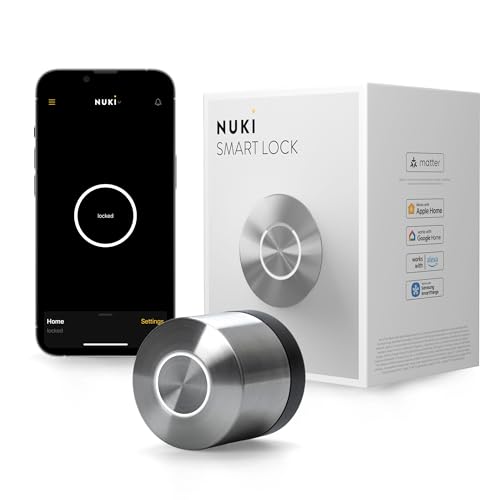
Tool-free, 5-minute installation with no drilling or lock replacement. Removal leaves no damage, making landlord approval straightforward. Matter-over-Thread certified with Home Assistant official certification for local-first control. European heritage (Austrian design) with rigorous AV-TEST security certification. Three motor speeds let you trade noise for speed.
Aqara U200 – Best Budget Option

Matter/Thread native at roughly half the price of Schlage. Fingerprint recognition is reported as fast and accurate in early testing. The Grade 3 rating is adequate for most homes but not commercial-grade. If you already have a Matter hub and want to minimize cost, this is the entry point.
Features That Matter vs. Marketing Fluff
The features that sound most impressive often deliver the least. Here’s what actually affects daily use and security.
Apple Home Key – Genuinely Superior
Home Key uses the iPhone’s Secure Enclave to isolate credentials cryptographically. An attacker would need physical possession of your authorized device; remote hacking is cryptographically infeasible. The 4cm NFC range limits exploitation. In testing, Schlage achieves 99%+ success on first tap, while Yale shows fewer than 2 failures over 6 months.
The limitation: iPhone/Apple Watch only. Android users will need to wait for Aliro (Q1 2026) for equivalent functionality.
Fingerprint and Facial Recognition – Convenient, Not More Secure
Fingerprint spoofing with silicone molds and high-resolution prints can fool capacitive and optical sensors. Apple’s own biometric security guidelines recommend fingerprint + PIN for high-security doors.
Facial recognition systems without liveness detection can be defeated by 3D masks, photographs, and identical twins. Only Lockly Visage Zeno uses radar-based liveness detection, and long-term reliability is unknown.
These features offer convenience when conditions are right (clean, dry fingers; good lighting and angle). They’re not security improvements over PIN codes or Home Key.
Auto-Unlock (Geofencing) – Often Buggy
The promise: your door unlocks as you approach. The reality: 50% success rate is typical across most locks. Kwikset Halo Select is the exception, achieving 100% reliability in testing.
Auto-unlock drains phone battery (location services running constantly) and is particularly unreliable on Android. Always have a PIN backup if you rely on this feature.
Guest Codes with Expiration – Essential for Rentals
This feature genuinely delivers value. Create temporary codes that expire after each visit, monitor entry/exit logs, and revoke access instantly without collecting keys. Yale supports 250 codes; Schlage supports 100. For rental properties, this isn’t optional – it’s the primary reason to choose a smart lock.
Field data from property managers with 1,000+ installations shows less than 1% lockout incidents with good locks and a 0.2-star improvement in host communication ratings (guests don’t have to coordinate key handoffs).
Which Lock Fits Your Situation
For Families
Recommended: Yale Assure 2 Plus
DoorSense prevents false “locked” alerts – you’ll know if someone left the door ajar before bed. Reliable Home Key means no fumbling with apps while holding a baby or groceries. Proven track record matters when the consequence of a dead battery is being locked out with kids.
Verify before buying: IPX5 weatherproofing rating for exposed doors. Test door alignment (if bolt doesn’t slide smoothly, fix that first).
For Rental Properties & Airbnb Hosts
Recommended: Yale Assure 2 (base model, $160–200)
250 user codes with expiration. Proven integration with property management systems (Guesty, Hostaway, Airbnb). Field data shows less than 1% lockout incidents across 1,000+ installations. Time savings from eliminated key handoffs justify the cost on your first booking.
Verify before buying: Test PMS integration with your specific platform. Confirm Wi-Fi or hub requirement for remote access. Plan battery replacement schedule (6 months with Wi-Fi).
For Apple Households Prioritizing Reliability
Recommended: Schlage Encode Plus
99%+ Home Key success rate, Grade 1 mechanical rating, integrated Wi-Fi. This is the “it just works” option. Premium price ($320) reflects proven reliability over years of field use.
Verify before buying: 100-code limit is adequate for most households but may be limiting for high-turnover situations. No fingerprint reader if that matters to you.
For Android or Mixed Households
Recommended: Kwikset Halo Select or Nuki Gen 4
Matter support means the lock works with any Matter hub regardless of manufacturer – Apple TV, Google Nest Hub, Amazon Echo, Samsung SmartThings. Household members can use different platforms simultaneously. 12+ month battery life with Thread.
Verify before buying: You need a Thread Border Router (Apple TV 4K, Eero, Nest Hub). Enabling Matter on Kwikset disables some Kwikset app features – choose your primary ecosystem upfront.
For Renters Who Can’t Modify the Door
Recommended: Nuki Smart Lock Gen 4
Tool-free, 5-minute installation. No drilling, no lock replacement. Removal leaves no damage; original lock reinstalls. Landlord approval is typically straightforward since it’s non-permanent and adds security.
Verify before buying: Compatibility with your existing lock cylinder (check Nuki’s compatibility tool). Matter support requires a Thread hub.
For Budget-Conscious Buyers
Recommended: Aqara U200 ($150–200)
Matter/Thread native at roughly half the price of premium options. Fingerprint + app control. 6-month battery life with Thread.
Trade-off to accept: Grade 3 mechanical rating is adequate for most homes but not commercial-grade. Verify door alignment first – a misaligned door will kill any smart lock faster than anything else.
Before You Buy: Installation & Maintenance Reality
Installation quality affects smart lock performance more than most buyers realize. A lock that works flawlessly on a well-aligned door will fail chronically on one that’s even slightly off.
Door Alignment Is Everything
Test your existing lock before buying: does the bolt slide smoothly into the strike plate, or do you have to lift/push the door to get it to latch? If there’s any friction, the smart lock’s motor will strain with every cycle, draining batteries faster and causing premature failure.
Misaligned doors are the #1 cause of premature battery drain and mechanical failure in smart locks. If your door doesn’t close smoothly, hire a locksmith to adjust the strike plate ($80–200) before installing a smart lock. Locksmith roles are in who changes locks on doors. DIY installation on a misaligned door is a false economy.
Battery Replacement Is Non-Negotiable
Smart locks using AA alkaline batteries have predictable drain curves. Accept that you’ll replace batteries every 6–12 months depending on connectivity type and door traffic.
Tips for battery management:
- Use high-quality alkaline batteries (Duracell, Energizer). Lithium batteries last ~20% longer but cost 3–4× more.
- Never mix old and new batteries. Replace the entire set.
- Set phone reminders to check battery status in the app every 2 months.
- Clean battery contacts if you see visible corrosion (dry cloth or pencil eraser).
Firmware Updates Aren’t Optional
Check your lock’s app every 30 days for firmware updates. Update immediately when available – security patches typically lag 2–6 weeks behind vulnerability disclosure.
Avoid locks that stopped receiving updates more than 3 years ago. Academic research in 2024 identified 14 zero-day flaws across mainstream smart lock models; older locks without update capability remain permanently vulnerable.
Emergency Access Planning
All smart locks should have mechanical key backup. Store a backup key outside your home – safe deposit box, trusted friend, or locksmith copy. Never rely solely on app-based access.
Additional backup methods:
- 9V emergency connector: Many locks have an external contact. Keep a 9V battery in your car or bag.
- Apple Express Mode (Schlage and newer models): Uses iPhone battery reserve for unlock even when phone is “dead.”
Test your emergency access scenario before relying on the smart lock for daily use. Run through 10 lock/unlock cycles to verify consistent operation.
How to Avoid Smart Lock Regret
- Check door alignment before buying – misalignment kills locks faster than anything else
- Store a backup key outside your home (not inside)
- Set battery check reminders every 2 months
- Commit to monthly firmware update checks
- Test 10 lock/unlock cycles before relying on it daily
Locks to Avoid
- Level Lock+ – Chronic battery drain (2–8 weeks vs. claimed 6 months), 10% Home Key failure rate, buggy app with no fix ETA. Premium price, subprime reliability.
- August Smart Lock – International customer abandonment in 2024, escalating hardware failures, declining support. Legacy units may work; new purchases carry elevated risk.
- Any lock without recent firmware updates – Security vulnerabilities compound over time. If the manufacturer hasn’t pushed an update in 3+ years, the lock is a liability.
- Grade 3 locks on primary exterior doors – 400K cycle rating is inadequate for high-traffic entry points. Grade 3 is fine for interior doors or low-security applications, not your front door.
Your Door Matters Too
Smart lock performance depends on more than the lock itself. Door alignment, frame condition, and hardware quality all affect reliability. If your door doesn’t close smoothly or your existing hardware is worn, addressing those issues first will save you frustration later.
Related posts
 What Homeowners Wish They Knew Before Buying Smart Door Locks
 10 Smart Locks for Doors Behind Storm Doors
 Revolutionizing Security: The Rise of Smart Locks for Gates
 What Smart Lock Should I Get for My Front Door?
 The Real Cost of Woodworking: Is This Rewarding Hobby Worth the Investment?
 Are 8 Foot Doors Worth the Money? A Comprehensive Guide
 How to Maintain a Wood Front Door (And When It’s Not Worth It Anymore)
 Pivot Front Doors: How They Work and When They Are Worth It